SURF CITY – Kerri Allen acknowledged early on what was also obvious to her audience.
“I do not need to tell anyone in here we have a really high density of leases,” the North Carolina Coastal Federation’s coastal management program director said. “In our public trust waters, when you have that many users, there are going to be conflicts.”
Supporter Spotlight

Several people sitting inside the Surf City Municipal Complex’s town council chambers that April 14 afternoon nodded in agreement, eager to share their thoughts on the subject.
With either temporary or permanent shellfish leasing moratoriums in North Carolina waters to its north and south, Topsail Island’s waters have become a hot commodity for oyster growers.
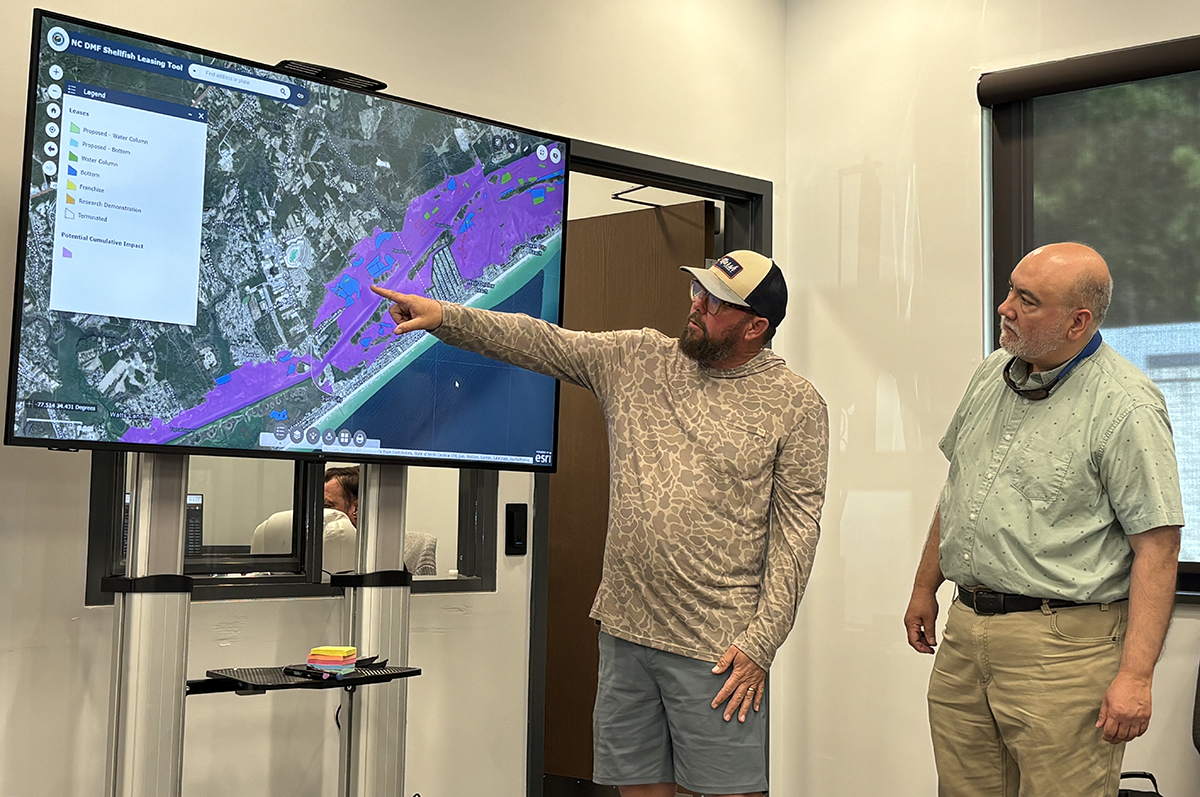
There are now nearly 190 shellfish leases in the waters behind the 26-mile-long barrier island from the New River and its adjacent estuarine waters south to Topsail Sound.
That’s a roughly 46% increase from the collective number of leases in 2018 in Onslow and Pender counties.
The squeeze put on the waters around Topsail Island has prompted ongoing calls for a temporary moratorium on new shellfish leases in the area.
Supporter Spotlight

The Topsail Island Shoreline Protection Commission, or TISPC, which is composed of elected officials from each of the island’s three towns – Topsail Beach, Surf City and North Topsail Beach – initiated a request for a temporary pause on leases more than a year ago. Commissioners in Onslow and Pender counties did the same.
Shellfish lease moratoriums in the state may be enacted only by the North Carolina General Assembly.
On April 10, 2025, Rep. Carson Smith, R-Pender, introduced legislation requiring a statewide study on shellfish leasing and the current lease moratorium.
House Bill 841 made it no further than the Senate’s Rules and Operations Committee.
“If there is a temporary moratorium, we don’t feel that’s unreasonable,” Allen said last week.
A pause would give the Coastal Federation and North Carolina Sea Grant more time to talk with those who live along and use the waters around the island and come up with suggestions to help shape future policy that would protect the industry, make it sustainable long term, and ease user conflicts, she said.
Additional focus groups, including one for shellfish growers, will be scheduled this fall.
Meanwhile, a temporary moratorium that has been repeatedly extended since it was first enacted in New Hanover County in 2019 is set to expire in July.
“It’s very reasonable to say if we were able to open up some of these other areas that could help alleviate the pressure that this area is seeing,” Allen said. “A lot of the oyster growers that we work with in this region live in New Hanover County and they would love not to have to drive up here to take care of their farms. We are actively trying to get New Hanover to not extend their moratorium. I do not have a good feel, one way or another, how that’s going to go yet, but we are having those conversations.”
Surf City Mayor Teresa Batts said officials on the island do not intend to wait for a decision before asking for a temporary moratorium.
“I know you’re going to go through the procedural steps, but the TISPC, we’re not going to sit back and wait,” she said. “If we see that New Hanover County is trying to extend their moratorium, then we’re going to try to slide in there on their session and piggyback on their moratorium.”
The Coastal Federation, which publishes Coastal Review, and North Carolina Sea Grant teamed up last year to launch a Geographic Information System, or GIS, database pinpointing areas where leases may or may not be suitable in the waterways behind Topsail Island. The GIS database is anticipated to be published next year.
Recommendations shared with the organizations will help shape the North Carolina Strategic Plan for Shellfish Mariculture, a plan commissioned by the General Assembly in 2017.
This document is effectively the state’s roadmap for a sustainable shellfish industry. It’s not meant to be a fixed document, rather one that evolves as the industry evolves and conditions change, Allen explained, adding, “which they very much have changed since 2017.”
In the years since, the state has seen a shift where shellfish farmers are using floating gear to grow oysters in the water column, a method that allows them to maximize the spaces in which they grow their product.
Unlike cages that are placed on the waterbed, those in water column leases poke up from the water’s surface.
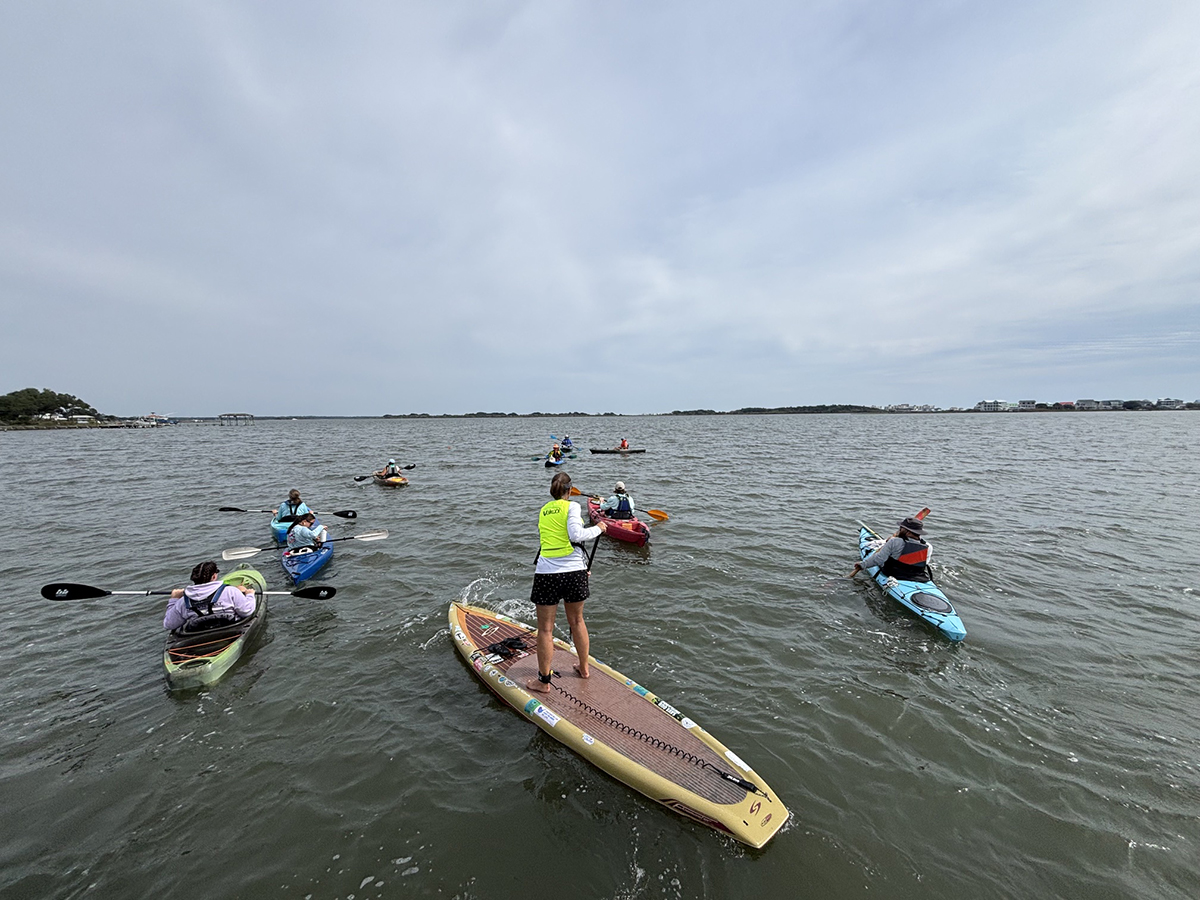
And, as more water column leases have been granted, complaints have mounted about their impacts to the viewsheds of waterfront properties, boating and kayaking access, and infringement on popular fishing spots.
Fishing guide Capt. Ray Brittain offered to take Allen and N.C. Sea Grant Extension Director Frank López on his boat, and on his dime, to show them how the leases affect his business.
“There’s so many PVC pipes out there,” Brittain said. “You don’t need a thousand PVC pipes to mark,” a lease area. “We can’t fish in those. I mean, mark your outer edge to show people where it is, but a lot of it is just unnecessary stuff.”
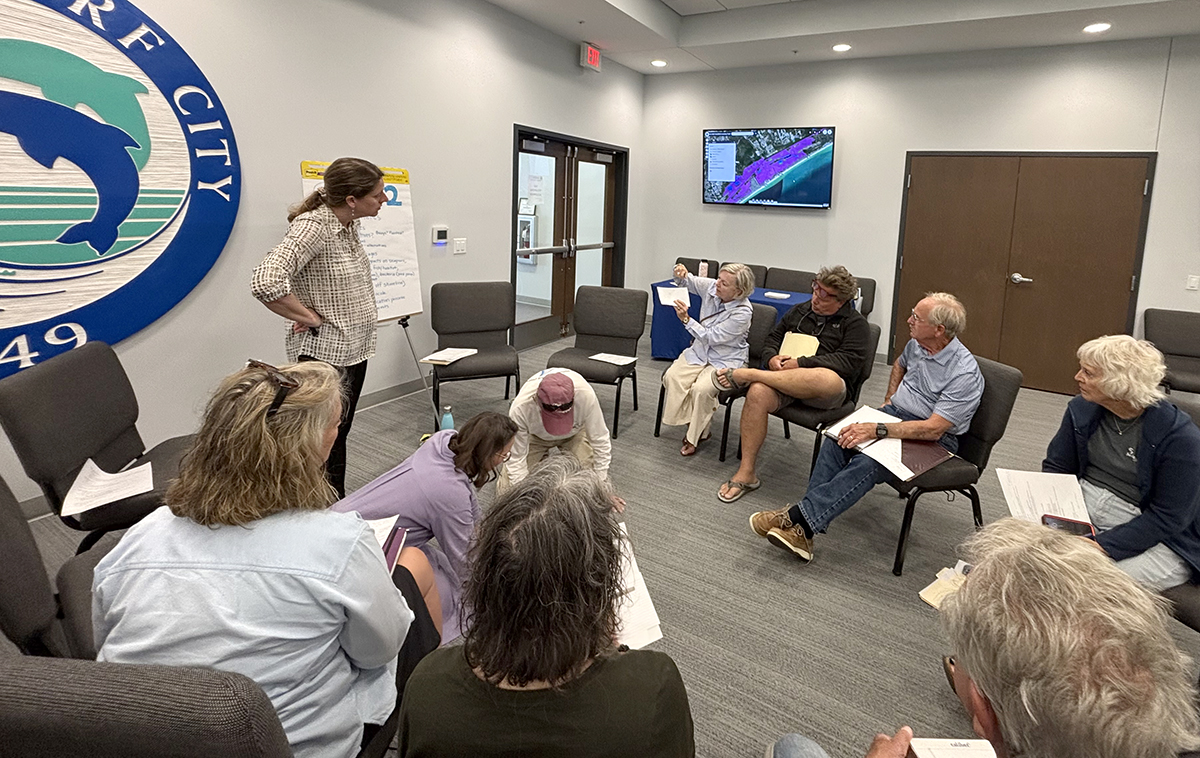
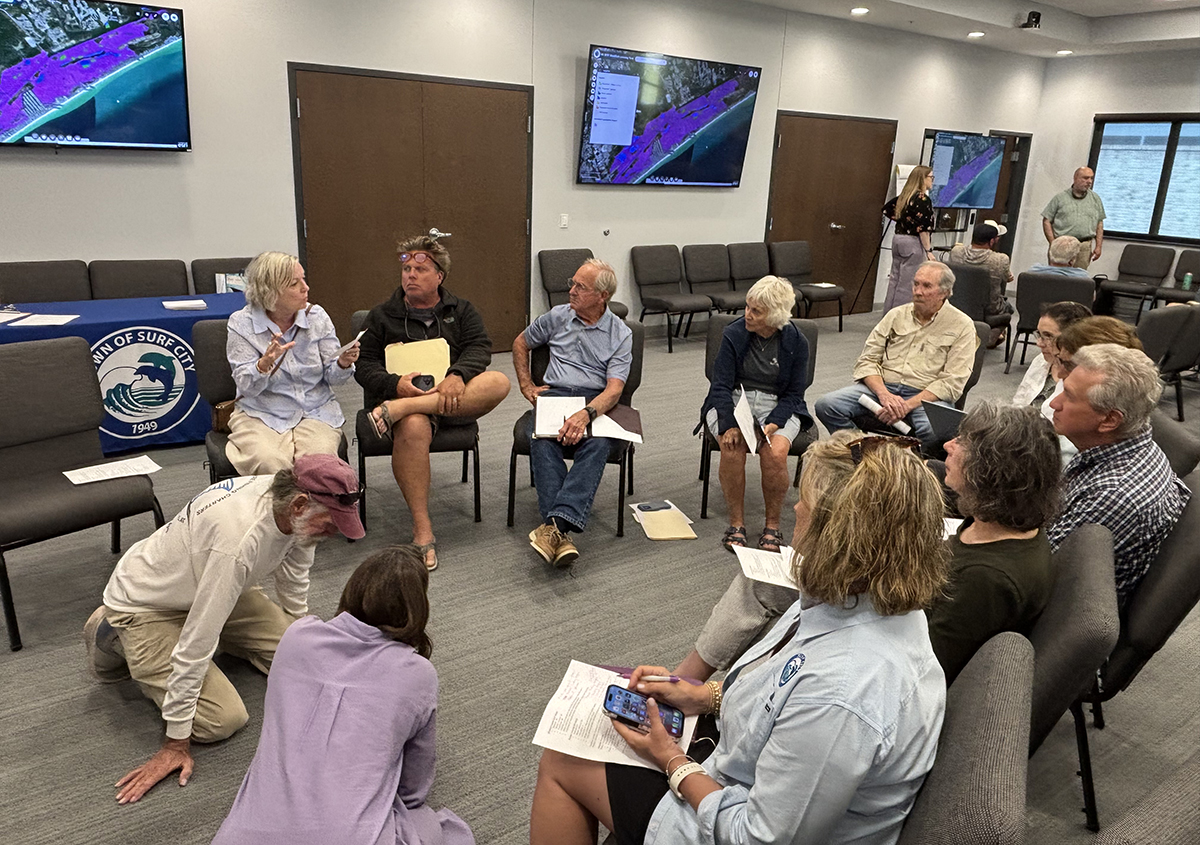
Brittain was among nearly 30 attendees at the April 14 meeting, where participants were asked to break into two groups to discuss concerns and recommendations that will be documented and shared with local elected officials, legislators, and state agency officials.
Those at the meeting in Surf City last week touched on a host of issues, raising concerns related noise associated with shellfish farming activities, nighttime navigation around shellfish leases, the density of leases around Permuda Island Reserve, and linear placement of leases along estuary island shorelines blocking anglers from following fish.
Some asked for shellfish farmers to be required to carry liability insurance, while others suggested the North Carolina Division of Marine Fisheries create a more robust public notification system announcing lease applications that would include property owners whose land is within and adjacent to the viewshed of a proposed lease.
Other recommendations included an implementation of buffers by moving leases further from shorelines based on specific locations within a waterbody, potentially increasing lease fees, decreasing the length of time a lease is valid, and the possibility of commissioning studies on the impacts of floating cages on the ecosystem.
The Coastal Federation and Sea Grant are accepting comments online through the Stump Sound shellfish mariculture planning – stakeholder input form through Aug. 1.