The University of North Carolina Wilmington Blue Economy Index (Bloomberg Ticker: BLUEECO) declined 4.15% in March amid what index managers described in a news release as “a broad global market selloff.”
The index tracks the “economic activity of companies operating within oceans and waterways, with a focused lens on environmental sustainability.” It aligns with the World Bank’s Blue Economy definition: “the sustainable use of ocean resources for economic growth, improved livelihoods, and jobs while preserving the health of the ocean ecosystem.” It offers investors a way to evaluate the sustainable growth potential of sectors such as shipping, offshore energy, aquaculture, and marine infrastructure.
Supporter Spotlight

By comparison, the index’s major benchmarks recorded steeper losses than BLUEECO, with the Standard & Poor’s 500 falling 5.16%, the Morgan Stanley Capital International All World Index declining 6.22%, and the S&P Industrials dropping 10.66% during March.
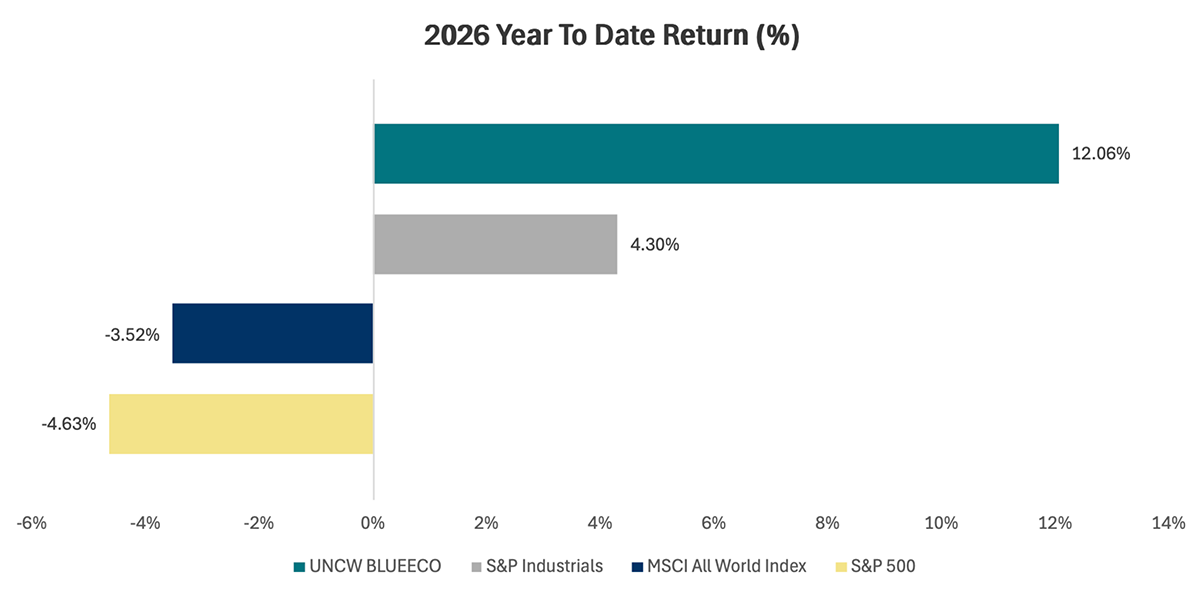
“The downturn was driven by rising geopolitical tensions and renewed inflation concerns, which weighed on investor sentiment throughout the month,” according to the index managers. On a year-to-date basis through the first quarter, BLUEECO is still up 12.06%, compared to 4.30% for the S&P Industrials and declines of 3.52% for the MSCI All World Index and 4.63% for the S&P 500.
Industrials declined 7.61% in March, losing much of the strong gains seen earlier in the year, which was attributed to “renewed trade policy uncertainty and tariff escalation, which dampened capital expenditure expectations and weighed on cyclical demand across heavy industry and manufacturing segments,” according to the release.
Consumer staples declined 7.89% in March, driven by rising input costs across energy and logistics, alongside currency headwinds in key export markets, which, officials said, put pressure on margins for food production, processing, and distribution companies.
Utilities declined 3.90% in March, showing some resilience during the broader market selloff.
Supporter Spotlight

Consumer discretionary spending slipped 13.35% in March, making it the worst-performing sector. “The decline reflected deteriorating consumer confidence amid escalating trade tensions and equity market volatility, which weighed heavily on forward bookings and discretionary spending across travel, leisure, and cruise operators,” according to the release.
March’s top performers were concentrated in utilities and renewable energy, supported by rising energy prices and increased strategic interest in power and infrastructure assets.
For more, visit the Alliance for the Blue Economy.