Photo: Brian Tress
Reprinted from the Outer Banks Voice
Debbie Swick has a way of spotting problems that most people barely notice — and then refusing to let them go.
Supporter Spotlight
On the Outer Banks, the Southern Shores resident is best known as the driving force behind the push to ban balloon releases, a grassroots effort that helped shift public awareness around a form of litter that can travel hundreds of miles before landing in waterways and harming wildlife.
This time, her focus is something less visible but just as persistent: discarded monofilament fishing line — the nearly invisible plastic filament that can linger in the environment for centuries, entangling and injuring marine life long after it’s been cast aside.
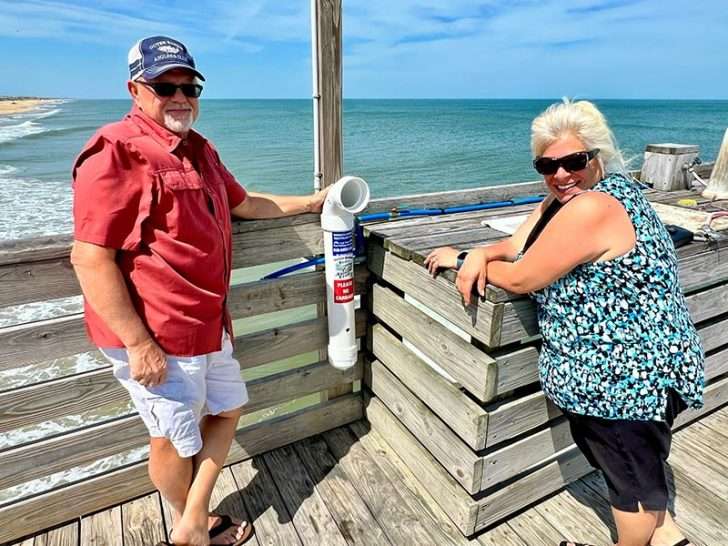
In partnership with the Outer Banks Anglers Club, Swick has helped launch a new monofilament recovery and recycling program — one that aims to intercept that line before it becomes a long-term hazard in the water by installing and maintaining collection vessels at sites across the Outer Banks.
“It is a strangling mechanism,” Swick said. “It becomes entangled in fish gills, sea turtles, seals, porpoise. It doesn’t break down. It will amputate and maim marine life.”
Discarded fishing gear — including monofilament line — is widely recognized by marine scientists as one of the most dangerous forms of ocean debris. Research has found that roughly 740,000 kilometers (about 460,000 miles) of fishing line enter the ocean each year — enough to circle the Earth more than 18 times.¹
Supporter Spotlight

According to the National Oceanic and Atmospheric Administration (NOAA), at least 260 marine species are known to be harmed by entanglement in marine debris, including sea turtles, seabirds, and marine mammals.2 Monofilament line is particularly dangerous because it is nearly invisible underwater and extremely durable, capable of persisting in the environment for hundreds of years.3
That is something David Masters Jr., vice president of the Outer Banks Anglers Club, sees regularly. “It’s usually tumbled up in seaweed or buried in the sand,” he said. “I pick it up all the time. I’ve seen birds with fishing line caught on the wings or legs and that’s very sad.”
Local conservation groups and park officials have long warned that sea turtles along the Outer Banks can become entangled in discarded fishing line, which can impair their ability to swim or feed — and in some documented cases, lead to death.4 Necropsies of stranded turtles in North Carolina have identified monofilament entanglement as a contributing factor, underscoring the long-term danger posed by fishing line that remains in the environment.5
Swick is a member of the Outer Banks Anglers Club and last year’s Member of the Year. That, combined with her reputation as an accomplished environmental advocate and volunteer — including recognition with a Governor’s Medallion Award — gave her the standing and credibility to introduce the idea of monofilament recovery to the
anglers. She brought the concept to the club’s board in January, and by February, they were building the collection vessels.
“I told the board, under no circumstances were we going to half-ass this,” she said.
This time, Swick wanted something different: accountability. Each location would be “adopted” by a member of the Outer Banks Anglers Club, responsible for monitoring, emptying, and maintaining the vessel.
“I have the list,” she said. “I know who is supposed to be picking it up, when and where.”
Recreational fishermen are often among the strongest stewards of the waters they fish — a point echoed by fisheries managers and conservation organizations who increasingly emphasize angler participation in sustainability efforts.6
The Outer Banks Anglers Club has its own track record, including helping spearhead the creation of artificial reef AR-165 off Oregon Inlet.
The program itself is simple by design. Collection vessels made from PVC pipe have been installed at fishing-heavy locations across the Outer Banks, including piers, marinas, and public access points. Among the initial sites are Kitty Hawk Pier, Avalon Pier, Jennette’s Pier, the Manteo waterfront, Wanchese Marina, and several others.
“We haven’t spoken to one entity that said no,” Masters said, noting support from local governments, property owners, and organizations.
Anglers deposit used monofilament line into the vessels. From there, club members assigned to each site collect the material, clean it, and bring it to monthly meetings. Swick then weighs the line and ships it to a recycling facility operated by Berkley Fishing in Iowa. There, it is processed through the company’s national recycling program, which
has collected millions of miles of monofilament since 1990 and repurposes it into products such as tackle boxes, other plastic goods, and components used in aquatic habitat structures.7
The program is still in its early stages, but initial results are encouraging. At one early collection site at Pirates Cove, volunteers gathered 4.5 pounds of monofilament in a single pickup. “That could have all ended up in the water,” said Swick.
As of now, about a dozen sites are in place, with a goal of reaching roughly 20 locations. Organizers are also working to expand the program through local tackle shops and a developing partnership with the North Carolina Beach Buggy Association, whose members could help collect discarded line from beach areas on Hatteras and further south.
Swick has set a clear benchmark for the program’s first year: 100 pounds of collected line. But success, she said, will be measured in other ways too. “When the community starts talking about how much less monofilament they are seeing in the water,” she said, “and when they start asking for us to put more vessels up — that’s a good sign.”
For Masters, the effort reflects something broader about the club itself. “It’s important people realize recreational fishermen really respect the natural resources we have here, because it is our love to fish here,” Masters said. “We want to keep it pristine.”
Sources
- Global estimates on lost and discarded fishing gear and ghost gear impacts, based on peer-reviewed research (Richardson et al., 2022, Science Advances), including annual losses of fishing line and gear.
- National Oceanic and Atmospheric Administration (NOAA) — Marine Debris Program, documenting entanglement impacts affecting at least 260 marine species.
- Florida Fish and Wildlife Conservation Commission — monofilament fishing line persistence estimates (up to ~600 years in marine environments), widely cited in coastal management and debris mitigation guidance.
- Outer Banks Forever — Cape Hatteras National Seashore conservation guidance on sea turtle entanglement risks from discarded fishing line.
- Outer Banks Voice — regional reporting on North Carolina sea turtle necropsies identifying monofilament entanglement as a contributing cause of mortality.
- NOAA Fisheries — Recreational Fishing Policy, emphasizing “proactive stewardship” and collaboration with the angling community as essential to sustainable fisheries management.
- Berkley Fishing — Berkley Conservation Institute, “Dedicated to the Future of Fishing,” documenting the company’s national monofilament recycling program (established 1990) and reuse into products such as tackle boxes and habitat materials.
This story is provided courtesy of the Outer Banks Voice, a digital newspaper covering the Outer Banks. Coastal Review is partnering with the Voice to provide readers with more environmental and lifestyle stories of interest about our coast.