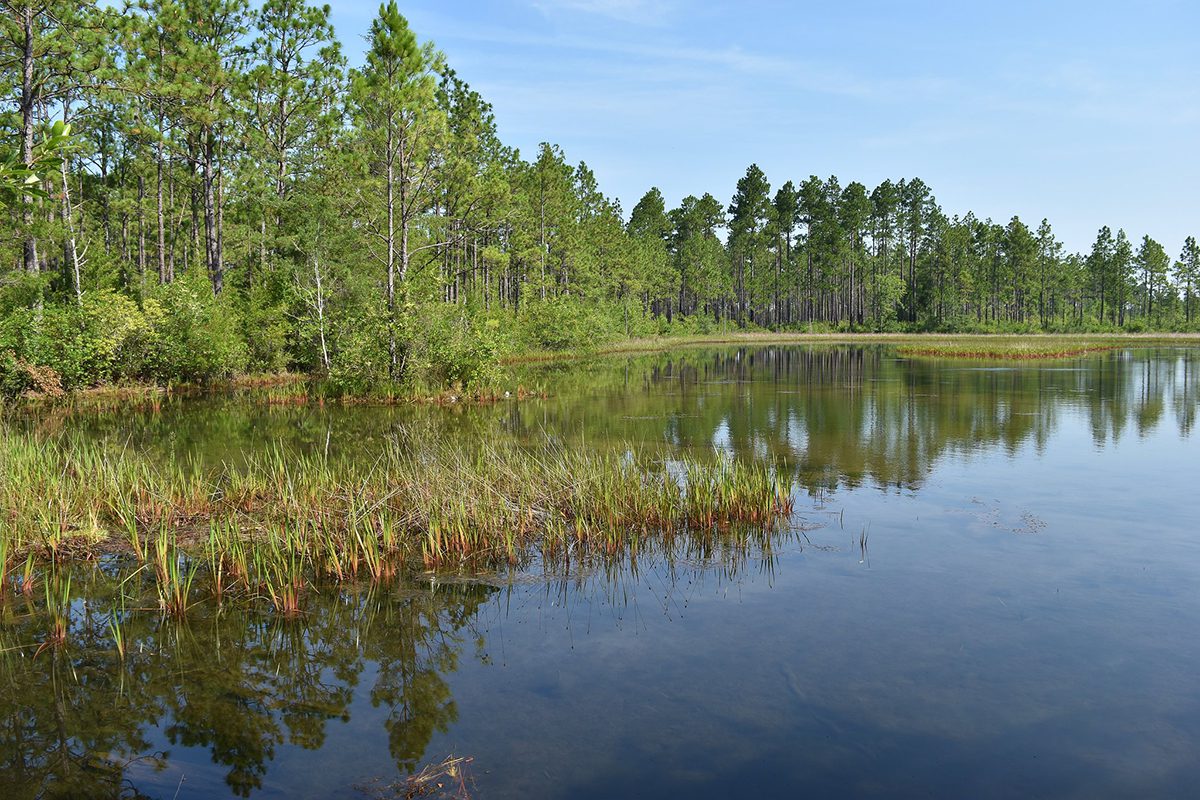
The two federal branches that enforce the Clean Water Act last month pitched changes to the “waters of the United States” definition, which establishes the types of waterbodies that are federally protected against pollution, and if these amendments pass as written, conservation groups fear millions of acres of nontidal wetlands will be left vulnerable.
The Environmental Protection Agency and Army Corps of Engineers have for decades had the authority to regulate “navigable waters,” which means “the waters of the United States, including the territorial seas,” as written in the 1948 Federal Water Pollution Control Act. Expanded in the 1970s, the measure is typically referred to as the Clean Water Act.
Supporter Spotlight

The EPA explains on its website that the Clean Water Act “establishes the basic structure for regulating discharges of pollutants into the waters of the United States and regulating quality standards for surface waters.”
One thing the Clean Water Act doesn’t do is clearly define “waters of the United States.” The EPA calls it a “threshold term in the Clean Water Act and establishes the geographic scope of federal jurisdiction under the Act.”
EPA and Army leadership announced Nov. 17 plans to update the definition, which has been the subject of lawsuits and years’ worth of arguments.
The “Updated Definition of ‘’Waters of the United States’’’ was published Nov. 20 in the Federal Register, launching a 45-day comment period on the proposed changes that closes Jan. 5. A virtual public meeting is scheduled for 12:30 to 4 p.m. Tuesday, with a 2-2:30 p.m. break. Attendees must register online to speak by 5 p.m. Monday. To listen only, register by the start of the meeting.
This latest attempt, which would exclude isolated wetlands, is directly linked to the Supreme Court’s May 2023 Sackett v. EPA decision. The Sacketts are an Idaho couple fined in the late 2000s for backfilling a section of their property that the EPA considered wetlands.
Supporter Spotlight

Judges ruled in the final opinion on the case that the “(Clean Water Act)’s use of ‘waters’” only refers to geographical features described in everyday language “as ‘streams, oceans, rivers and lakes’ and to adjacent wetlands that are ‘indistinguishable’ from those bodies of water due to a continuous surface connection.”
Earlier that year, the EPA had finalized a “Revised Definition of ‘Waters of the United States'” rule that took effect March 20, 2023, and which the Sackett case invalidated. In August 2023, the EPA and Army Corps issued an amendment to align the rule with the Sackett decision.
That final conforming rule is what the EPA and Army Corps leadership are proposing to amend.
The agencies argue that the change “would fully implement” the Supreme Court’s ruling “by ensuring federal jurisdiction is focused on relatively permanent, standing or continuously flowing bodies of water—such as streams, oceans, rivers, and lakes—and wetlands that are connected and indistinguishable from such waterbodies.”
With this proposed rule, the agencies explain in the docket, they “intend to provide greater regulatory certainty and increase Clean Water Act program predictability and consistency by clarifying the definition of ‘waters of the United States.’ This proposed rule is also intended to implement the overall objective of the Clean Water Act to restore and maintain the quality of the Nation’s waters while respecting State and Tribal authority over their own land and water resources.”
Environmental groups argued then, when the Sackett case was ruled, and still maintain that by removing protections from the millions of acres of nontidal wetlands, there will be consequences: Water quality will be jeopardized and flooding will increase, to name just two.
Southern Environmental Law Center Senior Attorney Mark Sabath said in an interview that for 50 years, the Clean Water Act has been the strongest and best federal protection for many of the waters and wetlands around the country.
The law does that “by saying you can’t pollute, you can’t fill, you can’t destroy certain features, certain waters, without a permit,” Sabath said, and the permitting process means that there are certain protections and controls you have to apply to minimize the amount of destruction.
Sabath added that a number of features of the Clean Water Act are dependent on the type of water, and, in addressing its critics, not every puddle in the country covered by the act.
“It’s only things that meet the definition of waters of the United States, and that isn’t defined in the statute itself,” Sabath continued. “Congress didn’t define it, so EPA and the Army Corps, in a series of rules over the years, have tried to define exactly what wetlands are and aren’t covered by the Clean Water Act.”
This proposed rule is the latest revision and it is “by far the most narrow, the most extreme definition,” Sabath continued. “It includes the fewest number of streams and wetlands and other waters of any interpretation of ‘waters the United States’ that we’ve seen.”
North Carolina Wildlife Federation Conservation Policy Vice President Manley Fuller told Coastal Review that with this proposed rule, the bottom line is a massive loss of protection of waters of the United States, which are vital habitats for fish and wildlife.
“This will also negatively affect hunting and fishing, which are a significant part of our natural resource-based economy,” he continued. “Wetlands are also buffers for the built environment and help reduce downstream flooding. Protecting clean waters and wetlands is extremely popular with the public for many reasons and we need to strengthen rather than weaken these programs.”
North Carolina Sierra Club Deputy Director Erin Carey told Coastal Review the rule will effectively remove federal protections from at least 80% of wetlands and over 5 million miles of streams across the country.
“This rule will open millions of acres of wetlands to the threat of development, leaving communities already vulnerable to flooding without the frontline protection afforded by these invaluable habitats. Wetlands act as filters for floodwaters and other runoff, making them critical not only to flood mitigation, but to the preservation of clean water resources,” Carey said.
Environmental Defense Fund Coasts and Watersheds Science Senior Manager Dr. Adam Gold pointed out as well that if the proposed rule is implemented as written, nearly all nontidal wetlands and intermittent streams could be without Clean Water Act protections in North Carolina and across the United States.
While there are many changes in the proposed rule, the most notable are to the definitions of “relative permanence” of waters and a “continuous surface connection” for wetlands, Gold said, adding that the proposed language introduces the concept of a “wet season.”
“Under the proposed rule, wetlands and waters would only receive Clean Water Act protections if they have surface water throughout the ‘wet season,’ described in the rule as ‘an extended period where there is continuous surface hydrology resulting from predictable seasonal precipitation patterns year after year,’” Gold said. “This proposed rule would make it easier to drain or develop wetlands that do not meet the ‘wet season’ surface water requirement, putting our wetlands and the benefits they provide at serious risk.”
In North Carolina, the impact of the proposed rule is 3.2 million acres, or about 88%, of nontidal wetlands estimated to be without Clean Water Act protections. “Importantly, this analysis relies on wetland ‘wetness’ during the growing season, but the proposed rule uses the ‘wet season,’” Gold said.
About the wet season, Gold continued, there are “fundamental issues with the proposed rule’s ‘wet season’ dataset.”
He said the classification of the “wet season” comes from the Army Corps of Engineers Antecedent Precipitation Tool, but the underlying data this tool relies on is modeled using the average monthly temperature and precipitation between 1950 and 1999. The modeled dataset was published in 2001 and does not use the best-available methods.
“The agencies proposed ‘wet season’ dataset classifies most of the year, and in some cases the entire year, as ‘wet’ for much of coastal North Carolina. So, under this proposed rule, wetlands or streams in Jacksonville would need to have surface water year-round (the whole year is classified as ‘wet’) to have Clean Water Act protections. For New Bern, the ‘wet season’ is 11 months, and for Wilmington or Brunswick County, the ‘wet season’ is 10 months.”
Gold said the proposed rule “which could essentially remove nontidal wetland and intermittent waters from the Clean Water Act, does not align with the goal of the Clean Water Act to ‘restore and maintain the chemical, physical, and biological integrity of the nation’s waters.’ Science shows us that all wetlands, regardless of how ‘wet’ they are, clean our water, provide critical wildlife habitat, and reduce downstream flooding impacts.”
The EPA and Corps also asserted the week the proposed changes were announced that the new rules would provide “the regulatory certainty needed to support our nation’s farmers who feed and fuel the world and advance EPA’s Powering the Great American Comeback initiative.”
Sabath noted that the idea that this will have huge benefits for farming and for farmers is a common refrain when they’re restricting the protections of the Clean Water Act, “but the Clean Water Act actually exempts most farming activities from coverage already, so you don’t need to get a permit for doing regular farming activities, even when they would affect a wetland or stream that would otherwise be covered.”
The idea that this is a huge benefit for farmers is a nicer story, “because they don’t want to say, well, this is a huge benefit for large industrial facilities, industrial polluters, developers,” Sabath said.
Carey sees the proposed rule as demonstrating “that the EPA has abdicated its mandated responsibility to protect the environment and the people who depend on it. Even worse, the agency appears eager to sacrifice our natural resources on the altar of corporate greed.”
The public should be “very concerned that the federal agency tasked with ensuring clean water, clean air, and the protection of our natural environment seems determined to undermine that responsibility. With this proposed change, the EPA claims to seek clarity in regulation, but this rule would serve only to allow industry to profit from environmental destruction, and the ruination of our natural resources,” she added.
White Oak Waterkeeper Riley Lewis said in a statement that the EPA’s new definition of Waters of the United States ignores decades of scientific understanding and generations of Indigenous knowledge.
“By redefining wetlands using ambiguous criteria seemingly designed to maximize developable land and reduce regulatory barriers, the agency is turning a blind eye to the very real, very predictable impacts on our communities,” Lewis said. “Water will continue to move beneath our feet through groundwater and across the landscape during storms, regardless of a federal definition or a construction permit. This rule sets Americans up for flooding, damaged infrastructure, and increased pollution in the waters we rely on for our drinking supply, our food, and our way of life.”
So, why does this actually matter to the public? Sabath said it does in a few ways.
In North Carolina, people who hunt, fish and paddle use wetlands directly and those might be impacted by being destroyed or polluted without a permit.
“Anyone who is in a community that floods during extreme weather, and we all know that that’s happening more and more now, or that’s at risk of flooding,” Sabath said. By losing those wetlands, you lose their ability to protect communities from flooding, and that comes more often now from extreme weather.
“It’s a double whammy. You’re losing the benefits that they provide, and you’re probably creating more problems,” and more potential pollution or channels of pollution at the same time by replacing wetlands, natural areas with pavement or developed areas, he said.
With wetlands being a “good natural sponge” that can absorb huge amounts of water, “if anything, we should be trying to expand wetland coverage rather than take it away, Sabath said.
“In short,” Carey with the Sierra Club continued, “communities will watch rivers and streams in their communities fall victim to unchecked pollution. Without federal protections, industry will discharge and develop at will, destroying habitats, water quality, and flood protection measures as they go. The wetlands and streams of this country belong to all people, not just those who seek to exploit them.”