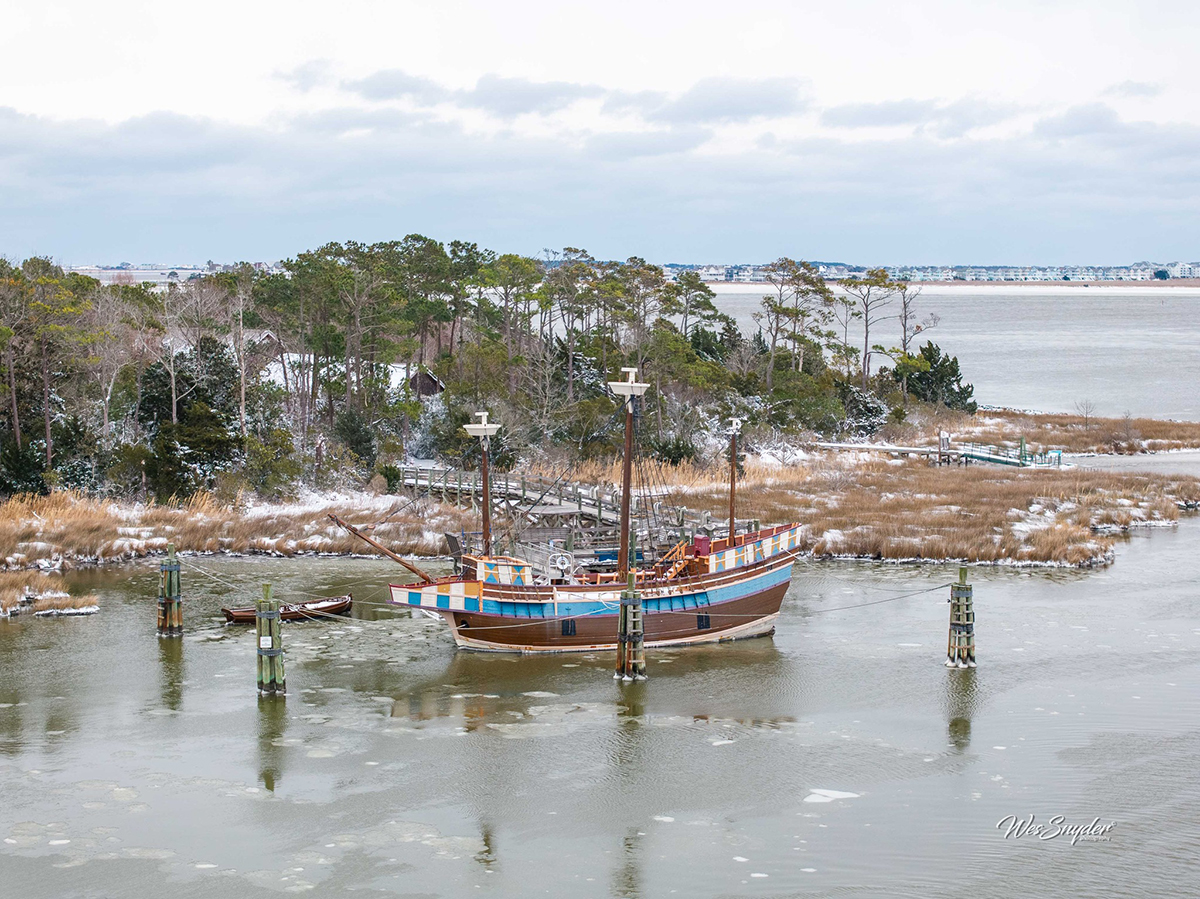
MANTEO — Shoaling in a Roanoke Sound channel just outside Shallowbag Bay has once again prevented the state attraction Elizabeth II from leaving its moorings at Roanoke Island Festival Park for maintenance.
And once again, Dare County has agreed to help manage another dredging project for the state so the ship can motor to the Wanchese state shipyard for its overdue haul-out.
Supporter Spotlight
“We’re still essentially in the planning stages,” Dare County Waterways Commission administrator Barton Grover said in a recent interview. “We’re not exactly sure what path we’re going to take moving forward.”
The 43-year-old wooden-hulled vessel, built to represent a 16th-century English sailing ship that participated in Sir Walter Raleigh’s 1584-1587 Roanoke Voyages, was last hauled out for dry-dock maintenance in 2021, after sitting in brackish water for four years.
Grover said that the proposed project would be addressing the same clogged area near where the channel intersects at Roanoke Sound and Shallowbag Bay that had earlier blocked the ship from moving.
In November 2020, the county had approved a contract and a grant application to conduct maintenance dredging in the channel to allow larger vessels, including the Elizabeth II, to access Manteo harbor. The vessel, which has an 8-foot draft, was able to safely leave its dock in Dough’s Creek about a week earlier than completion of the project in late February 2021, according to the county website.
Although the Roanoke Channel is officially a federally authorized channel, Grover explained that the U.S. Army Corps of Engineers pipeline dredge does not do work north of Wanchese. Ultimately, a bucket-and-barge method was used for the 90-day project, which increased the depth of about 2.2 miles of channel from as little as 1 to 5 feet to 9 feet. Another 290 feet in a connector channel to the ship’s berth was also dredged. Costs for the $1.9 million project were appropriated by the North Carolina General Assembly, with an additional $170,000 provided by the state’s Shallow Draft Navigation Channel Dredging and Aquatic Weed Fund and the town of Manteo.
Supporter Spotlight

Some of the factors that come into play with the proposed dredge project, Grover said, include higher costs to dispose of the dredged material, as well as the lack of an obvious disposal area.
In the earlier projects, the material — scooped from the channel, piled onto a barge and then transported to land — was hauled off in a truck to the be placed on top of the county’s Manns Harbor landfill. But the increased expense may have made that option less attractive, he said. Other possibilities could include placement in a permitted area of water, or beneficial re-use along a shoreline or other area, he said.
Another consideration under review is whether the local hopper dredge Miss Katie would be capable of doing the necessary work instead of again using a bucket-and-barge method, Grover said. But the choice of an appropriate disposal site could also come into play in determining costs for that dredge to reach the site.
Typically planning and permitting for a similar dredge project takes at least “six-plus” months, he said. Also, the state has yet to secure the funding. Ideally, he said, a project would be ready to go during the upcoming winter of 2026-2027.
By then, the 69-foot-long ship will have been sitting in the brackish water alongside its dock in Dough’s Creek for about six years.
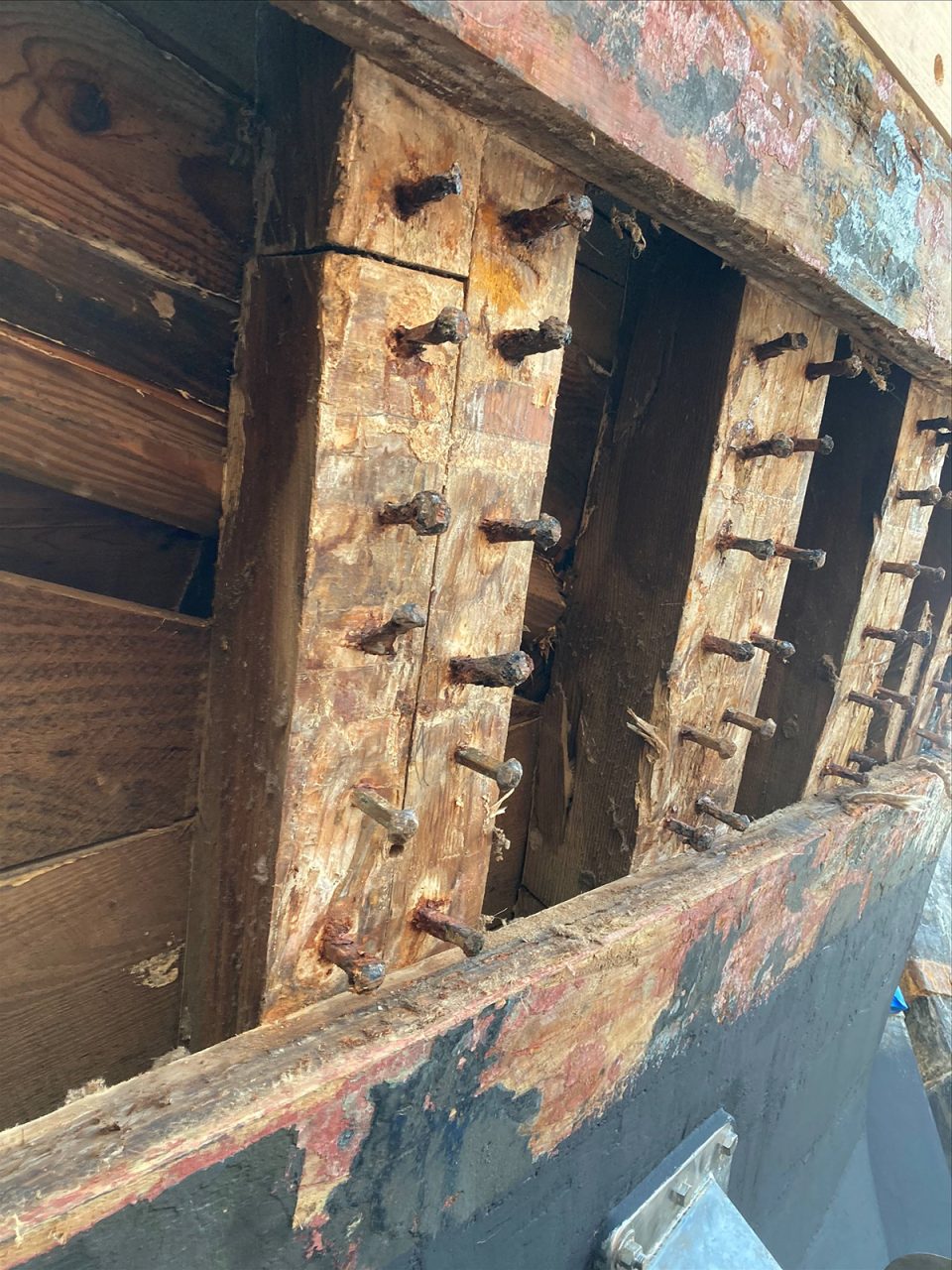
Michele Walker, assistant communications director at the North Carolina Department of Natural and Cultural Resources, said in an email responding to questions from Coastal Review that the last condition report was done by surveyor Paul C. Haley with Capt. G. W. Full & Associates Marine Surveyors in 2016, when numerous issues, including signs of rot and deterioration of the exterior and interior, were detailed.
When the vessel was hauled out in 2021, she added, Haley did not travel to the Outer Banks because of the COVID-19 pandemic, but he verified with the firm’s staff on site that the earlier repair recommendations had been completed.
“In addition, the ship is inspected annually by the U.S. Coast Guard,” Walker wrote. “This provides us approval to operate as an attraction vessel, which allows us to have passengers on board while moored.”
Walker added that the ship is maintained above the waterline throughout the year, with more extensive maintenance done while Roanoke Island Festival Park, a state museum that memorializes regional English precolonial and Native American history, and the adjacent Elizabeth II State Historic Site are closed January through mid-March.
Haley’s 2021 report, while emphasizing his familiarity with the vessel from doing the surveys in 2004, 2011 and 2016, also lauds the park for always following through on the surveyors’ recommendations.
Notably, when compromised planking documented in the earlier survey had been replaced, he said, the frames exposed during the work were observed to be in good condition. Also, all the critical repairs and plank replacements had been completed, he said.
“The vessel has a good maintenance program by the park and they haul out the vessel on a regular basis for repainting of the bottom and doing any maintenance work that requires the vessel being out of water,” he wrote.
Except for a few months in the winter, the Elizabeth II welcomes visitors aboard to experience a sailor’s view of ship life and duties, guided by interpreters in period costumes who regale them with stories.
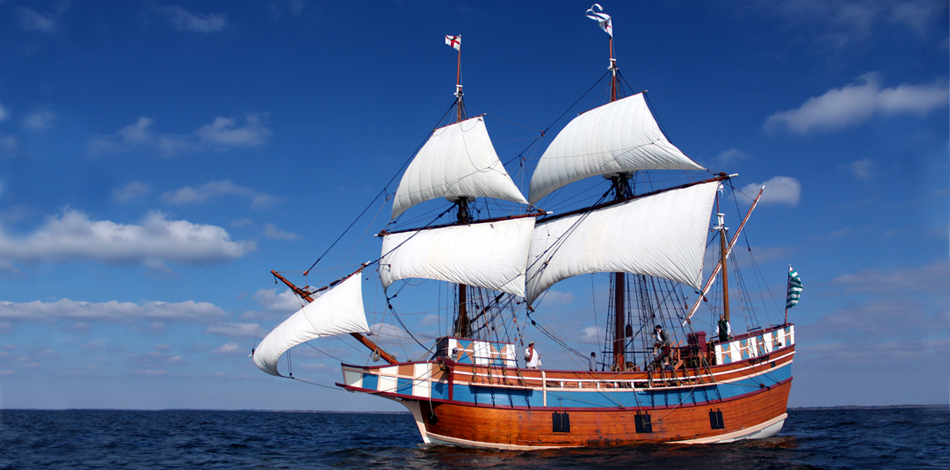
As a representative vessel, the Elizabeth II was built based on knowledge of the tools, materials and basic designs used in Elizabethan-era shipbuilding, but there are no original design sketches of the actual merchant ships that sailed during the late 1500s to Roanoke Island from England. Still, the three-masted, square-rigged ship with dashing blue-and-white markings contrasting with its wooden hull — even while rarely moving from its dock across from the Manteo waterfront — has reliably served its mission as an ambassador for the state, the Outer Banks and Manteo’s heritage as the site of the first English colony in America.
But since the flashy ship’s 1984 launch during the town’s 400th anniversary celebration of the Roanoke Voyages, which culminated in the ill-fated “Lost Colony” that was never seen again after its governor left for supplies in 1587, once-routine day trips to visit coastal ports or join in community festivals fell by the wayside due to lack of funds, scheduling difficulties and other challenges. And gradually, even annual haul-outs started being delayed for multiple years, despite that prolonged time in the water for wooden hulls can lead to damage from shipworms and rot.
The ship’s current dockside stranding was not anticipated during the last review five years ago.
“It is the plan of this office to be present and to conduct a full survey at the haul out at the beginning of 2022,” Haley wrote in the report. “With this in mind, it is our opinion that the vessel is suitable for her present use.”
On Dec. 18, the nonprofit Friends of Elizabeth II indicated no intent to give up the ship, so to speak, posting a notice seeking to hire a new captain for the vessel. Applications were due Jan. 29. In addition to overseeing the maintenance of the ship and leading the crew and interpreters, the job’s responsibilities include training staff and volunteers in rigging, sailmaking and marine woodworking.
The required duties also illustrate that the Elizabeth II isn’t just a pretty ship decorating a small historic North Carolina town’s harbor. The captain must not only understand Coast Guard regulations associated with “moving watercraft” through waterways, the captain must be capable of “sailing the Elizabeth II as needed.”