The N.C. Department of Environmental Quality’s Division of Coastal Management has announced guidance to property owners, organizations and towns that plan to accept natural Christmas trees this year for use in dune restoration.
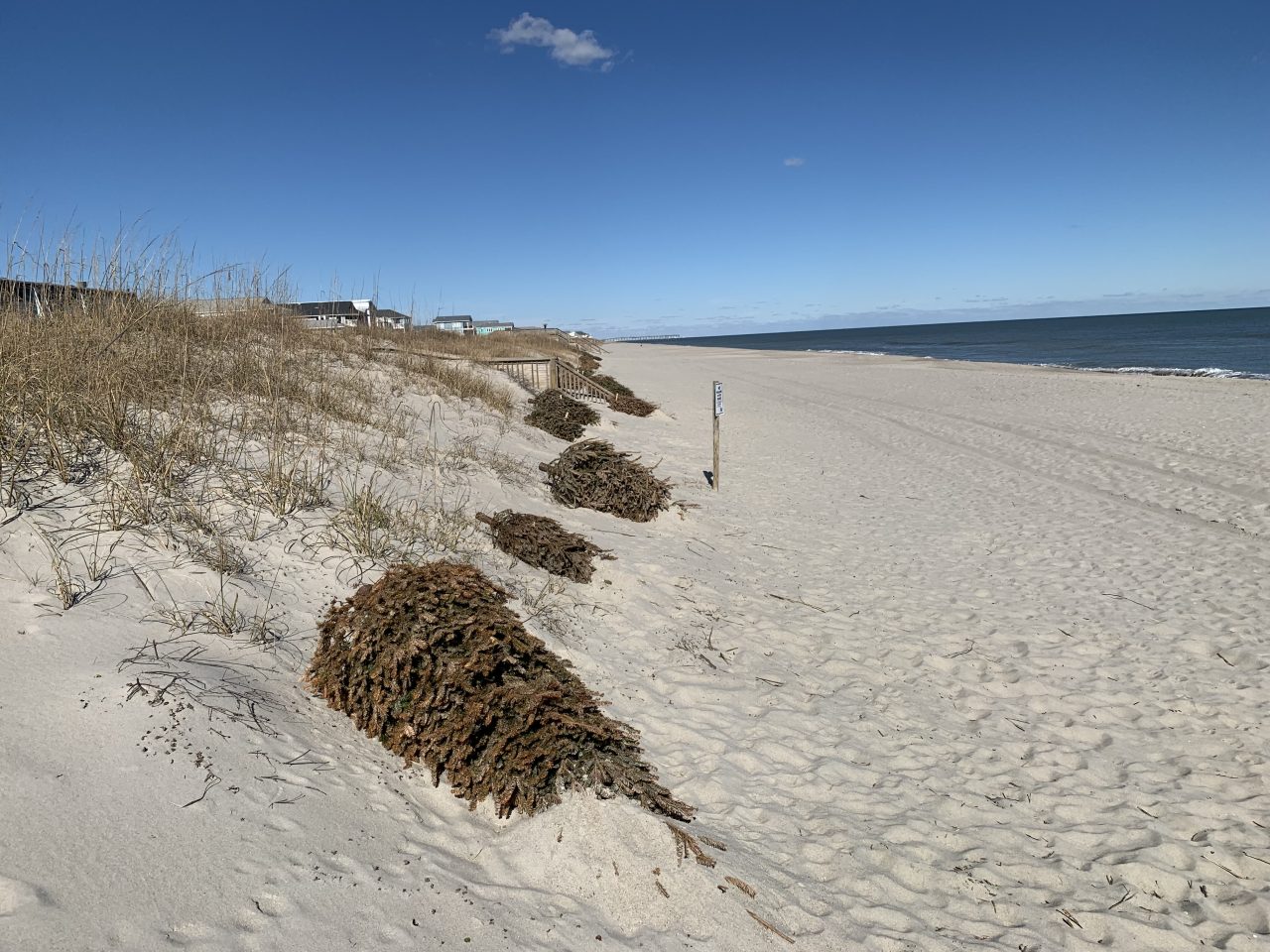
Locally donated, undecorated natural Christmas trees may be used as a substitute for traditional sand fencing, a barrier, usually made of wood or synthetic materials, placed on beaches or dunes to trap blowing sand.
Supporter Spotlight

Donated trees should be placed in a manner that meets the state’s rules for sand fencing, with the exception that Christmas trees may be placed no closer to the ocean, sound, river or shoreline than the base of the closest dune to the waterline.
Christmas trees should not block public access to the beach, recreational use of the beach, emergency vehicle access or be placed on private property without permission. Trees should be placed at an angle no less than 45 degrees to the shoreline, and trees should be spaced apart at a minimum of 7 feet.
If sand fencing is present, a 7-foot separation between trees and the fence sections must also be maintained. Rows should be single-tree width. Unvegetated beach berms, or recently created “starter dunes,” are not considered natural dunes. Trees should not be placed at the seaward base of these berms, starter dunes or on the open beach.
The division notes that if the proposed layout of trees along the beachfront does not meet Coastal Area Management Act criteria, applicants should submit a CAMA Minor Permit application for review. For more information, contact the local CAMA permitting authority or appropriate Division of Coastal Management district office prior to tree placement.
To ensure compliance with recycling programs in your neighborhood, we suggest contacting the appropriate local government office for information regarding recycling natural Christmas trees.
Supporter Spotlight
Coastal Review will not publish Jan. 1 in observance of New Year’s Day.