A Piedmont town’s request to permanently pull millions of gallons of water a day from the Cape Fear River would raise the risk of water shortages during periods of drought, undercut utilities’ ability to keep up with growing demand, and result in higher levels of contamination in the raw drinking water source for downstream communities, opponents of the plan say.
Of the dozen people who spoke Tuesday night during a public hearing in Raleigh, none supported Fuquay-Varina’s call for transferring 6.17 million gallons per day from the Cape Fear River Basin to the Neuse River Basin to meet that town’s projected water demands.
Supporter Spotlight

Similar opposition was expressed during a hearing held in Fayetteville last week by the North Carolina Environmental Management Commission and the state Division of Water Resources. A third hearing was scheduled to be held Thursday in Pittsboro.
Both elected officials and heads of public utilities in the lower Cape Fear region on Tuesday continued pressing the commission and division to host a public hearing in that area.
“None of the hearings for the Fuquay-Varina request are being held in the lower Cape Fear region, even though our communities will feel the downstream impacts,” said New Hanover County Commissioner Rob Zapple. “Residents in the city of Wilmington and the counties of New Hanover, Brunswick and Pender would have to spend four to five hours on the road just to attend the public hearing. Most residents simply cannot do that. Holding a hearing in the lower Cape Fear region in Wilmington would reduce frustration, encourage public trust, and allow our communities to be hearing in a constructive manner.”
As of Wednesday, more than 20 counties, municipalities, environmental organizations, businesses and drinking water providers have adopted resolutions opposing Fuquay-Varina’s request for an interbasin transfer certificate, or IBT.
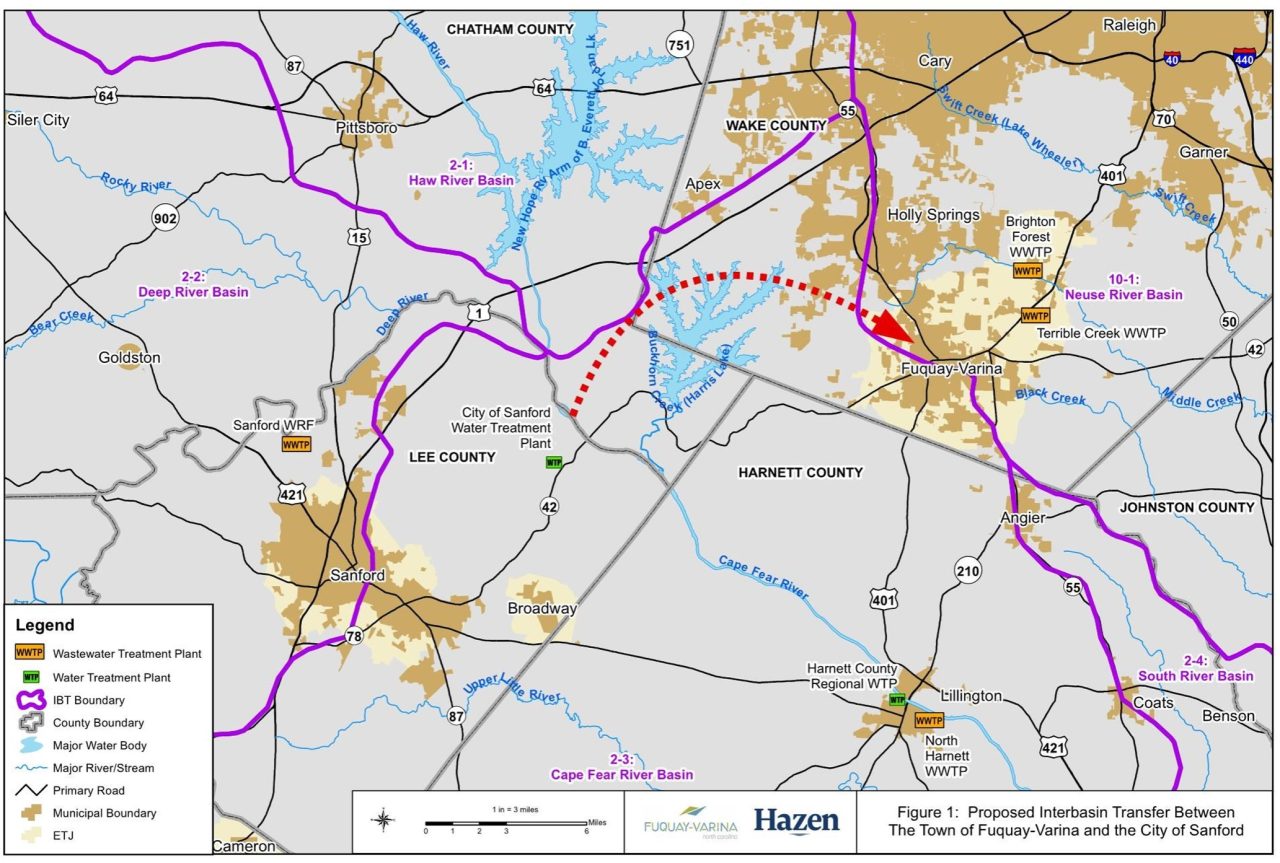
Officials in Fuquay-Varina, which is about 30 miles south of Raleigh, project that the amount of water the town currently buys from the capital city, and Harnett and Johnston counties will fall short of demand by 2030.
Supporter Spotlight

Under the proposed preferred alternative identified in a draft environmental impact statement for the IBT, the town would source its entire water supply from a water treatment plant in Sanford, which is in the Cape Fear River Basin.
Once water pulled from the Cape Fear River is used by residents and businesses within the town, the treated wastewater would be discharged into the Neuse River Basin. This would permanently subtract more than 6 million gallons each day from the river flow that currently sources more than 500,000 residents with drinking water.
“We have absolutely no problem with Fuquay-Varina wanting to continue with their development,” Zapple said. “But if you take the water, just return it. That’s all. That’s the way the system works. And, if it costs more, well maybe that’s the price of doing business. We need our development down in the lower Cape Fear region as well and we can’t afford to lose 6.17 million gallons a day.”
The Cape Fear River is Brunswick County’s “primary and only reliable water source,” said Christopher Giesting, Brunswick County Public Utilities deputy director of water operations.
The utility supplies drinking water to 19 municipalities and serves more than 350,000 residents and seasonal visitors.
Giesting said that Brunswick County has invested more than $183 million to expand its Northwest Water Treatment Plant and upgrade to a reverse osmosis system designed to remove per- and polyfluoroalkyl substances, or PFAS, discharged into the river by upstream polluters.
“These investments were made with the expectation that the full safe yield of the Cape Fear River at the intake would remain available,” he said. “Any IBT that removes water without returning it means that safe yield volume is reduced, ultimately making these major infrastructure investments unable to function as planned and designed. Our county alone has more than 50,000 planned housing units already built, under construction, or in the works. Without reliable access to the full safe yield of the Cape Fear, we cannot meet future water demands for these communities.”
The IBT proposal also threatens water quality, Giesting continued, because the requested daily transfer would lessen the amount of water available to dilute contaminants, including PFAS and 1,4-dioxane, discharged by upstream polluters.
The Lower Cape Fear Water and Sewer Authority, which provides wholesale regional raw water to treatment facilities that serve more than 550,000 customers in a five-county area, has sourced from the Cape Fear River more than half a century.
Authority Executive Director Tim Holloman said the river is already being substantially used as a water resource in the region.
“For a river that’s already maxed, we just ask that that be considered. If the IBT is granted, that (water) be returned to the Cape Fear River Basin because the need is not going to go away. It’s only going to increase over time,” he said.
Fayetteville Public Works Commission Chief Executive Officer and General Manager Timothy Bryant said that the commission would be forced to spend millions more each year to ensure safe drinking water to its more than 250,000 customers.
“I would argue very strenuously that no one with any legitimacy can claim that removing over 6 million gallons of water per day isn’t a foreseeable detrimental effect on the river basin and the 900,000 downstream residents of North Carolina who depend on this water every day,” he said. “To be clear, growth in Fuquay-Varina should not come at the expense of other communities. There are multiple reasonable alternative options presented that are not only consistent with the intent and letter of North Carolina law, but also squarely place the cost burden on Fuquay-Varina and not the customers downstream of it.”
Cape Fear Public Utility Authority Executive Director Ken Waldroup asked that the Environmental Management Commission look into what he said are “critical technical shortcomings” associated with models presented by the town.
The commission will make the final determination on whether to grant Fuquay-Varina’s request.
If approved, the IBT would occur after 2031, according to the draft impact statement.
No announcement had been made at the time of this publication as to whether a public hearing will be held in the lower Cape Fear region.