There are skills that are so ingrained and synonymous with the activity with which they are associated that we often don’t even notice them or think much about them, we just assume they are performed.
Dribbling a basketball. Breath-holding in swimming. Keeping the beat in music. Casting in fishing.
Supporter Spotlight

The best performers in these disciplines often do these skills so well, that they seem to occur without attention or any discernible effort whatsoever. But make no mistake, much practice had to be done to achieve that level of proficiency. We’re going to take a look at casting a spinning rod and then break down the skill to find out what separates the best from the rest.
I want to emphasize that I’m going to be talking about using a spinning rod, not revolving spool/baitcasting. The focus of most of our light-tackle fishing here is most appropriate for a spinning rod. Light rods and long casts are the order, most commonly. Even though bait-casters are popular in the Gulf Of Mexico for some reason, I just don’t feel they’re applicable with light lures or weekend anglers, and they create a lot of potential problems with tangles and backlashes.
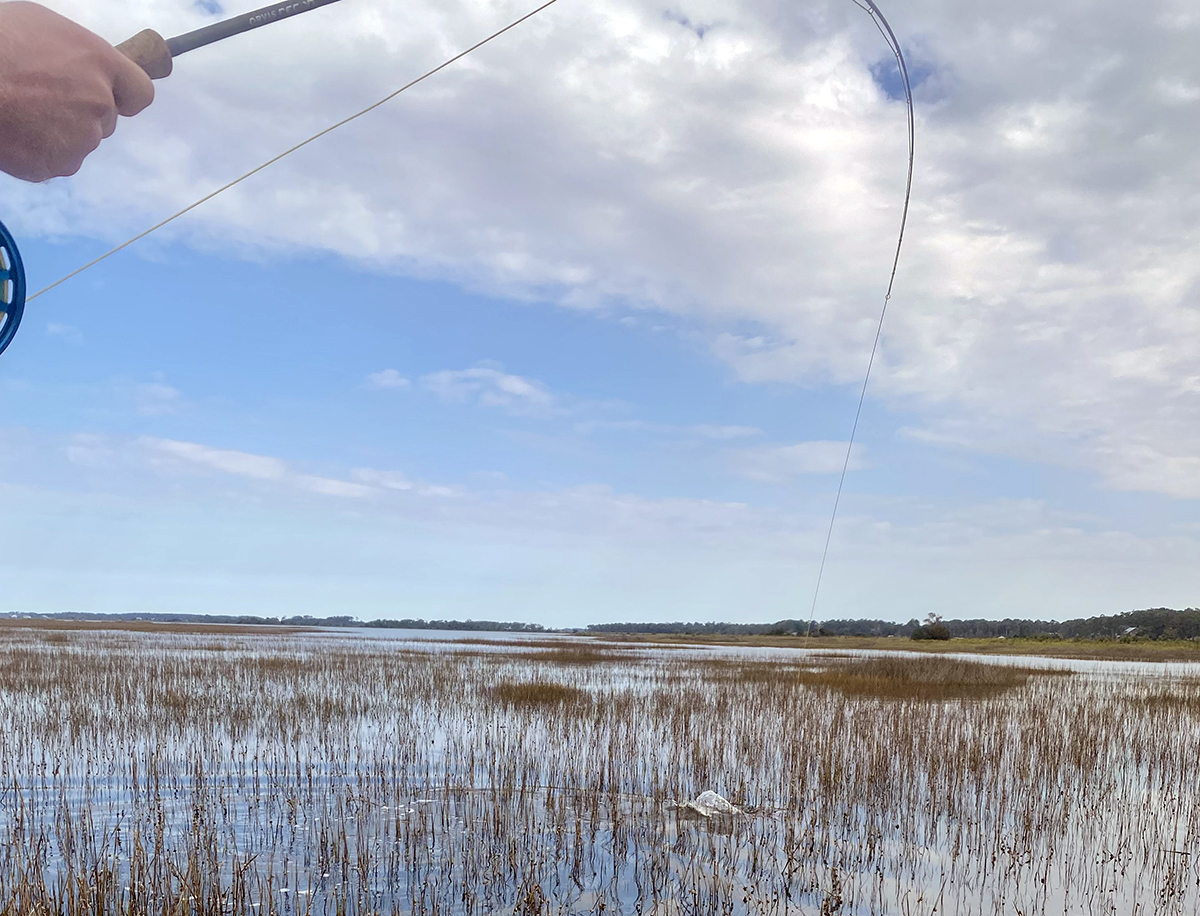
Merriam-Webster defines casting (among other things) as the act of throwing out a fishing line. On the most basic level, this is what it is, and it seems simple. Most people can accomplish the basic skill after a couple of practical attempts. They feel the line on the finger and let it go. I’ve been showing kids how to do it my whole life, and that’s all it takes to get a bait in the water. However, if you want to do it well, which means delivering it distantly and accurately, you’ll need to do some work.
First let’s talk about stance. You should be balanced. You don’t have to be in a linebacker stance, but go for an even distribution of your weight. If casting with one hand, small rods and light weight, drive forward with your casting hand and follow through with your rod guides pointing forward. If it’s a rod with a longer handle, we’ll cast with two hands.

A common error I see is that people will release their rod with the top hand. Keep both hands on and drive forward with your top hand and then pull back with your bottom hand. This will allow maximum force to be applied.
Supporter Spotlight
There is a big difference between distance and accuracy in casting. Let’s start with getting longer and then move to becoming more accurate. Most people step up to the water’s edge and want to heave it way out there. There are techniques that enable us to get maximum distance.
Let’s start with a two-handed approach. This allows us to use all the force we can apply. Then we need to choose tackle that matches what we’re trying for. When making long casts with small lures we want to have a light, fast action rod with a flexible tip and use as light a line as you can get away with. With the newer braided lines, we can easily use line that is twice the breaking strength of the biggest fish we realistically hope to catch. This enables us to make longer casts because heavier line produces more friction which takes energy away from the lure.
Be careful about going too light or you’ll run the risk of applying too much energy, and a small timing error can snap the line and send it to the stratosphere without you. Let’s avoid that.
There is also heavy gear for long range. Now, we’re talking about thick rods, 10 to 12 feet long. Long popularized by the Hatteras Heaver style of rod design. Heavy weights. Big baits. Strong currents. Often the biggest versions will use revolving spool reels. This is big gear for big water.
Both styles will have a common denominator: Those who get the most distance will be the most proficient performers of the Pendulum Cast. It’s a method for using the full length of the rod to increase the linear velocity of the projectile.
Start with an even stance. Rock your weight back and forth over your shoulder on a lead almost as long as the rod. As you get better, more length on the pendulum will equal longer casts. Time the rocking up with a forward swing and step forward like throwing a football. This timing is what allows for long casts. With a little practice you’ll be zinging it out there.
Nick Meyer from Breakaway Tackle and nickaway.com shares a video on his YouTube channel that gives an excellent illustration of how to do it effectively. He also adds that, “The ability to long cast increases your effective fishable area. When bait fishing, trimming down your bait will make the rig aerodynamic and will increase your distance.”
For accurate casting, there are some adjustments to be made.
We’ll start again with a balanced stance. Keep the length of the overhang less than half the length of your rod or less. Just enough to keep the hooks from snagging. Whether using single- or double-handed technique, drive forward with the top hand and pull back with the lower. Keep your eyes focused on the target. A good way to practice is to pick targets like leaves or anything else floating around. That way when confronted with a tight situation, you’ll be prepared.
Remember, the more you practice in true-life situations, the better. My old biomechanics professor, Dr. William F. Straub, used to tell us, “You have to make practice game-like, if you want to win games.”
Now, picture this real-life scenario. We’re fishing a big, wide, open flat. The visibility isn’t great because it’s early in the morning and there’s no light. The fish could be anywhere in front of us. Being able to make long casts quickly is beneficial. Start out with using a long overhang and pendulum with a long casting lure such as a plug or a spoon (I always preferred topwater for this). Cover the water and be prepared for anything. Strikes can come at any time and be quite sudden. There’s nothing subtle about it.
Maybe after a while, and hopefully a few fish, you’ll spot a tailing fish back in the shallows. These will have their noses down and not be conducive to chasing anything. Most likely they are finding shrimp or crabs right in their face. Now we have to be accurate.
Hopefully you have a second rod rigged with an appropriate lure such as a soft plastic jerk bait or shrimp. You’re probably going to want it to be weedless. This is where the accurate cast is handy.
Shorten the overhang. Make sure you’re within range. Lock your eyes on a spot from 6 to 8 feet from the fish. Cast toward the end of the fish that actually does the eating. You won’t have many chances. If it all goes well, you’ll be watching one of the finest sights in angling as it snacks on your lure right in front of you.
Make no mistake, doing this well takes practice. “Drive for show, putt for dough,” is what the old golfers say. This is an 8-footer, downhill, for birdie, to win the tournament.
Coastal Review will not publish Jan. 1 in observance of New Year’s Day.