Being able to watch a mother sperm whale give birth to her calf in the eastern Caribbean Sea a couple of summers ago “felt like an encounter with something both impossibly rare and profoundly ancient,” marine biologist David Gruber told Coastal Review.
Gruber, a National Geographic Explorer and City University of New York distinguished professor of biology, is president of Project CETI (Cetacean Translation Initiative). He founded the nonprofit based in the U.S. and Dominica in 2020. It’s made up of artificial intelligence and natural language processing specialists, cryptographers, linguists, marine biologists, roboticists and underwater acousticians from a network of universities and other partners, per the website.
Supporter Spotlight

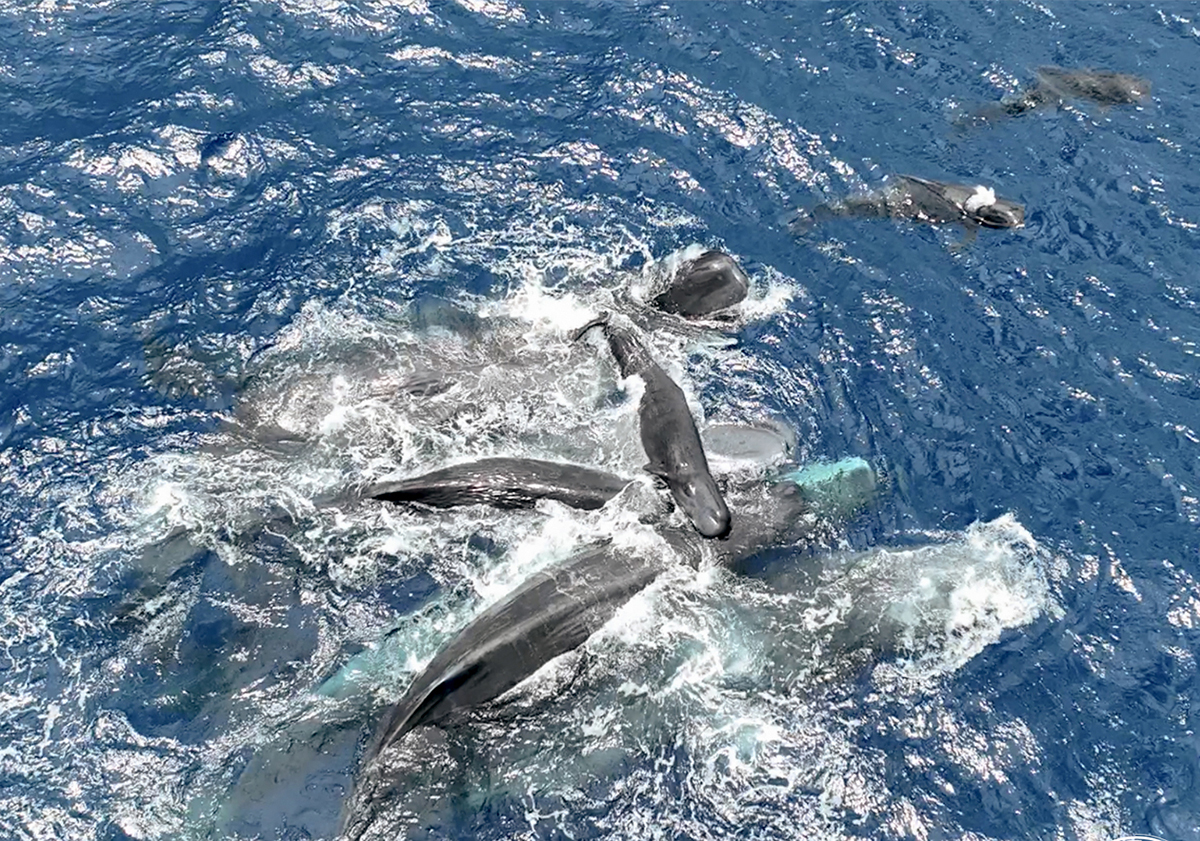
He was aboard the organization’s sailing research vessel on July 8, 2023, off the coast of Dominica, where scientists have been observing whales for decades, when the team noticed that all 11 members of a known sperm whale unit had gathered at the water’s surface.
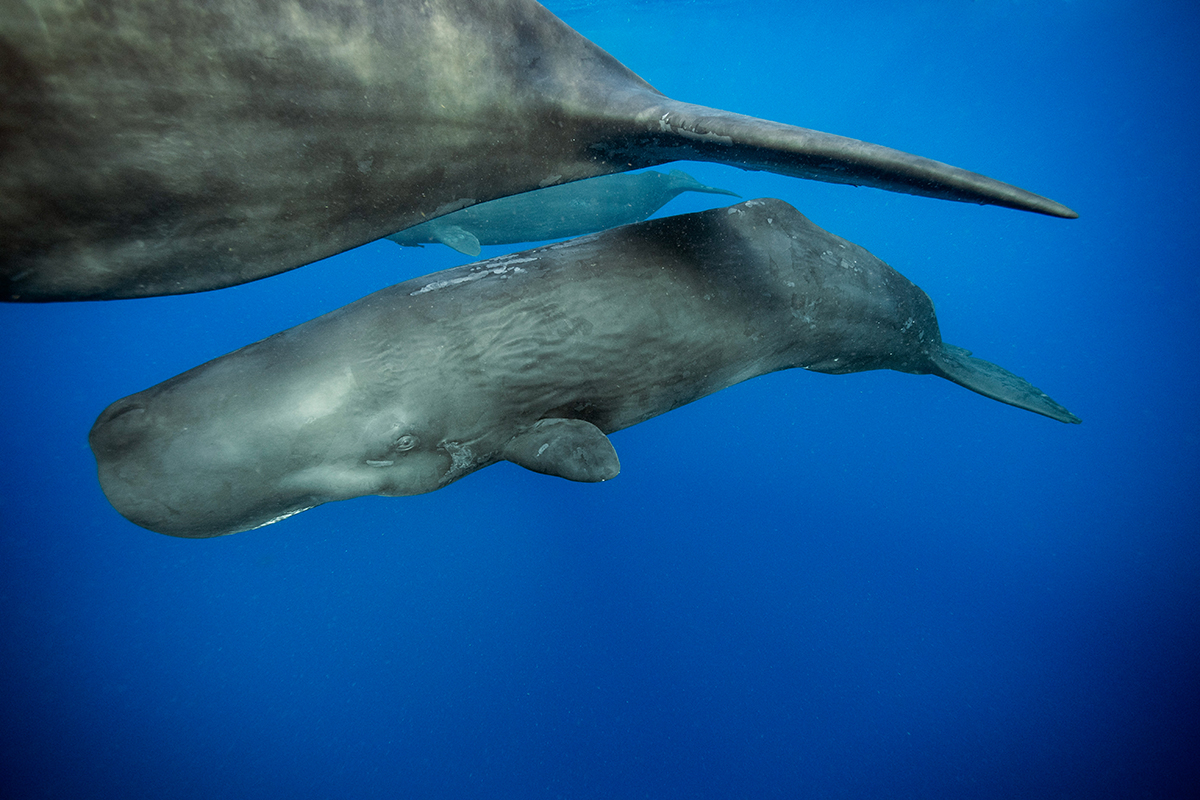
The team soon realized that they were witnessing the exceedingly rare 34-minutelong birth of a sperm whale in the wild and the coordinated care efforts for the newborn by the other adult females.
Project CETI published two reports detailing what the team observed, calling the work in a March 26 press release “the most comprehensive documentation of a sperm whale birth ever recorded and the first quantitative evidence of cooperative birth assistance among non-primates.”
The two studies analyze more than six hours of underwater audio and aerial drone footage recorded during the birth event.
Gruber, in the March 26 release, stated that these findings fundamentally reshape how we understand whale society. “What we’re seeing is deeply coordinated social care during one of the most vulnerable moments of life.”
Supporter Spotlight

Researchers said that understanding of labor, birth, postnatal and neonatal behavior is lacking for most cetaceans, with observations of these births in the wild recorded for less than 10% of species. Cetaceans are marine mammals such as whales, dolphins and porpoises.
“Of the described 93 species of cetaceans only nine species have reported birth observations collected in the wild,” the study states. “And reports of birth events of pelagic, deep-diving cetacean species, such as sperm whales, are exceptionally rare.”
Published in Nature’s Scientific Reports, “Description of a collaborative sperm whale birth and shifts in coda vocal styles during key events,” gives a chronological timeline of the birth framed within the context of known whale behavior, communication and evolution.
“Audio data revealed distinct shifts in vocal styles during key moments of the birth, including the presence of vowel-like structures, adding a new dimension to Project CETI’s ongoing work decoding sperm whale communication,” according to the nonprofit.
The journal Science published “Cooperation by non-kin during birth underpins sperm whale social complexity.” The organization explained that the study quantified the behavior of the 11-member unit by using high-resolution drone footage, computer vision, and multiscale network analysis using software developed for the work, combined with previously made scientific observations, including reports of whale births.
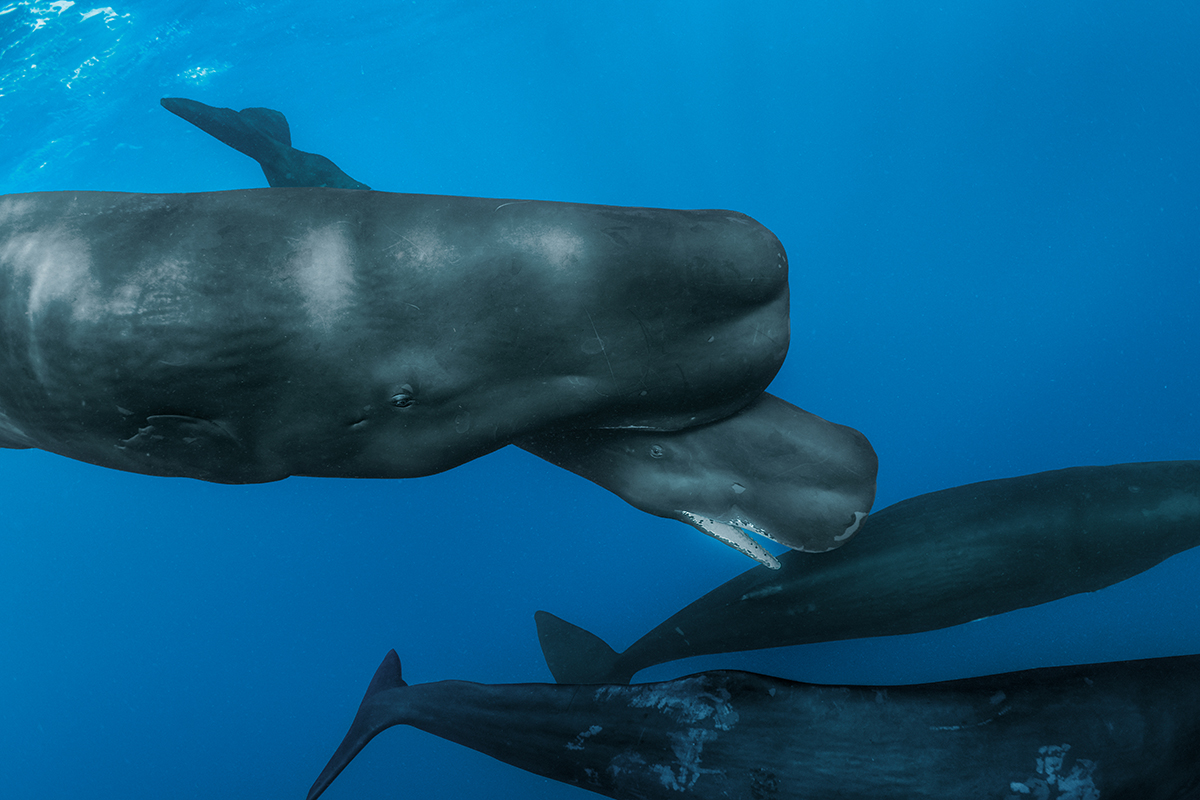
“The findings show that female sperm whales from two unrelated matrilines come together during a birth to assist the labouring mother, and both kin and non-kin taking turns assisting the newborn. This provides the first quantitative evidence of birth attendance outside of humans and a few other primates,” researchers state in the press release, adding that the birth attracted the attention of short-finned pilot whales and Fraser’s dolphins.
Gruber told Coastal Review what it was like to witness the live birth.
“To be on CETI’s sailing research vessel, in that moment, felt like an encounter with something both impossibly rare and profoundly ancient,” he noted.
“In marine biology, so much of a career is impacted by luck — being present when ocean life decides to reveal itself,” Gruber continued. “I’ve been fortunate enough to witness things like the first biofluorescent turtle seen to humans, but nothing compares to witnessing a sperm whale come into the world.”
Gruber went on to say that very few such births have been seen by humans, and the last scientifically recorded observation after the birth was decades ago.
“It makes you wonder what Herman Melville would have written had he glimpsed this: not the violence of whaling, but the circle of care and a society revealing itself through cooperation,” he explained about the author of the 1851 American novel, “Moby Dick,” that tells the tale of a whaling vessel’s captain and his quest for vengeance against the whale that took his leg.
“We witnessed culture in action,” when the 11 whales, across family lines, “coordinated to keep a newborn alive, communicating in ways we’re only beginning to understand.”
Gruber said it took more than 50 scientists 2.5 years “to begin to interpret even a fraction of that moment, because Project CETI sits at the intersection of marine biology, artificial intelligence, and network science — fields that must come together if we are to decode these lives,” he said. ”And, in some sense, this is why Project CETI exists: We are one of the few teams in the world continuously embedded with these whales, with the tools, the longitudinal data, and the interdisciplinary lens to not only witness something this rare, but to begin to understand it.”
Shane Gero, National Geographic Explorer, Project CETI biology lead, and founder of The Dominica Sperm Whale Project, leads the research.
Researchers, who have been tracking since 2005, the mother that gave birth, observed her that day with both her mother and her daughter.
“This is the most detailed window we’ve ever had into one of the most important moments in a whale’s life,” Gero said in the release. “Because this family unit has been studied for decades, we could see what the grandmother was doing, how the new big sister acted, and how each helped mom and newborn, placing this rare birth within a deep social and behavioral context.”
The two studies point to cooperative caregiving during birth being ancient evolutionary behavior.
The behaviors documented in the research “suggest that cooperation during births functions to reinforce social bonds between sperm whales, which underpin their large-scale society. Helping unrelated companions drives them to help in return later. In this way, a foundation of trust and collective success builds their social world,” researchers said.