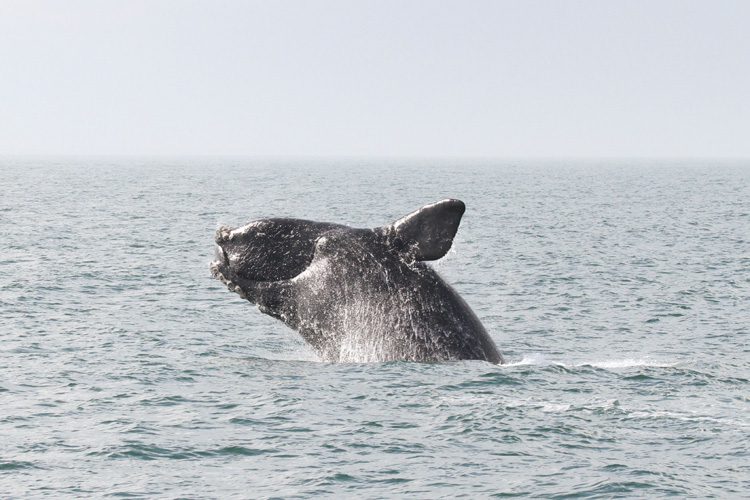
The North Carolina Maritime Museum in Beaufort will devote a full day to exploring whales and whaling from multiple perspectives, highlighting both the cultural history of whaling and today’s conservation efforts.
The annual Whales and Whaling Symposium is scheduled for 10 a.m. to 4 p.m. Friday, March 20, followed by an evening program at 5:30 p.m. in the museum’s auditorium. The symposium was held at Fort Macon State Park last year while the Beaufort facility was undergoing renovations.
Supporter Spotlight
The symposium is offered at no charge, but reservations are requested because there is limited seating. For more information or to RSVP, call call 252-504-7758 or visit ncmaritimemuseumbeaufort.com.
“We wanted to create a program that looks at whales through many lenses: science, history, art and conservation,” Associate Education Curator Christine Brin, who coordinated the symposium, said in a release. “Whales have shaped coastal communities for centuries, and they continue to shape conversations about how we care for our oceans today.”
The program begins at 10:15 a.m. with “NC Whales: Diversity, Distribution, and Conservation,” presented by Keith Rittmaster, the museum’s natural science curator and director of the Bonehenge Whale Center.
Rittmaster is to discuss the 35 species of cetaceans, or the whales, dolphins, and porpoises, documented off North Carolina’s coast, conservation challenges and ongoing work at Bonehenge Whale Center, a facility in Beaufort focused on marine conservation, educational programming, outreach, publications, and stranded specimen collection and maintenance for these mammals.
Next on the schedule is historian David Cecelski who will present at 11:15 a.m. “Nye’s Clock Oil and the Bottlenose Dolphin Fishery at Hatteras Island.” His talk examines the surprising connection between North Carolina’s coastal fisheries, the waning days of American whaling and the rise of the U.S. clockmaking industry at the turn of the 20th century.
Supporter Spotlight

After lunch at 2 p.m. Dr. Vicki Szabo, professor of ancient, medieval and environmental history at Western Carolina University, will present “Watching Whales in the Middle Ages.” In her talk, Szabo contrasts whale mythology in medieval Europe with the practical knowledge of coastal communities, drawing on historical texts and archaeological evidence.
Marine biologist and conservation-based crafter Tommy Tucker is to present at 3 p.m. “How Many Whales Does It Take to Save a Species?” that focuses on the critically endangered Rice’s whales and uses the stories of individual whales to illustrate the intersection of maritime history, natural history and conservation.
The day concludes with the evening program featuring the North Carolina aerial survey team for North Atlantic right whales. Operated locally in Beaufort by the Clearwater Marine Aquarium Research Institute in Florida and funded by the U.S. Army Corps of Engineers, the team will discuss right whale biology, current population trends and how aerial surveys are supporting recovery efforts for this critically endangered species.
“Each speaker brings a unique perspective, but together they tell a much larger story,” Brin said. “From medieval whale myths to modern aerial surveys, this symposium shows how our understanding of whales has evolved and why that understanding matters more than ever.”
The North Carolina Maritime Museum in Beaufort is part of the Division of History Museums under the North Carolina Department of Natural and Cultural Resources.