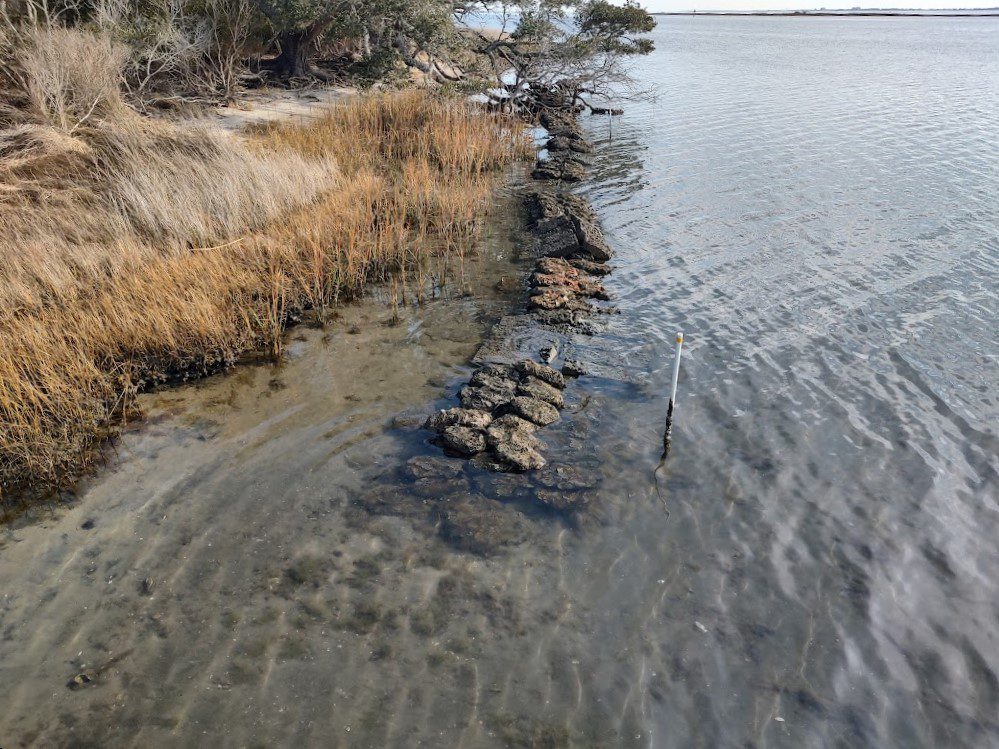
Nature-based coastal shoreline erosion control structures that successfully attract and grow oysters can better defend shores from waves, according to a study led by East Carolina University researchers.
The study, published late last year in the journal Scientific Reports, found that the more oyster-dense a breakwater designed to recruit and grow those shellfish is, the better that structure is at dissipating waves.
Supporter Spotlight

“We actually found that wave attenuation increased or improved as the structures recruited oysters,” said Georgette Tso, a doctoral candidate in ECU’s Integrated Coastal Sciences Program and co-author of the study.
As more and more oysters grow on a surface, their shells building layer by layer, those shells alter that structure’s surface, making that surface rougher and less permeable.
After documenting two seasons of oyster recruitment, researchers found that living shorelines constructed with living oyster breakwaters absorbed wave activity by an increase of 10-15%.
Their findings are based on observations of living shorelines at two private properties along Bogue Sound in Newport in Carteret County.
The structures were installed between May and June 2022 by Native Shorelines, the coastal resiliency division of Davey Resources Group, using concrete-based breakwater systems called QuickReef.
Supporter Spotlight

QuickReef is built from materials primarily of natural calcium carbonate formed into concrete slabs. Those slabs are installed to allow water flow and attract oyster larval, which attach to and grow on the structures.
Living shorelines are becoming increasingly attractive for coastal waterfront property owners seeking ways to curb erosion of their land.
“I think there’s been a lot more awareness within coastal North Carolina about living shoreline options as an alternative to a hardened shoreline, like bulkheads or some other vertical structure, which oftentimes actually costs more over time to repair. And, they’re not as resistant to hurricane damage because of that vertical profile,” Tso said.
The benefits of living shorelines, including their resiliency against the effects of rising sea levels, have been documented through research spanning back more than a decade.
But Tso said that there is little data how smaller-scale living shoreline projects like the ones she and her fellow scientists observed for this study actually change the way waves interact with shorelines.
Their observations proved to be “an exciting finding,” Tso said, because they prove what researchers have suspected for some time.
“Oysters grow vertically and they increase the roughness on the surfaces that they grow on. They also can grow within interstitial spaces and reduce porosity in that way. So, we hypothesized that the amount of wave attenuation a structure could provide would increase with the recruitment of live and healthy oyster populations,” she said. “This additional factor that’s not been explored, of it actually improving the wave attenuation potential and reducing the wave energy that hits the back of your shoreline over time, is something that we should communicate more to homeowners because they’ve actually bought into a solution that has increased benefits over time that they may not have anticipated when they first put in the structure.”
And while it’s fair to say the longer these structures recruit oysters the more protection they may offer to a shoreline, Tso said there is one important caveat.
“This is just a two-year study so we’re not capturing the point in time where the oyster population will eventually plateau. The size of the structure and the amount of food available to the oysters in the water is limited, obviously, so the oyster population will eventually plateau. So, though we’ve observed increases in wave attenuation potential, probably it’s going to cap off at some point,” she said.
It is also important to note that oyster recruitment and growth will not be the same at every shoreline.
Shorelines bend and curve, leaving pockets where water does not circulate to deliver oyster larvae.
“What we found is only relevant if your structure can actually recruit oysters, and that’s not true on all North Carolina shorelines,” Tso said. “If you don’t have baby oysters being delivered to your shoreline, you’re not going to be able to recruit oysters. If you’re in a site where that’s not possible then the wave attenuation potential that you have at construction is what you’re going to have. It’s not going to improve because you’re not recruiting oysters.”
Successful oyster larval recruitment and growth also depends on things like water temperature, salinity, and tidal variation.
Tso is in the process of analyzing data researchers collected last summer at more than a dozen QuickReef living shoreline sites. Scientists during that time also revisited their two original study sites, which continued to recruit oysters, Tso said.
The other researchers on this study include Dr. Siddharth Narayan, assistant professor in ECU’s Integrated Coastal Programs, Megan Geesin, a doctoral candidate at ECU, Dr. Matthew Reidenbach, professor and chair of environmental sciences at the University of Virginia, Dr. Jens Figlus with Texas A&M’s Ocean Engineering Department, and Dr. Rachel Gittman, assistant professor with ECU’s Department of Biology.