Editor’s note: Coastal Review regularly features the work of North Carolina historian David Cecelski, who writes about the history, culture and politics of the North Carolina coast. More of his work can be found on his website.
Earlier today, March 20, I gave a lecture at the annual Whales and Whaling Symposium in Beaufort. It is a special event, and one that I treasure.
Supporter Spotlight
Sponsored by the Bonehenge Whaling Center, which is part of the North Carolina Maritime Museum, the symposium invites scientists, historians, and the public to come together and share their knowledge of whales and the history of whaling on the North Carolina coast and throughout the Atlantic.
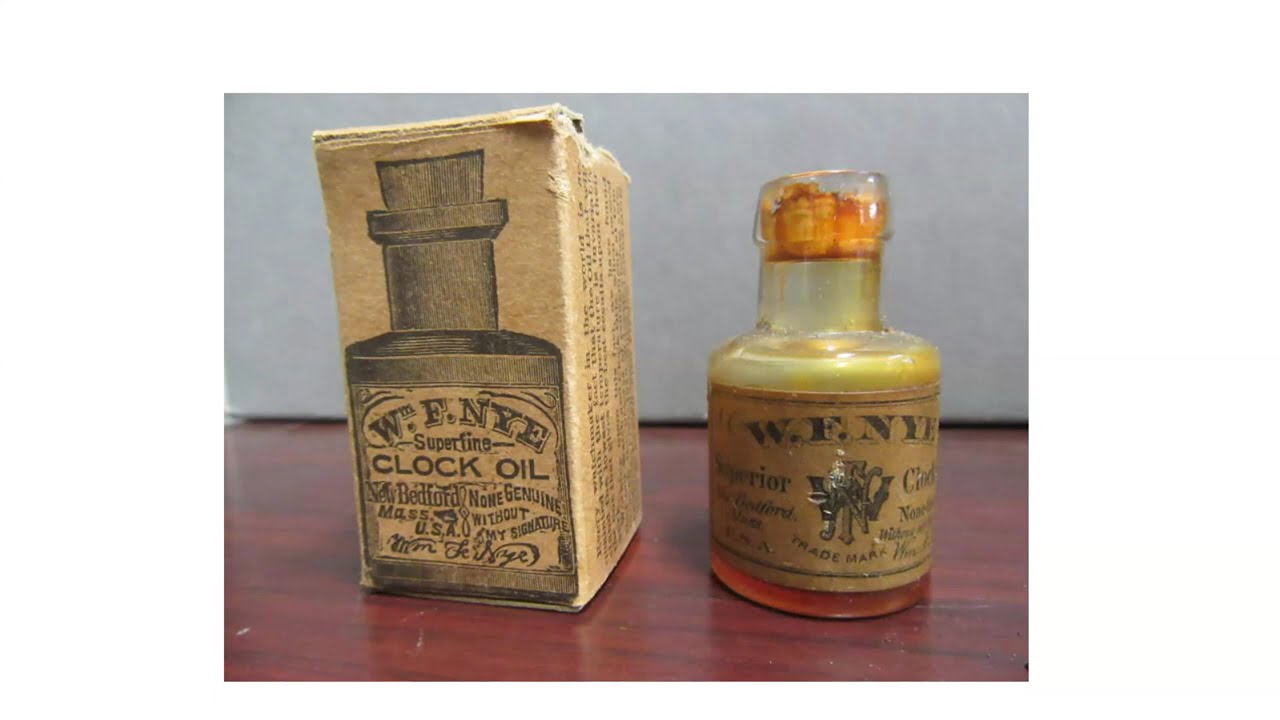
My lecture was titled “Nye’s Clock Oil and the Bottlenose Dolphin Fishery at Hatteras Island.”
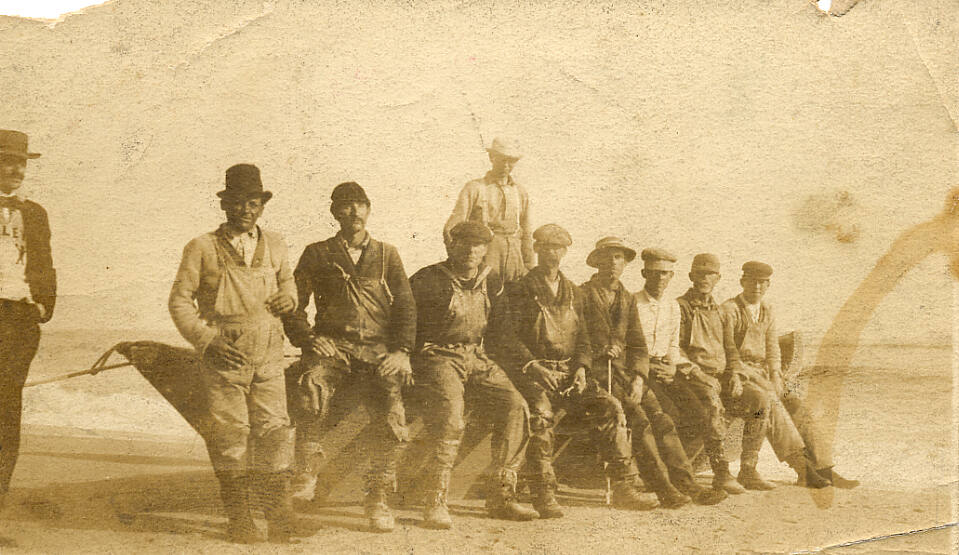
The photograph above was one of the illustrations that I used in my lecture. It shows one of the crews that was hunting bottlenose dolphins on Hatteras Island in the winter of 1907 to 1908.
This crew worked for the William F. Nye Co., a New Bedford, Massachusetts, firm that operated a bottlenose dolphin fishery on Hatteras Island between 1907 and 1928.
Arising in New Bedford when it was the whale oil capital of the world, the William F. Nye Co. was the country’s largest maker of highly specialized whale and dolphin oils uniquely suited for lubricating clocks, watches, chronometers, scientific instruments, and other delicate machinery.
Supporter Spotlight

The company did not obtain those oils from whale blubber, but from two anatomical structures only found in the heads of bottlenose dolphins, pilot whales, belugas and other small-toothed whales.
Specifically, the William F. Nye Co.’s “oilers” extracted those oils from the fatty tissues in the animals’ lower jawbones and from an organ in their foreheads that is called the “melon.”
Both play central roles in the echolocation ability of those whales and dolphins. That is, they are key to the way that they navigate, find prey and generally “see” underwater by emitting sound waves and interpreting their echos when they reflect off objects around them.
On Hatteras Island, the company’s workers butchered the dolphins on the beach. They then did a small degree of refinement at a facility on Durant’s Island, a knoll on the sound side of the island.
They then shipped the oil to the company’s factory in New Bedford for far more extensive refining.
Between the American Civil War, which spanned from 1861 to 1865, and 1900, the William F. Nye Co. acquired the largest part of its supply of those oils from pilot whale strandings on Cape Cod and Long Island.
In many of those cases, local fishermen herded the whales into shallow waters where they were trapped and grounded.
To establish a more stable supply of those oils, William F. Nye’s son Joseph came south and established the bottlenose dolphin fishery on Hatteras Island in 1907. He recruited local fishermen and seafarers, many of whom had been involved in earlier bottlenose fisheries on Hatteras.
Hatteras Island was the site of the oldest and longest running bottlenose dolphin fishery in North America.
At the National Museum of Natural History’s Paleobiology Archive, I found records indicating that there had been a commercial bottlenose dolphin fishery on Hatteras Island on and off since at least 1851.
To oversee the Hatteras fishery, Joseph Nye employed a third-generation Hatteras oiler, William C. Rollinson.
Rollinson had been involved in hunting bottlenose dolphins most of his life, as had his father and grandfather before him.
His father, John W. Rollinson, had been superintendent of a bottlenose dolphin fishery at Hatteras that had been operated by a company based in Wilmington, Delaware, in the 1880s and 1890s.
Even further back in time, his grandfather had been captain of a bottlenose dolphin crew at Hatteras Island before the Civil War.
It was hard, dirty work. When I was younger, and some of the men were still alive, they described it as a very grim business, the kind of job that one only did if there was no other way to make a living. But that was often the case on Hatteras Island in those days.
The William F. Nye Co.’s bottlenose dolphin fishery remained on Hatteras Island until 1928 or 1929.
I do not want to give the whole story away here, but if you want to learn more, the North Carolina Maritime Museum has already posted my lecture on its YouTube channel.
The whole symposium was wonderful. The amazing Vicki Szabo, who teaches at Western Carolina University, gave a fascinating presentation on the extensive mythology and scientific knowledge of whales in Medieval Iceland and other parts off the North Atlantic.
Keith Rittmaster, the founder and driving force behind the museum’s Bonehenge Whaling Center, gave an extremely informative overview of the 35 species of cetaceans that have been documented on the North Carolina coast.
Keith also discussed the conservation challenges ahead for whales and dolphins on our coast, and he charted some the exciting, day in and day out work that is happening at the Bonehenge Whaling Center, also in Beaufort.
Another exciting presentation was by marine biologist Tommy Tucker of the Coastal Studies Center on Cape Cod. With a contagious passion, they are devoted to understanding and raising public awareness of the critically endangered Rice’s whale, which is only found in the Gulf of Mexico.
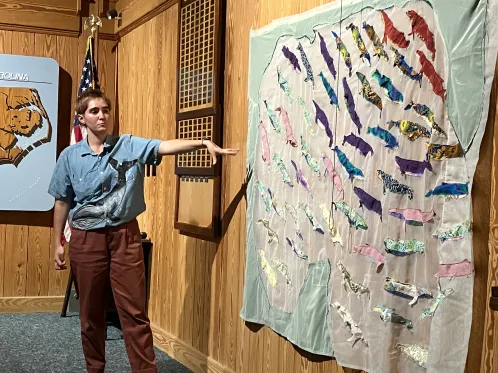
Their presentation was brilliant. In addition to studying Rice’s whales, Tommy also uses arts and crafts to nurture interest in them, including this tapestry in which each depiction of a Rice’s whale represents one of the 51 Rice’s whales currently known to be surviving in the Gulf of Mexico.
All of these presentations are now available on the museum’s YouTube channel. I don’t know about mine, but the presentations by Vicki, Keith, and Tommy are not to be missed!
I found the whole day inspiring. It was so encouraging to be at a museum where the staff are so dedicated to telling the story of North Carolina’s coastal history and do so in such a professional way.
The museum’s auditorium was full of people from many walks of life, including scientists, historians, students, fishermen and women, and all sorts of other lovers of whales and the sea.
All were coming together to discover more about these glorious creatures of the sea and what we might do to make sure that they are still here to inspire and enthrall our children and grandchildren.
It was a joy to be part of it.
* * *
The Bonehenge Whale Center was built by volunteers dedicated to marine conservation, education, and research on the whales, dolphins, and porpoises of the North Carolina coast. You can learn more about the Center’s remarkable work and how you might contribute to it here.