Part of an ongoing series on coastal North Carolina’s observance of America’s 250th.
The patriot victory over loyalist forces at the Battle of Moores Creek in the early morning of Feb. 27, 1776, set North Carolina up to be one of the first colonies to vote for independence from British Rule.
Supporter Spotlight
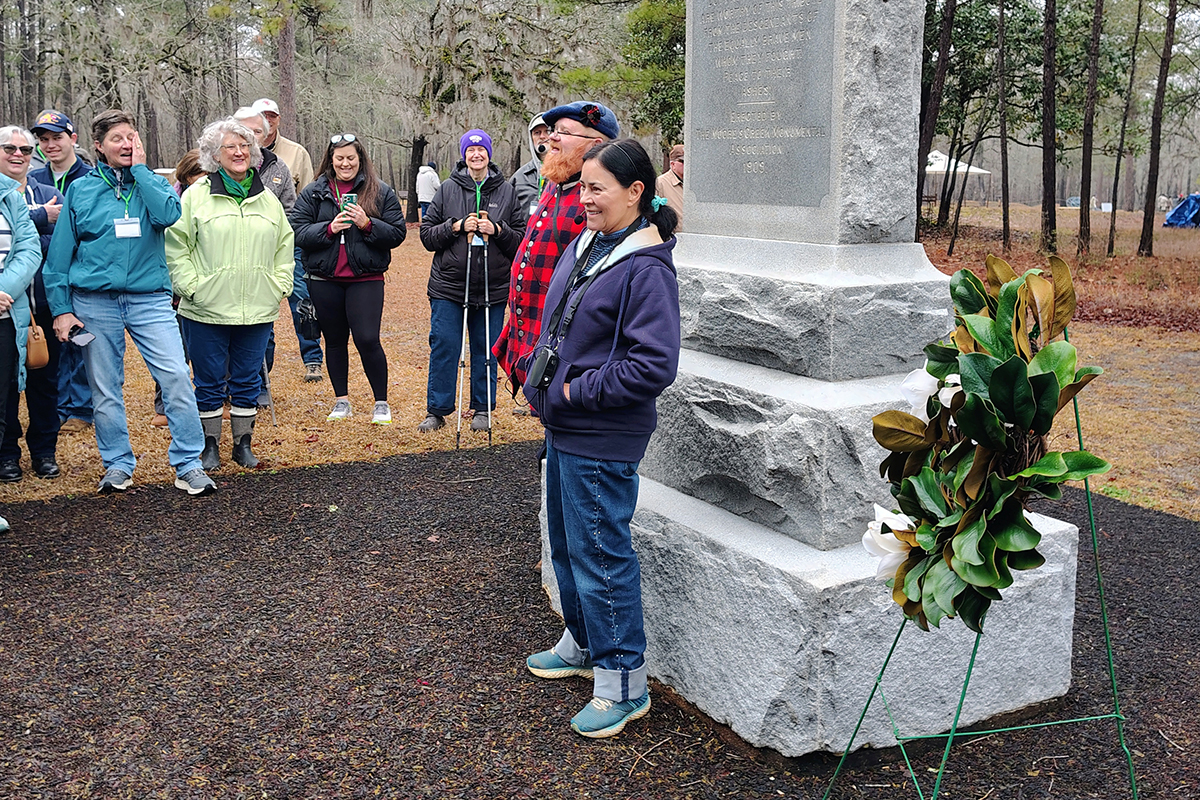
That bloody battle in a Pender County swamp is considered the first decisive win of the American Revolution and is commemorated every year with a wreath-laying ceremony by the National Park Service and regional partners at Moores Creek National Battlefield.
This year, the commemoration was expanded to two days, Feb. 27-28, and anchored the weeklong inaugural First in Freedom Festival held Feb. 21-28. Taking place at historical sites, museums and other locations in Bladen, Brunswick, Columbus, Duplin, New Hanover, Onslow, Pender and Sampson counties, the festival was supported by the state’s official celebration of independence, America 250 NC, under the North Carolina Department of Natural and Cultural Resources.
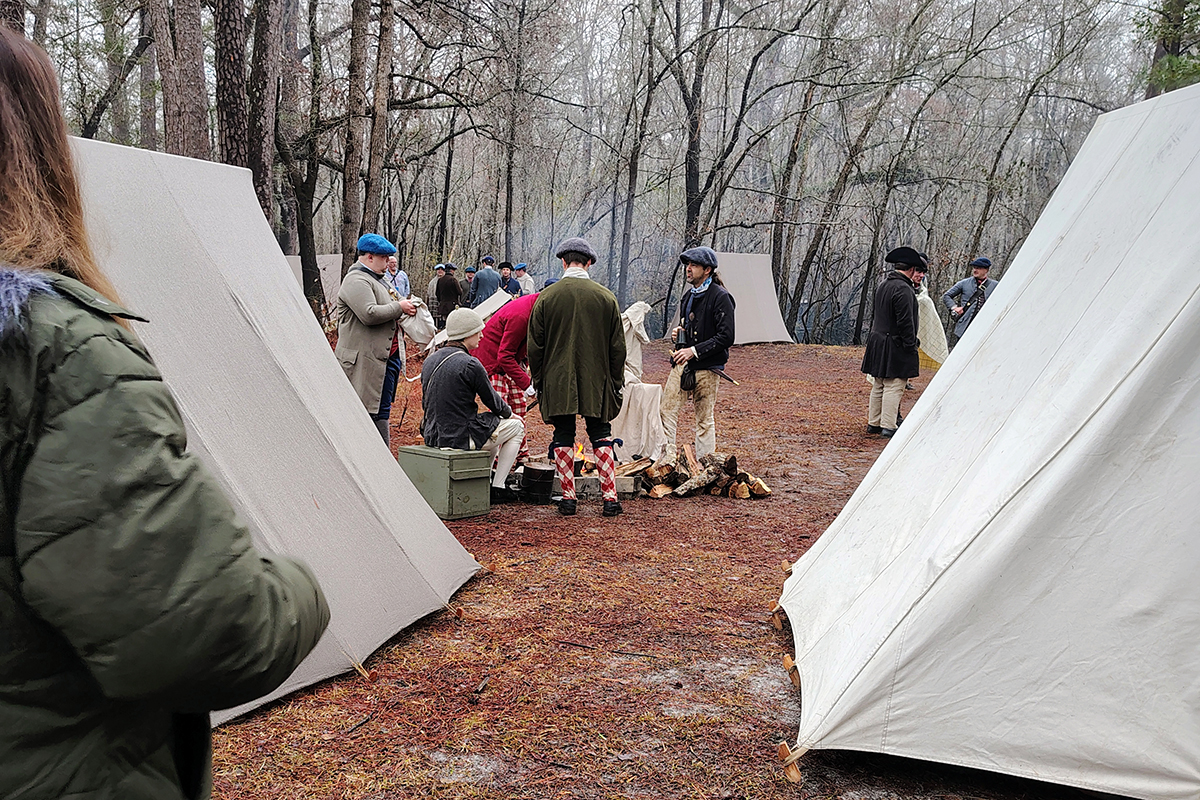
The weekend was both somber and celebratory, with a wreath-laying ceremony that began the two-day commemoration, living history demonstrations with both loyalist and patriot reenactors who camped on the grounds near the earthworks built by patriots for the battle, a ribbon-cutting for two new exhibits in the visitor center, and special guest, Diana Gabaldon, creator of “Outlander.”
“Outlander,” both a series of books and a television show, is about a World War II nurse who travels through time to 18th century Scotland, where she meets a young Highlander. The historical fiction series follows the couple from 1740s Scotland to the colony of North Carolina after the American Revolution.
While rainy conditions on the first day, Feb. 27, prevented a handful of the outdoor programs from taking place, including the weapons demonstrations. The weather, while still gloomy the next morning, allowed the sun to peek out later that day.
Supporter Spotlight

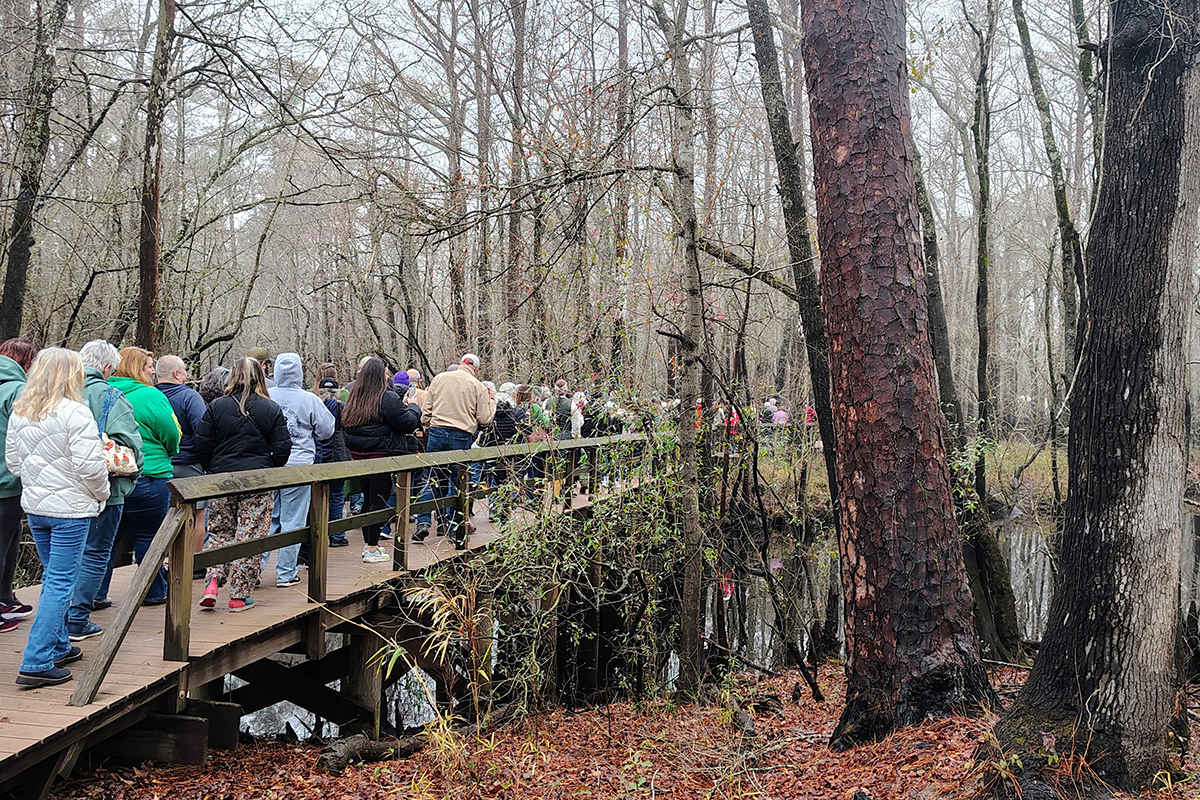
“Despite some challenges brought forward by the weather, the event was a great success, bringing over 17,500 visitors to Moores Creek National Battlefield during the event. The success was the result of a wonderful collaboration and partnership among the National Park Service, state and local partners, as well as volunteers, reenactors and living historians,” Battlefield Chief of Interpretation, Education and Volunteers Jason Collins told Coastal Review after the event.
With the steady pitter-patter of raindrops drummed on umbrellas and tents, leaves and puddles in the background, Michael Elston, president general of the National Society of the Sons of the American Revolution, said from the podium during the wreath-laying ceremony that North Carolina was one of the earliest colonies to end royal rule and establish its freedom from Great Britain.
The last royal governor of the North Carolina Colony, Josiah Martin, fled to the safety of a royal naval ship in July 1775 and began plotting his return to power as head of an army of loyal colonists. “Unfortunately for Gov. Martin, he overestimated the support he had in North Carolina,” Elston said. About 1,600 loyalists answered met him in what is now Fayetteville and they began marching to the coast to join British forces.
Meanwhile, patriot forces maneuvered the loyalists toward Moores Creek Bridge, where they had established a strong position.
“The patriots fought on their terms and won an extremely short battle with only one man killed and another wounded in the aftermath,” Elston said, disrupting loyalist recruiting efforts in the state. “The battle put an end to loyalist organization in North Carolina, more than five months before the Declaration of Independence.”
Historic Halifax State Historic Site Assistant Site Manager Frank McMahon, also coordinator of the 3rd North Carolina reenacting group, took the podium as well, and filled in what happened next on the state’s road to freedom.
After the Battle of Moores Creek Bridge, the people of North Carolina elected a provincial congress to lead the colony. The fourth provincial Congress, made up of 83 delegates representing 29 counties and six of North Carolina’s most populated towns, met in Halifax to define a new direction for the American Revolution.
On April 12, 1776, the members unanimously adopted the Halifax Resolves, the date for which on the North Carolina flag acting as a direct reminder of the significance of the event, McMahon said.
The document known as the Halifax Resolves was first read to the members of the Continental Congress in Philadelphia, Pennsylvania, in June of 1776, and “would empower North Carolina’s members of the Continental Congress to collaborate with other united colonies to declare independence from Great Britain,” McMahon said.
McMahon took the opportunity to mention the next America 250 NC signature event, the “Halifax Resolves Days: Prelude to Revolution.” There will be living history activities, historic weapons demonstrations, guest speakers, food and live music at the site southeast just east of Interstate 95 near the Virginia line.
Special to the weekend is the original copy of the Halifax Resolves that was presented to the Continental Congress in 1776, on load from the National Archives. The document will be on display in the newly renovated historic Halifax State Historic Site visitor center.
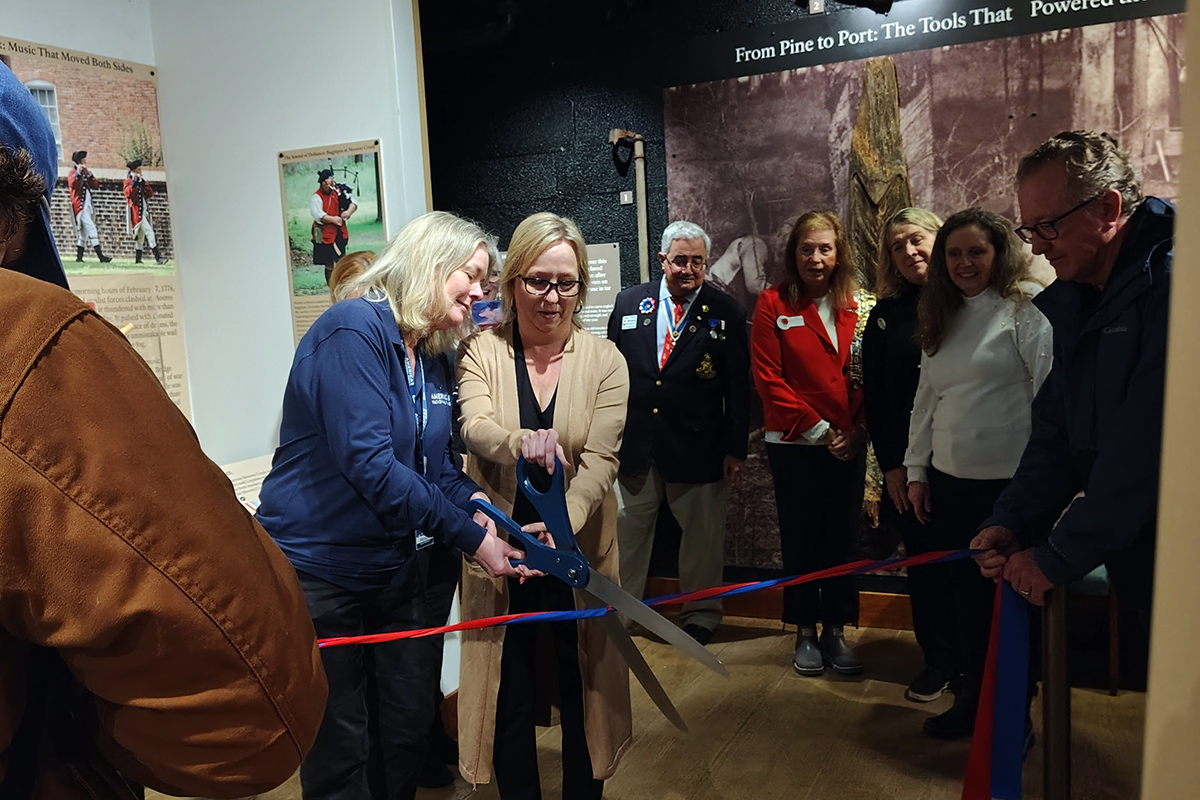
Part of the afternoon activities was a ribbon-cutting ceremony to introduce two new exhibits in the visitor center.
Collins said from inside the building that the existing displays were installed in 2006 but only tell part of the story.
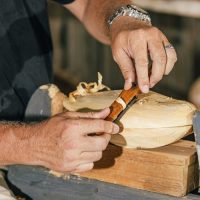
“A couple of the major parts of our history that we don’t get to tell are the stories of the naval stores and the story of music in this battle,” he said, which are the focus of the two new exhibits.
‘Outlander effect’
A “Weekend with Diana Gabaldon” featured three ticketed events, starting with “An Evening with Author Diana Gabaldon” Feb. 27 in Penderlea Auditorium in Willard, followed by a guided tour of the battlefield early Feb. 28, and concluded that afternoon with a book signing at a private venue. All events were sold out months ago.
During the evening program, Hunter Ingram, the assistant museum director for the colonial Burgwin-Wright House and Gardens, a 1770 structure open to the public, had a conversation with Gabaldon about how her path as a historical fiction writer brought her to Moores Creek and the influence her detailed accounts have had on tourism.
A lifelong and avid reader, Gabaldon said she knew at the age of 8 that she was supposed to write novels, “I just didn’t have any idea how.”
Before trying her hand at writing, Gabaldon pursued a career as a scientist, earning three degrees in the subject, including a master’s degree in marine biology and a doctorate in quantitative behavioral ecology. After she and her husband married, they just celebrated 54th anniversary, they had three children in the space of four years.
“It was busy, and at this point in my life, and I’m not sure why, probably sleep deprivation, I decided that this was the time to start writing a novel,” Gabaldon said. “Two jobs and three small children and a husband who decided to quit his job and start his own business.”
The inspiration for “Outlander” came from a “really old rerun of ‘Doctor Who’ on public television,” she said. “Doctor Who” is British science fiction television series that began in 1963.
“I was attracted, in this particular instance, to one of the doctor’s companions, who was a young Scotsman who appeared in his kilt, and I was thinking, ‘well, that’s kind of fetching’,” she explained, leading her to begin researching 18th century Scotland.
“So that’s when I started writing ‘Outlander’,” she said, explaining that she opted for historical fiction because “it seemed easier to look things up than to make things up.”
She begins “Outlander,” the first book that was published in 1991, with “people disappear all the time.” The line came to her one day but wasn’t the first line she wrote.
“I was thinking, ‘Well, sure, they do, but why do they?’ and then the next couple of lines just sort of evolved. This is one reason. This is another reason. And it got more mysterious, and I was sitting there thinking, ‘Well, why do they disappear?’ And that’s why there’s time travel in these books.”
As for how the characters end up in North Carolina, it’s because she’s following history. After the Battle of Culloden April 1746 in the Scottish Highlands, she said there was no reason for her characters to go back to Scotland and brought them to the Americas. Culloden was the final conflict in the Jacobite Rising and is featured prominently in the series.
“I was following history,” she said and the Highlander migration across the state, which is how colonial historic sites became part of the “Outlander” story.
Ingram praises her detailed description of Moores Creek in “A Breath of Snow and Ashes,” which is set in 1770s North Carolina.
It is not often that there are examples of someone looking at the region’s history from the outside and making it part of something so globally beloved, he said, adding it’s an interesting way to look at not just Moores Creek, but local history in Wilmington, in the Cape Fear region, and across North Carolina.
“A lot of the historic sites have seen an impact from people being interested in ‘Outlander’,” Ingram said.
Gabaldon told the audience that she’s seen similar in Scotland and has been given honorary doctorate degrees for services to country by the University of Glasgow and the University of the Highlands, and the Scottish Government gave her a Thistle Award, which spotlights the tourism industry.
It is being called the “Outlander effect.”
She recounted that when the show first began filming, she was on set for about six weeks in a village near Glasgow. During lunch, she and another writer went to a café to buy sandwiches, but the shopkeeper didn’t have change. He then realized she is the creator of “Outlander,” and explained that she had had no idea what she had done for the economy there.
Ingram said the effect has been noticeable at historic sites in the region and mentioned the discussion they when she was a special guest on the podcast he hosts for the Burgwin-Wright House called, “Outlander in the Cape Fear.”
He said that during the podcast, they discussed her impact and, “You said you felt it was a lovely side effect of the work that you’ve done, not just here in North Carolina — but we’re kind of biased that, you know, we want to see more people pay attention to our history — and so the fact that we’re all here on the 250th anniversary of Moores Creek today, I think, is a testament to what you’ve done.”
During the tour of the battlefield the next day with Historic Weapons Supervisor and Special Park Uses Coordinator Jason Howell and Gabaldon, Howell said something similar.
“She does a really good job of pulling you into the earthworks in the morning fog,” he said, adding how he remembered being captured by her writing. “And one thing Diana does is, she gets people like you interested in these sites. It’s from her viewpoint and it’s from an alternate viewpoint, but she captures your attention.”
And, as a result, he’s seen Outlander fans come to the site, who admit to not liking history that much but are interested in the battlefield.
More information on America 250 NC events, including details on the Halifax Resolves Days, can be found at america250.nc.gov.