First in a series
Something potentially and significantly consequential is underway now in North Carolina that could alter management of the state’s increasingly battered Atlantic coastline.
Supporter Spotlight

The state Coastal Resources Commission’s Science Panel is in the process of finalizing an analysis of beach erosion-control structures, a report that is expected to be submitted to the commission in June. Although the 10-member advisory panel’s study is meant to inform policymakers of their options, some fear – or hope – that it’s the first step toward repealing the state’s longstanding ban on hardened shoreline structures.
“Alarms are sounding in nearly all of our oceanfront counties,” state Division of Coastal Management Director Tancred Miller said at the commission’s meeting in November at Atlantic Beach, referring to threats from accelerating beach erosion. “Nourishment costs continue to rise and the lifespan of many of these projects is painfully short. Infrastructure is increasingly vulnerable, and some communities are very concerned.”
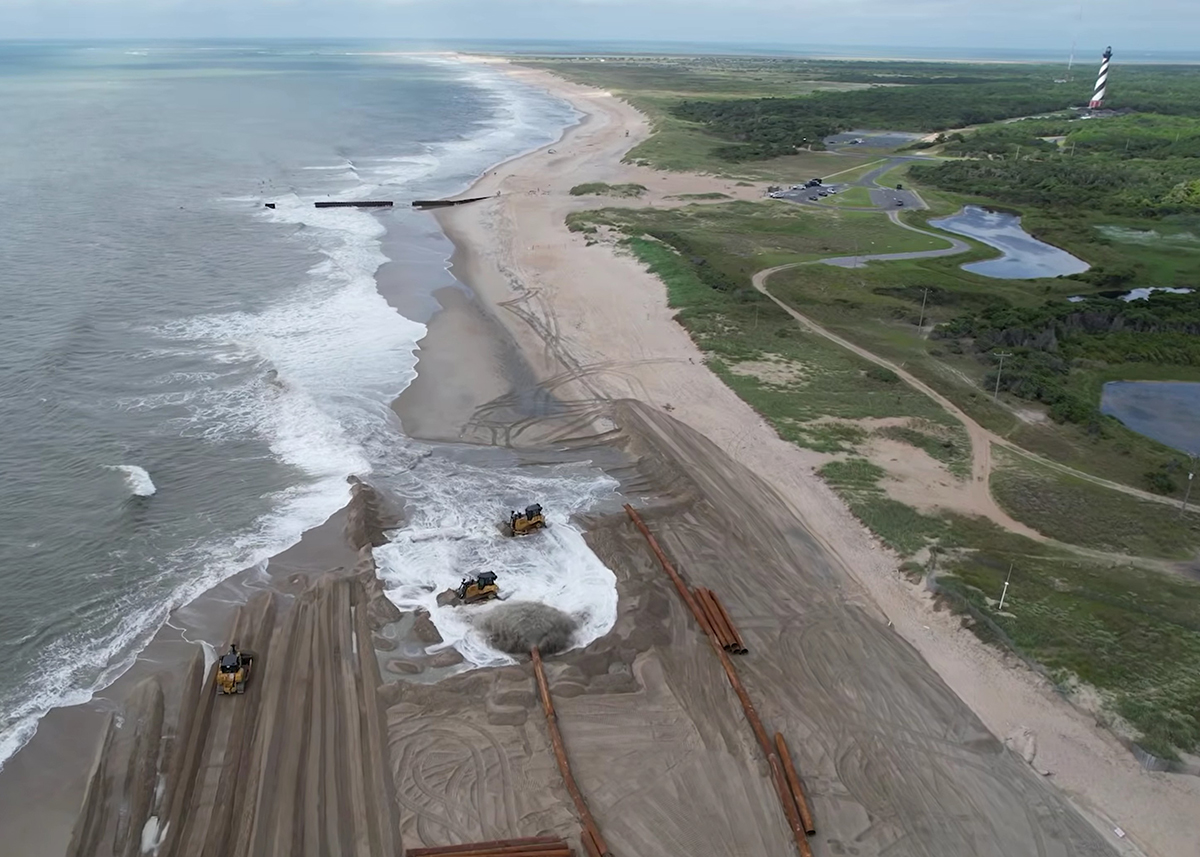
Since September 2025, the Hatteras Island village of Buxton, home of the Cape Hatteras Lighthouse and the massive corner of wild beach known as Cape Point, has seen 19 unoccupied oceanfront homes collapse into the surf. In addition to a beach nourishment project, Dare County this summer is planning to restore the only salvageable groin of a 57-year-old groin field in an attempt to prolong the project’s lifespan.
In response to calls from Dare and Hyde counties, among others, to allow more options to address erosion, the division last winter asked the Coastal Resources Commission to review the structures.
“We must approach these challenges with open minds, innovation, and balanced pragmatism,” Miller urged. “We must take a critical view of our past and current practices, embrace what continues to succeed, and replace practices that are no longer working.”
Supporter Spotlight

But even the draft outline that the Science Panel submitted at the commission’s February meeting, titled “Report on The Effects of Hard Structures on Sandy, Open-ocean Coastlines,” revealed the complexity involved in redirecting, blocking, deflecting, buffering, or absorbing the power of an open ocean energized by high winds, with forceful longshore and cross-shore currents feeding beaches with sand here, starving them of sand there.
“We’ve broken this into two categories according to how these erosion-management measures function; essentially all erosion-management approaches fall into two categories,” CRC Science Panel Chair Laura Moore told the commission. “One is structures or approaches that trap sand, and the second is structures that that really harden the shoreline.”
While the report will provide details about protective barriers and techniques, she said, it is less about offering remedies than providing information about effects of each option. It will also include comparisons to beach-restoration methods such as nourishment and living shorelines.
Erosion has been a fact of life along North Carolina’s 320-mile-long ocean shoreline for centuries, but before coastal development and tourism went into overdrive, the Coastal Resources Commission, the 13-member body that sets coastal policy in the state, took steps to preserve beaches.
In 1985, after studying the down-shore erosive effects of seawalls, bulkheads, groins, jetties and sandbags, the commission established a policy banning permanent hardened structures on the ocean coast. Sandbags were permitted as temporary structures.
Upheld in court in 2000, the ban was codified as law three years later by the North Carolina General Assembly. Then in 2011, a law was passed that permitted a limited number of terminal groins — sand-trapping barriers built near inlets or at the end of an island. Much of the ban, however, remains the law of the land. Environmentalists and countless coastal scientists have credited the limits on hard structures for preserving the state’s coastal wildlife and beautiful natural beaches, which attract millions of tourists every year. But critics blame the ban for limiting the ability to protect shorelines, as well as private and public property and infrastructure.
No magic, one-size-fits-all formula exists to address erosion, Moore said, and many factors will need to be weighed.
“There are approaches and strategies that can either shift the erosion problem to another adjacent location, or in some cases, we can slow the problem down,” said Moore, who is professor of coastal geomorphology at the University of North Carolina Chapel Hill. “We can create more time to make perhaps bigger adjustments that are likely to be needed going forward.”
With seas rising and Atlantic storms intensifying over recent decades as a result of climate change, erosion on the state’s barrier island beaches has been happening faster and more dramatically, especially along the high-energy Outer Banks coastline, where erosion rates at some locations – as severe as an annual average of 14 feet – are among the highest on the East Coast. Dozens of oceanfront houses on eroded beaches, pounded and undermined by surging surf, have fallen into the sea. At the same time, more Outer Banks inlets and waterways are filling with sand, clogging channels that until the recent past had always been navigable.
But the entire coast has been experiencing its own degree of changing and increasingly destructive conditions, and the pressure has been building to find ways to prevent or mitigate damages at different locations, each with different conditions.
“I would say most of the North Carolina coastline is either barrier or behaves like barrier,” Moore told Coastal Review. “Certainly, subsidence in the north is a factor that’s going to make the relative rate of sea level rise a little higher. But there’s also the shape and the orientation of the shoreline and the wave approach angles and the wave energy and how those drive longshore sediment transport gradients, and how much sand is coming into a stretch of coast versus how much is leaving. Also, a really big factor is how frequently in the past the coast has been nourished.”
The final report is to be centered on sand-trapping and shoreline-hardening structures, Moore said. But it will also look at other widely used erosion management tactics, ranging from avoidance with setbacks or relocation, sand trapping with fences or beach plants, and building the beach with sand nourishment and dunes.
The two-category design of the document is focused on function of the structures, she said, “because there are hundreds, maybe even thousands, of coastal erosion management approaches out there, and they all essentially fall into two buckets.” What the panel of volunteer scientists cannot do, she added, is analyze each approach.
“What we are trying to do is provide a better, clearer explanation of how structures function and what their effects are,” Moore said.
Moore emphasized that the science panel’s task is to provide an assessment of structures on the coastline. But she understands the urgency people feel for finding a “solution” rather than a range of options.
“And although we’re not providing recommendations, I do want to highlight that we will be discussing tradeoffs, and I think that’s really important, because whether an approach has benefits or negative effects depends on the perspective and goals of the beholder,” she said. “We certainly know that there are efforts afoot to repeal the ban. And again, it’s not our job to say whether that should or should not happen. It’s our job to lay out in a clear way what the tradeoffs are, given how these different approaches to mitigating erosion function.”
Next in the series: How have hardened structures currently installed on North Carolina beaches performed?