North Carolinians may now check daily air quality forecasts for ozone across the state.
This year’s ozone season began Sunday, signaling a reset for state and local environmental agencies to post daily air quality forecasts for ozone.
Supporter Spotlight

The North Carolina Department of Environmental Quality’s Division of Air Quality will include ozone in its daily air quality forecasts, which includes year-round fine particulate matter pollution, through Oct. 31.
Ozone forms in the air from the Earth’s surface when nitrogen oxides react with hydrocarbons in the presence of heat and sunlight. Potential human health effects from exposure to high levels of ozone including heart and lung conditions, such as asthma, particularly in young children and older adults.
“Ozone levels on North Carolina’s highest ozone days continue to decline due to steady reductions in emissions from its primary air pollution sources: power plants, industry and motor vehicles,” according to the state.
North Carolina was designated as attaining the 2015 ozone standard statewide by the U.S. Environmental Protection Agency in 2017, and has maintained compliance with the standard since.
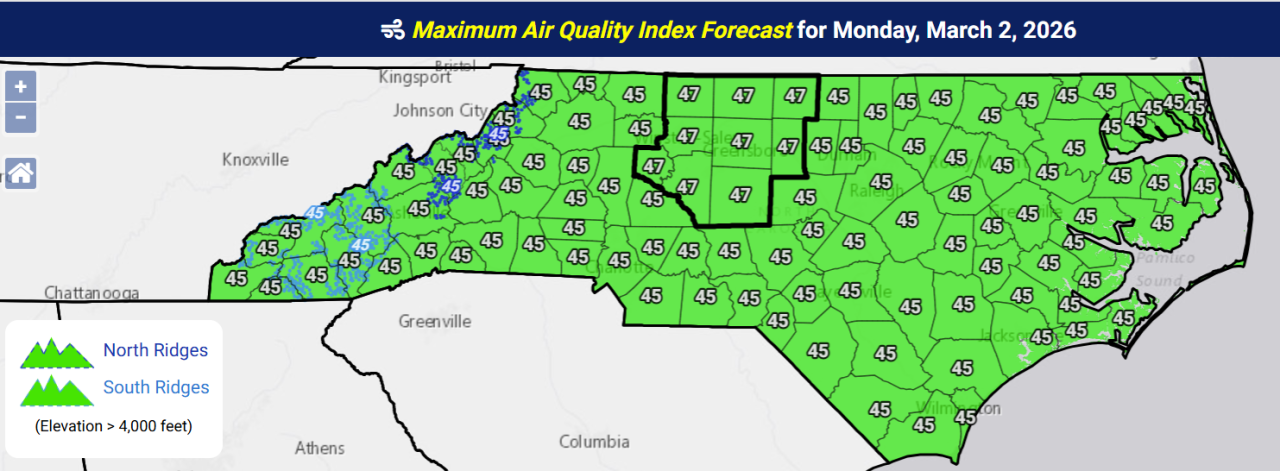
The division’s meteorologists use the air quality index to monitor and forecast ozone and fine particular matter. Daily forecasts are issued every three days out by 3 p.m. with a morning update by 10 a.m. the next day.
Supporter Spotlight

The state agency provides up-to-date, localized forecasting for 91 of North Carolina’s 100 counties and two mountain ridgetop zones.
The Forsyth County Office of Environmental Assistance and Protection forecasts air quality for the greater Triad region, including Winston-Salem and Greensboro.
In addition to the state’s air quality portal, forecasts are also available through the EPA’s AirNow website and app.
The division’s X feed and Facebook include forecast updates, information about active air quality alerts and opportunities to learn more about air quality.
Real-time and historical air quality and meteorological observations are available through the Ambient Information Reporter tool. Current- and long-term ozone trends for monitors through the United States are provided by the Ozone Design Value Predictor tool.
An educational video explaining the different air quality index color codes is available in English and Spanish.