HERTFORD — Even as the proposed Mid-Currituck bridge project has been uncharacteristically zipping along in the planning process, a new analysis of two revenue options has cast doubts on the project’s future, with serious concerns raised about the latest estimated construction costs that hover around $1.2 billion.
The North Carolina Department of Transportation presented a report Feb. 18 to the Albemarle Regional Planning Organization comparing a traditional toll project and a “P3” toll project, as required by federal law, to determine “value for money.” With a traditional toll project, the state is responsible for financial, operational and construction-related risks. A “P3” toll project is where a private sector/single developer has responsibility for revenue, financial, operational and construction-related risks.
Supporter Spotlight

“The base case financial results from the comparative analysis reveal that neither the Traditional Toll Delivery nor the P3 Toll Delivery are currently financially feasible,” the report said. “The analysis highlights funding gaps of $1,005 million for the Traditional Toll Delivery and $875 million for the P3 Toll Delivery, both of which exceed the $173 million of committed STIP (State Transportation Improvement Plan) funding.”
And it doesn’t appear that sunny prospects are around the corner. “Project costs have continued to increase above inflation and any schedule delays would likely increase costs further,” the report adds.
NCDOT has scheduled another presentation to the Albemarle Regional Planning Organization of the Mid-Currituck bridge comparative analysis for 11 a.m. Wednesday at the Albemarle Commission headquarters, 512 South Church St., Hertford.
A decision on the next step must be made by the organization’s board by its April meeting.
Although the transportation department and the North Carolina Turnpike Authority, the state agency responsible for tolling, are not advocating for any particular decision, the report said, it did cite several potential options.
Supporter Spotlight

One option is to adjust the STIP schedule and submitting it again to compete for funding, or removing the project from the schedule all together, which would free up the $173 million bridge allocation to be used for other Division 1 projects. Other options are to continue applying for federal grants, looking for other funding sources, consider local sales or occupancy taxes, and/or request an annual state appropriation.
Despite the challenging budgetary situation, the bridge agencies are still in the fight, with both NCDOT and the Turnpike Authority continuing to advance the project toward construction, Logen Hodges, the authority’s marketing and communications director, said in an email responding to questions from Coastal Review.
So far, he said, three permits have been issued for the project, including those issued by the N.C. Department of Environmental Quality’s divisions of Water Resources and Coastal Management on Sept. 19, 2025, and one issued by the U.S. Army Corps of Engineers on Oct. 28, 2025. While geotechnical investigations are being completed, another permit application to the Coast Guard is pending.
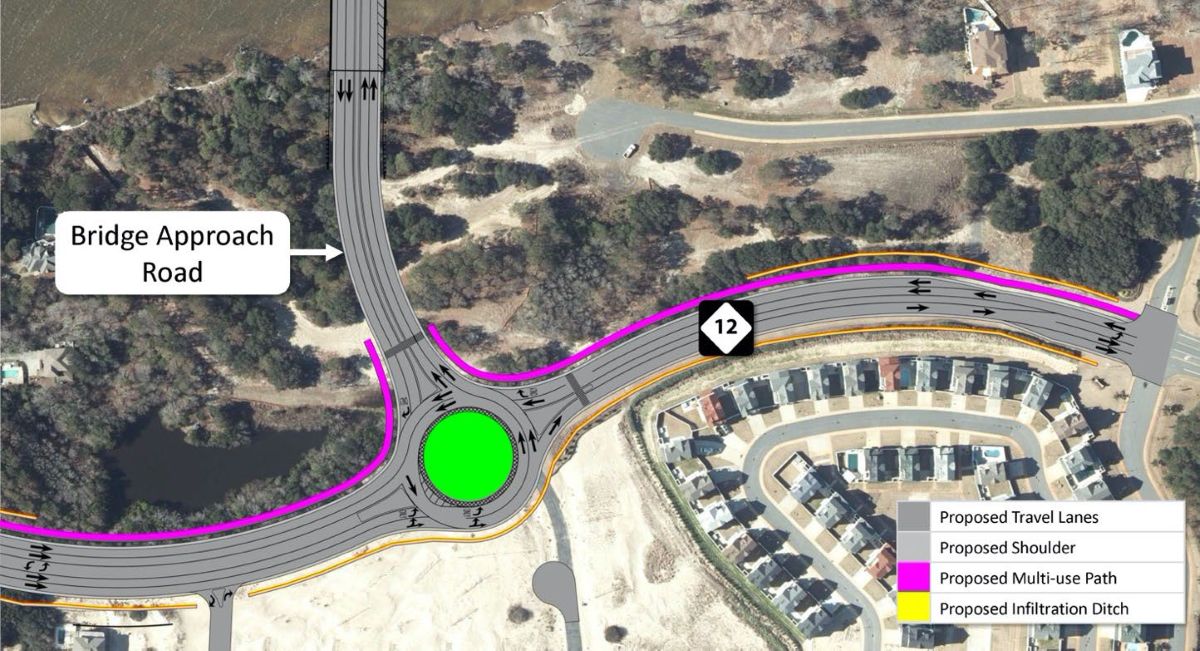
First identified as a need in 1975, the proposed bridge would connect the Currituck mainland at Aydlett to Corolla, on the Currituck Outer Banks. The 4.66-mile-long bridge would cross Currituck Sound and a 1.5-mile-long bridge would cross Maple Swamp on the mainland side about 25 miles south of the Virginia state line.
But the project, which has a timeline of five years for design and construction, has been rife with conflict, budget shortfalls, waning and waxing political support and repeated legal challenges. Dare and Currituck counties, and most of their respective towns and villages, have been pushing for the bridge for decades as a necessity to decrease traffic volume and improve hurricane evacuation.
At the same time, vocal opponents, many of them residents from both sides of the proposed bridge, have maintained that the bridge would be a costly boondoggle that would damage the environment and increase traffic.
Legal challenges were filed by the Southern Environmental Law Center, which challenged the permit issued by DEQ on different fronts.
“The timeline for resolution of this legal challenge is uncertain,” Hodges wrote. “Due to the pending legal challenge of an environmental permit and additional project funding needs, the project schedule will remain uncertain. To reflect this, the project construction let date has been extended by one year and may continue to be adjusted until a project schedule is determined.”
On behalf of No Mid-Currituck Bridge, a citizens’ group opposed to the bridge, and the Sierra Club, an environmental nonprofit group, the SELC submitted a Petition for a Contested Case Hearing to the state in November that challenged the DEQ’s Coastal Area Management Act, or CAMA, permit.
The petition argues, among others, that the bridge will bring adverse effects and disrupt communities on both sides.
“The permit for the construction of the Bridge Alternative would induce dramatic increases in traffic and development on both the mainland and Outer Banks, strain already overburdened coastal wastewater and drinking water infrastructure, permanently harm estuarine waters, wetlands, and other surface waters,” the document states.
In a separate action, the law center submitted a petition for judicial review to the state in December, also challenging the issuance of the permit by Coastal Resources Commission and DEQ.
To the community on the northern Outer Banks and the southern end of mainland Currituck County, as well as for visiting property owners and tourists, the summer traffic crossing the Wright Memorial Bridge back and forth from Currituck to Dare counties is an annual headache, with bumper-to-bumper traffic clogging roads to and from Corolla every weekend and holiday.
According to a September 2025 traffic and revenue report, more than 1 million vehicles crossed the Wright Memorial Bridge in July 2023, the highest count to date.
“The proposed (Currituck bridge) is expected to provide significant distance and time savings to residents and visitors, particularly to those that travel to the most northern portion of Dare County and the Currituck County portion of the Outer Banks,” the report said. “The (bridge) will reduce peak season congestion for trips to the south, facilitate planned growth north of the (Wright bridge), and improve emergency evacuation for those residing on all parts of the Outer Banks.”
Tolls would be charged starting in 2032, according to the report. Minimum tolls in 2023 dollars for cars would be $6 each direction, with discounts for tolls paid by transponders and future increases reflecting the inflation rate. Trucks and other heavy vehicles will pay proportionally higher tolls.
The report also states that the optimal toll rate of $15 would generate 90% of the maximum forecasted toll revenue. In the numerous models, calculated rates were as high as $40.
But Hodges cautioned that the models are not just that.
“While estimated toll rates were used for the purpose of the analysis, all toll rates are set by the North Carolina Turnpike Authority Board of Directors,” he wrote in the email. “Formal toll rates for the Mid-Currituck Bridge would not be established until closer to the facility’s opening.”
The $173 million in committed division funds represents about 20% of the total STIP funding for Division 1, Hodges said. Depending on the outcome of the project schedule, the DEQ permits would not expire on their own, he said. The Corps’ permit, however, is set to expire iis set to expire on Dec. 31,2030, unless an extension is granted.
But if the Albemarle Regional Planning Organization decides to move the project to the last five years of the STIP, he said, it could potentially be eligible for funding at statewide, regional impact funding and division needs tiers.
“Ultimately whether the project is funded and programmed for construction would be dependent on available funding at each tier and how the project scores relative to other projects submitted for prioritization,” he wrote.
Whatever its fate, it’s taken a lot of resources for the Mid-Currituck Bridge proposal to finally reach the runway, only to be stalled indefinitely — or eliminated.
“Since the early 1990s when the project was first conceived,” Hodges wrote, “approximately $60 million has been spent on early project work, including preliminary engineering, environmental analysis and initial right-of-way acquisition.”