Editor’s note: Coastal Review regularly features the work of North Carolina historian David Cecelski, who writes about the history, culture and politics of the North Carolina coast. More of his work can be found on his website.
A few weeks ago, I gave a lecture at Duke Law School on the history of the white supremacy movement of 1898-1900 and how it shaped our political system, our society, and our legal system here in North Carolina.
Supporter Spotlight

I always have to brace myself a bit to give that lecture: It is grim tale, one of the darkest chapters in my home state’s history, and I do not think that anyone could find a silver lining to the story.
Nonetheless, I rarely decline an invitation to give that particular lecture: the subject is just too important.
By almost any measure, the white supremacy movement of 1898 to 1900 is the most important event in North Carolina’s history over the last 150 years.
No event did more to shape our 20th century. None has done more to shape the world in which we live today.
None tells us more about why so many people today feel so helpless to mend the brokenness in our society.
Supporter Spotlight

None has more to teach us about how and why we, as a people, have come to feel so torn asunder and divided from one another.
None that I can think of speaks more directly to why so many working people today, of all races, find themselves shunted aside.
And yet, despite its central role in the state’s history, the white supremacy movement of 1898 to 1900 remains largely unknown to the vast majority of North Carolina’s citizens.
To my knowledge, no book, documentary, or museum exhibit has ever focused on the white supremacy movement of 1898-1900 as a whole.
Neither does any historical marker tell its story. Nor does any monument or memorial stand as a warning to us today.
With few exceptions, our schoolchildren are not taught about it.
In much the same way as I was at their age, our students are kept in the dark about one of the chapters in North Carolina’s history that they most need to understand if they are going to have a chance to make a better world than they have inherited.
-2-
In the last few years, I have given one version or another of my lecture on the history of the white supremacy movement of 1898 to 1900 at colleges and universities, high schools, community centers, book clubs, and Sunday school classes.
I am always surprised how people respond to it. If you grew up in North Carolina as I did, you were not taught anything at all about the white supremacy movement of 1898 to 1900.
At most, we were taught a thing or two, probably incorrect, about what we now call the Wilmington Massacre of Nov. 11, 1898.
The Wilmington Massacre was the worst atrocity committed by the white supremacists. However, the murder of so many of Wilmington’s black citizens and the takeover of the city’s government was only a small and in some ways far from central chapter in the state’s white supremacist movement.
The white supremacy movement of 1898 to 1900 did not arise in Wilmington.
None of its most important instigators came from Wilmington. Few of the wealthy bankers, industrialists, and attorneys who were its leaders and principal financiers came from Wilmington.
The white supremacy movement of 1898 to 1900 also drew only a small percentage of its supporters from Wilmington.
As a case in point, the white supremacists organized more than 900 “white supremacy clubs” in North Carolina in the spring and summer of 1900.
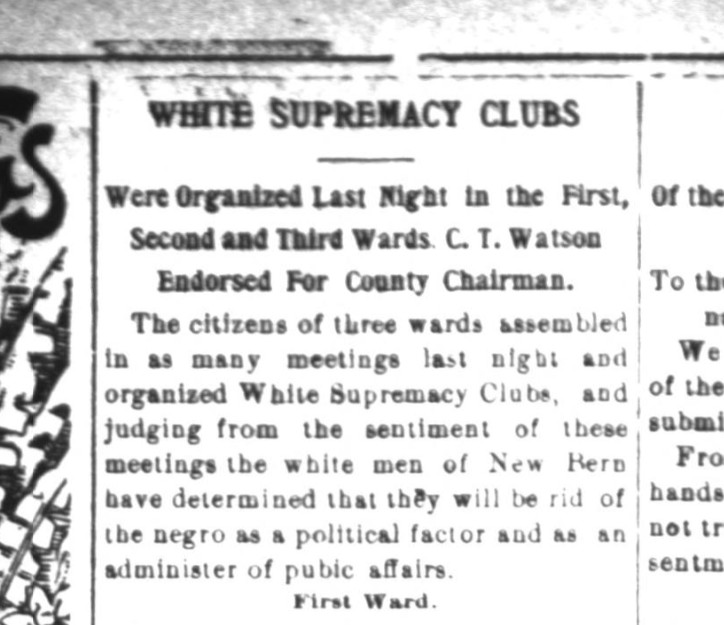
This is the mission statement of the white supremacy clubs as written by one of the movement’s leaders, an attorney and future United States senator named Furnifold Simmons, in the winter of 1900:
“The purpose of the organization shall be to fully restore and make permanent in North Carolina the SUPREMACY of the WHITE RACE and to develop in the state’s citizens a belief in the necessity of establishing and maintaining WHITE SUPREMACY, as the only hope for the preservation of our civilization.”
Not more than one percent of those “white supremacy clubs” were organized in Wilmington.
In that same summer of 1900, at least two dozen white militia groups called Red Shirts operated in North Carolina. They were the militant wing of the white supremacy movement, and they terrorized both Black voters and white citizens who stood with Black voters.
At most, only one of the Red Shirt militias was based in Wilmington.
Similarly, In 1900, the white supremacy movement’s leadership organized a speakers bureau that included more than 100 individuals.
If an individual volunteered to be part of the speakers bureau, he – they were all men – would accept assignments to speak at white supremacy rallies and at meetings of local white supremacy clubs.
Those speakers included past and future governors, several former and future U.S. senators and congressmen, and a large contingent of former and future district, superior, and state supreme court judges.
None of the white supremacy movement’s most popular orators were from Wilmington.
All of which is to say: We cannot say too much about the Wilmington Massacre. Its story was silenced for too long.
But at the same time, we have to keep our eyes on the prize, which to me, in this case, means focusing on the white supremacy movement of 1898-1900 overall and how it shaped our state then and now.
We have to remember something that we were not taught, but know now: in 1898-1900, white supremacists took over the state of North Carolina.
They took control of its legislature, its governorship and all its state agencies. They took over its judiciary, its towns and cities, and every one of the state’s public colleges and schools.
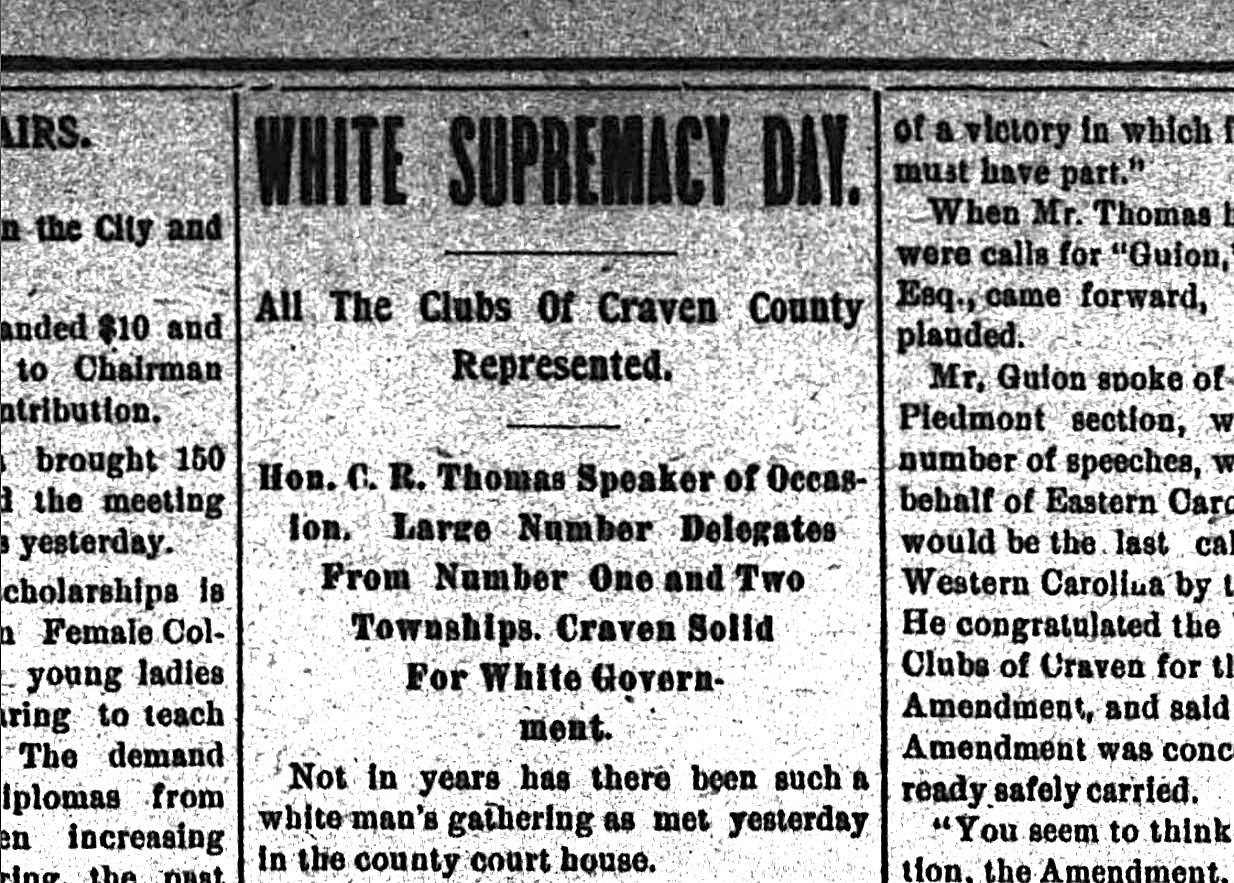
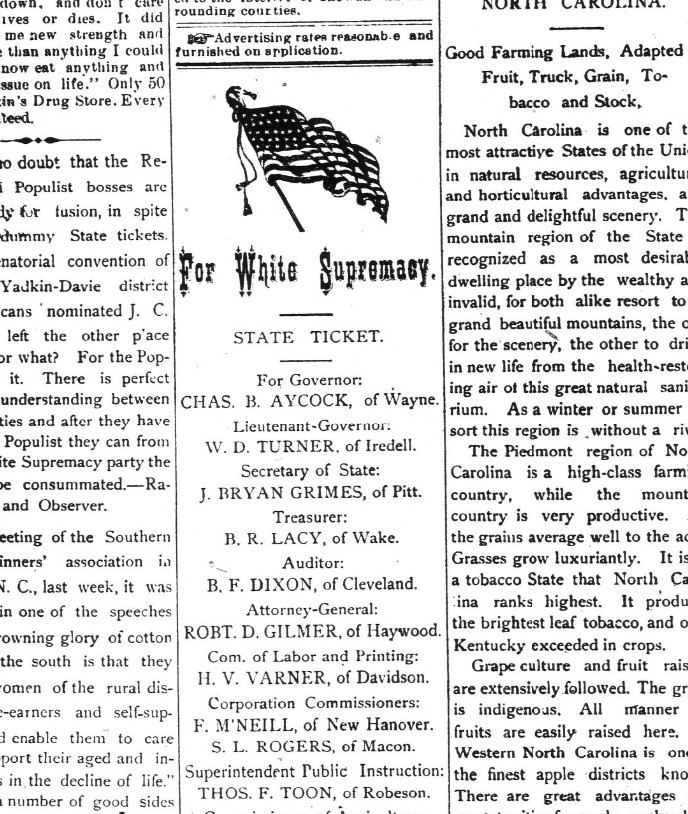
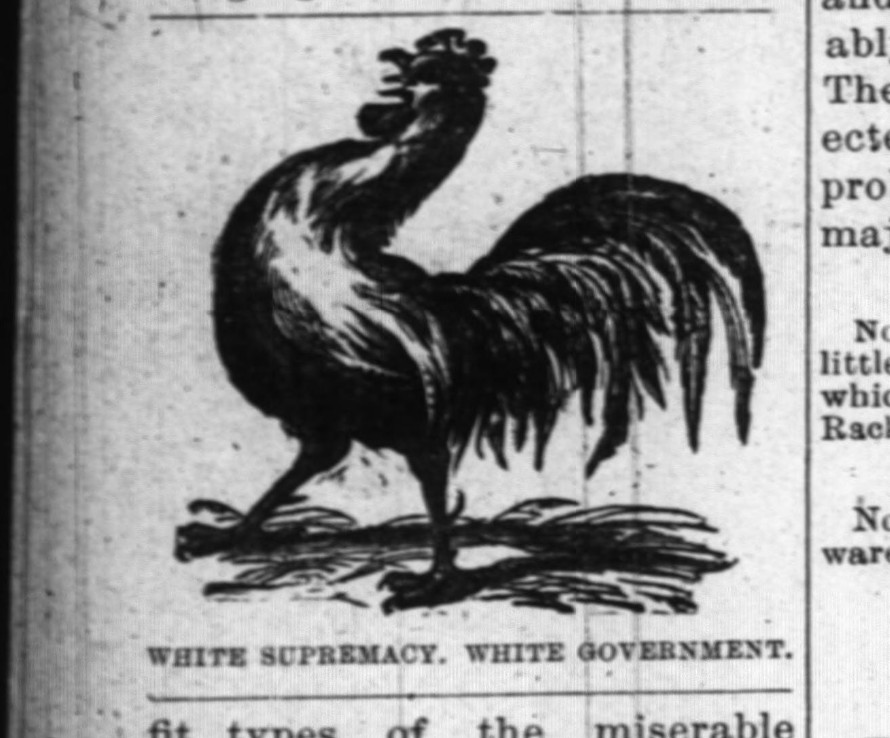
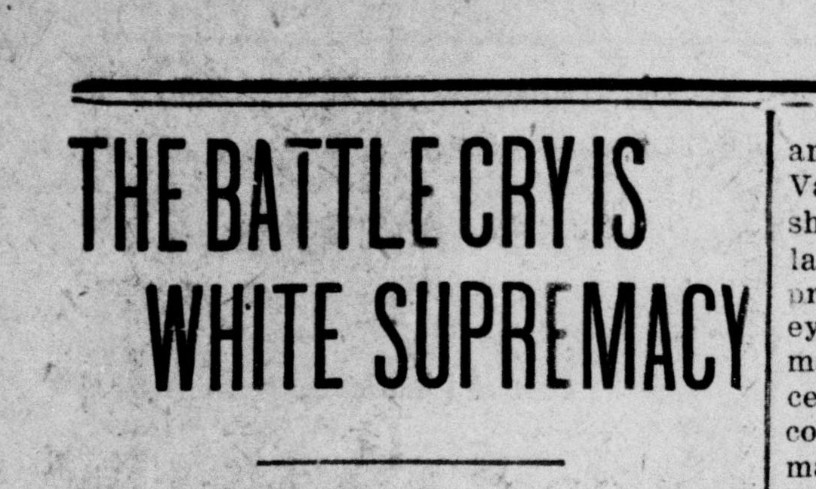
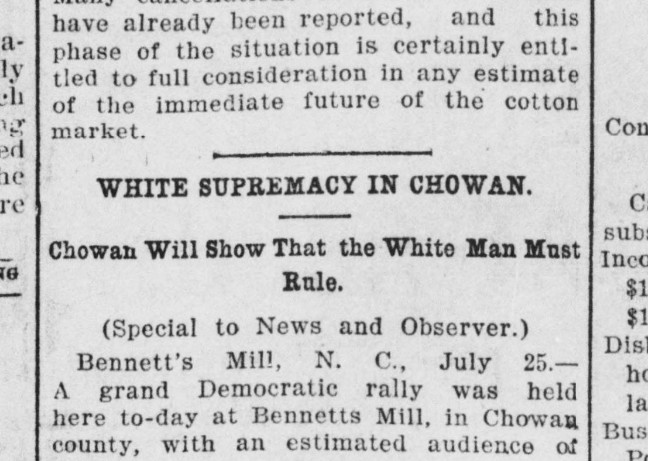
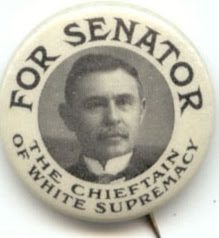
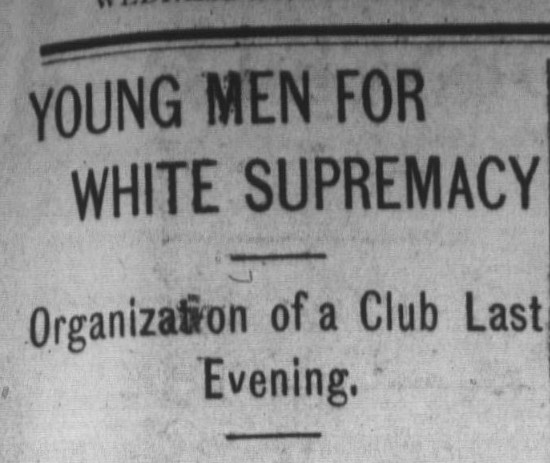
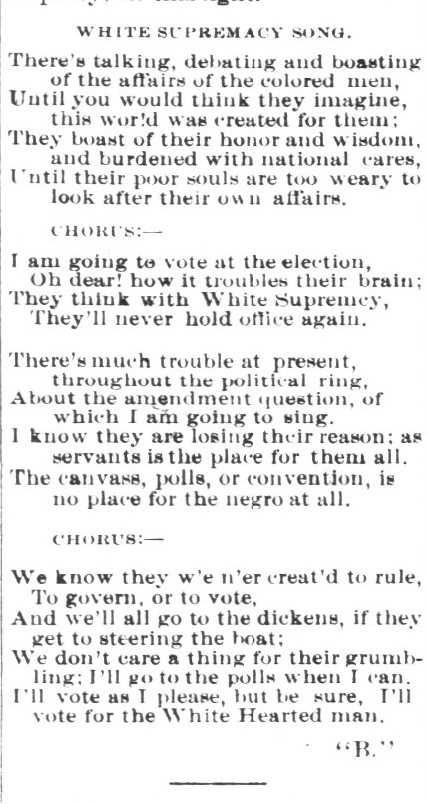
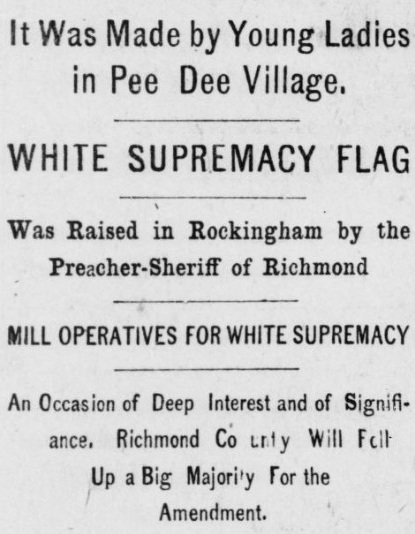
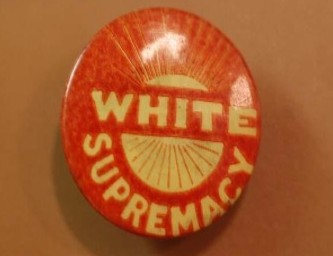
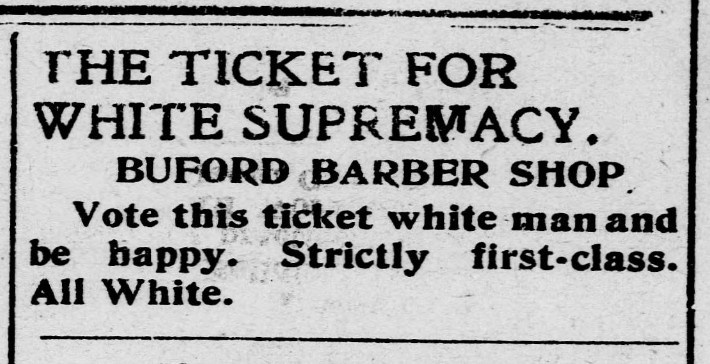
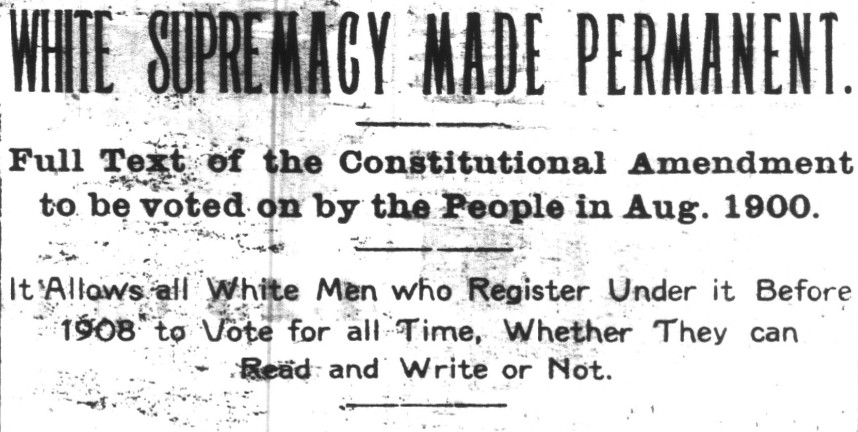
As you can tell from the illustrations that I am featuring here, these were not people to whom I am retroactively applying the term “white supremacy.” These were people who referred to themselves as white supremacists.
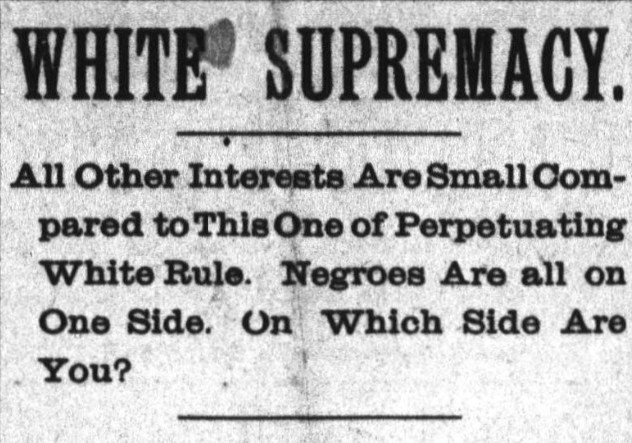
Who ran on the “White Supremacy Ticket.” Who joined “white supremacy clubs.” Who sang the “White Supremacy Song.”
Who celebrated “White Supremacy Day.”
Who carried white supremacy flags, wore white supremacy political buttons, and marched with banners proclaiming “White Supremacy.”
Whose leaders said things like:
“The Anglo Saxon planted civilization on this continent and wherever this race has been in conflict with another race, it has asserted its supremacy and either conquered or exterminated the foe. This great race has carried the Bible in one hand and the sword [in the other]. Resist our march of progress and civilization and we will wipe you off the face of the earth.”
William A. Guthrie, Oct. 28, 1898
Once in control of the state, the white supremacists methodically set about embedding the primacy of white supremacy and a deep distrust of fair elections and the democratic process in our municipal, county, and state government institutions and policies, as well as in our state’s economic and civic life.
As I discussed with the Duke law students, that is one of the reasons that attorneys played such a central role in the white supremacy movement in 1900. After taking power in 1898, the movement transitioned from taking power to institutionalizing white supremacy in North Carolina’s laws and civic life.
Writing the laws of white rule, revising the electoral process, and centralizing control in Raleigh, rather than at the local level, was the work of attorneys.
The white supremacists were extremely successful.
They were so successful, and the breadth of their success was so great that, in the following decades, dissent was almost unheard of. In the decades after 1900, I have yet to find historical evidence of a single one of our state’s political, business, or religious leaders, on any end of the political spectrum, who raised their voice against white supremacy.
In fact, the leaders of the white supremacy movement of 1898 to 1900 became our heroes. North Carolina’s leaders built statues to them. They named college buildings after them. They dedicated historic sites in honor of them.
Over time, and the passing of the generations, their way of thinking about the world, and the divisions they erected between us and our neighbors, began to be taken for granted. We could not remember a different kind of life. We lost sight of the possibility that a person’s race one day might not matter or that there might be a better way to treat one another.
We could not imagine that there could be a different kind of world than that into which we were born.
We forgot that we do not have to be so scared of one another. That we do not have to be so fractured.
We did not even dream anymore that we could be the kind of people that look out for one another and are there for our neighbors, no matter who they are or where they were born or who or how they love.
We could not imagine that we are all in this hard, hard life together, and that we might have been put here to help one another get through it.
-3-
The students at the law school were wonderful. They were engaged, curious, serious, and kind-hearted.
One even seemed to be worried about me. She wondered if I found it hard to study and talk about such dark moments in our history.
I do not. I am far too old for that. But I appreciated her thoughtfulness, and I found it very endearing.
Inevitably, the students were astonished and perhaps somewhat shaken by the similarities between the white supremacy movement of 1898-1900 and what is happening in America today.
I have come to see that as only natural. When I give this lecture, I do not draw explicit comparisons between the past and the present. However, the similarities are so striking that, on learning about 1898 to 1900, people of all ages inevitably see parallels between that time and ours.
Sometimes, like when I gave a version of this lecture at a Raleigh high school a few weeks ago, I can literally feel the sudden change of mood in the room as it dawns on the students that this is not just a history lesson but is about their lives and the struggles that they have ahead to make this a better world.
At those times, I can feel a kind of breathlessness in the room. Everything gets more serious.
Sometimes students who had not done so take out their notebooks and start taking notes for the first time in the lecture.
Then we can really get down to work. Then we begin to put our heads together and go beyond what I know.
That is when it gets really interesting and exciting for me.
The young people often see things that I do not, and they often make connections that I had not previously made.
Many times, they find far more lessons in the past that bear on our lives and our struggles to make a better world today than I had ever imagined.
At those moments, I am filled with hope. Their intellectual seriousness, their moral courage, and their refusal to accept an America that seems to have given up on being good or noble lifts me up.
And even if none of us by ourselves has all the answers — I certainly do not — I find every gathering where people come together to consider how we got here, and how we might contribute to making a better future for our children and grandchildren, tremendously uplifting.
I find that to be true whether I am in a crowded college auditorium, a high school classroom, or a table for six at a senior center.
It is always worth doing.
As James Baldwin famously said, “Not everything that is faced can be changed, but nothing can be changed until it is faced.”