This report has been updated for clarification.
Dominion Energy’s 2.6-gigawatt offshore wind project based in Hampton Roads, Virginia, which was ordered by the Trump administration to stop work right before Christmas, has resumed the project and is now on track for completion by early 2027.
Supporter Spotlight

But the 26-day shutdown of Coastal Virginia Offshore Wind, also known as CVOW, came at considerable cost to the company, its customers and the nation’s energy needs.
According to its Jan. 30 project update, Dominion tallied the current total project cost at $11.5 billion, reflecting $228 million for increases associated with the suspension, as well as $580 million related to actual/estimated tariffs. Dominion’s update in May 2025 had the project cost at $10.8 billion.
“It’s a terrible time to be restricting any source of new energy and especially sources of new clean energy that can be constructed in places that otherwise have limited ability to add new generation, whether that might be a new gas plant or a new coal plant,” Katharine Kollins, president of the Southeastern Wind Coalition, told Coastal Review.
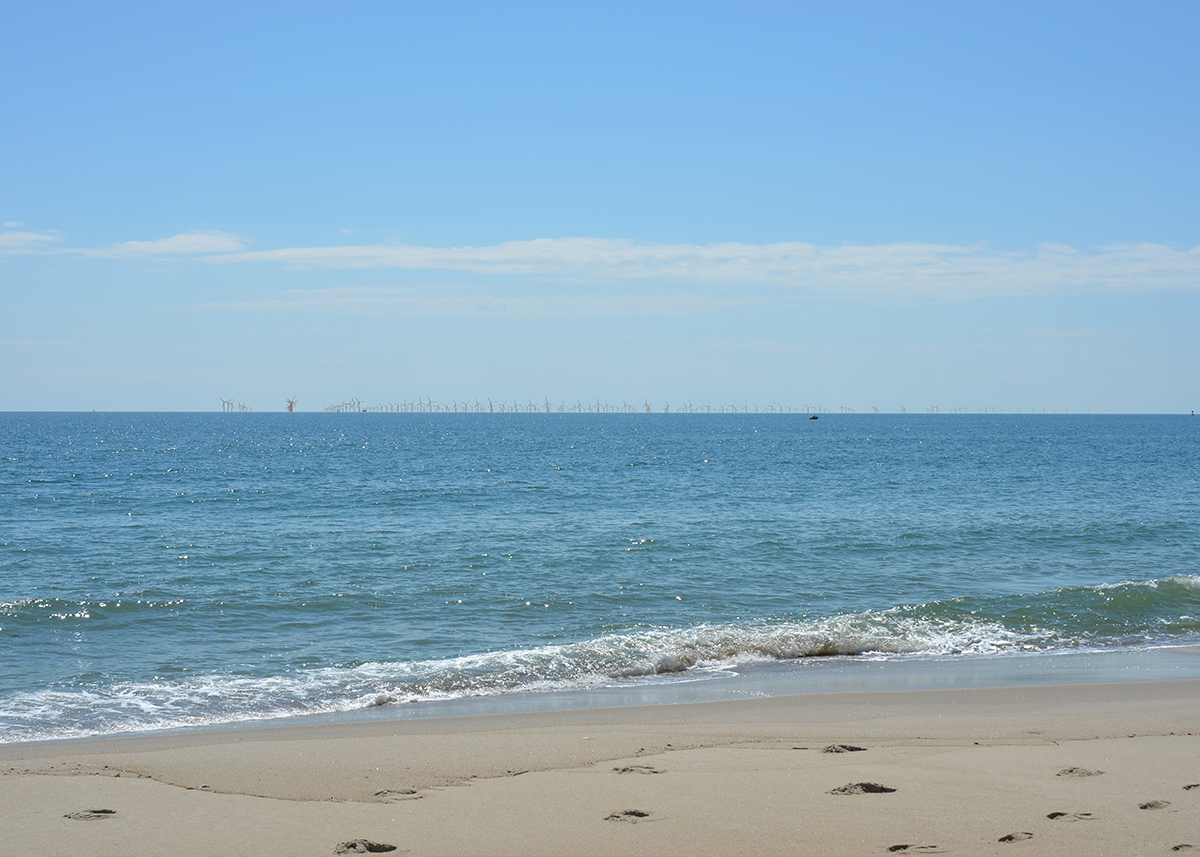
When fully operational, CVOW’s 176 wind turbines will generate enough energy to power up to 660,000 homes, making it the largest offshore wind farm in the U.S and one of the largest wind energy production facilities in the world. Dominion, which provides electricity to 3.6 million homes and businesses in Virginia, North Carolina and South Carolina and natural gas service to 500,000 customers in South Carolina, said the wind project is critical to its “diverse energy supply strategy” to meet growing regional demand.
“I think from the wind industry’s perspective, this is an industry that has been operating for over 20 years and has shown that there’s an ability to put a significant amount of new clean energy on the grid every year — when the free market is at play and when they are able to construct in areas where it makes sense to have wind,” Kollins said.
Supporter Spotlight

Citing risks to national security, the U.S. Department of Interior issued the suspension order on Dec. 22 to CVOW and four other offshore wind projects in varied stages of development on the East Coast. The following day, Dominion sued the federal government.
In the action, filed in the U.S. District Court for the Eastern District of Virginia, Dominion argued, in part, that it had worked extensively with military interests while developing the project to ensure that any concerns about radar, training or operational readiness were addressed. Not only did the agency director lack the “generalized authority” under the lease regulations to order the suspension “at whim,” the lawsuit said, the government did not cite an “applicable trigger” to halt construction.
“Our nation is governed by laws, and a stable legal and regulatory environment is essential to allow regulated public utilities like (Dominion) as well as other businesses, contractors, suppliers, and workers, to invest and support our nation’s energy needs and associated jobs,” according to the lawsuit.
“Sudden and baseless withdrawal of regulatory approvals by government officials cannot be reconciled with the predictability needed to support the exceptionally large capital investments required for large-scale energy development projects like CVOW critical to domestic energy security, continues the legal document. “That is true regardless of the source of energy.”
Based on a 2022 agreement with regulators on cost-sharing, for project costs beyond $10.3 billion up to $11.3 billion, the company and the customers each pay 50%, and from $11.3 billion to $13.7 billion, the company pays 100%, according to Dominion’s Jan. 30 project update.
Customers in Virginia, but not North Carolina, currently pay about $11 a month to cover CVOW costs, said Jeremy Slayton with Dominion media relations in a Feb. 10 email response to Coastal Review. Cost recovery, which influences rates, is updated annually, he added, and the October 2025 filing is still before the Virginia State Corporation Commission.
On Jan. 16, the court granted Dominion’s request for a preliminary injunction that allowed construction at CVOW to resume while the lawsuit is resolved. Courts have now allowed all five stalled offshore projects to operate for the time being.
“While our legal challenge proceeds, we will continue seeking a durable resolution of this matter through cooperation with the federal government”, Dominion Energy said in a press release.
The company didn’t waste time getting back to work. According to information provided by Slayton, project construction was by late January about 70% complete, with the facility expected to deliver its first power to the grid by the end of the first quarter of this year.
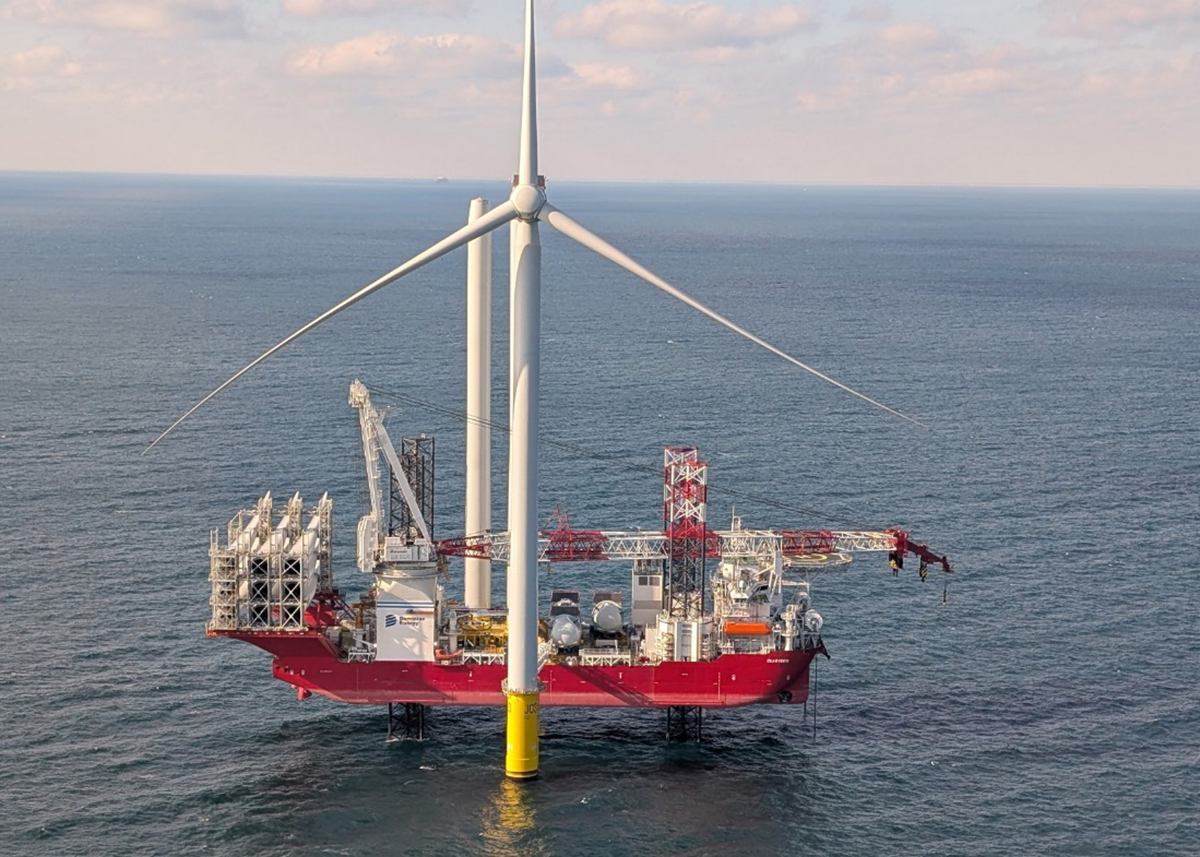
“Our U.S-flagged wind turbine installation vessel Charybdis completed the first turbine installation today,” Slayton wrote in the Jan 27 email.
So far, he added, all 176 monopole foundations have been installed, and 119 of the 176 transition pieces — the yellow parts that connect the foundations to the turbine towers — are in place.
Also, two of the three offshore substations have been installed, the deepwater offshore export cables installation has been completed and the nearshore export cables installation is about 60% completed. And about 67 miles of an estimated 231 miles of inter-array cables, which carry energy created by the wind turbines to the offshore substations, has been installed.
Onshore electric transmission construction is expected to be completed in early 2026. Before the abrupt stop-work order, CVOW, which started construction in 2024, had expected to flip the power switch on by that date, and be fully operational by the end of 2026.
In addition to the obvious benefit of clean, plentiful energy, the project has brought millions in economic value to the region, including many jobs and dollars while under construction.
“Offshore wind, in particular, provides the United States with a generational opportunity to supply large amounts of affordable, reliable power while spurring investment and creating U.S. jobs,” Dominion argued in its filing.
According to Dominion, the completed project will create 1,100 direct and indirect jobs annually in Hampton Roads, equaling about $82 million in pay and benefits, $210 million in economic output, $6 million in revenues for local governments and $5 million in state tax revenue.
Since Donald Trump’s reelection, the president has focused on dismantling renewable energy-related projects — solar, wind, battery storage, even grid modernization — in the U.S, and replacing it with fossil fuel and nuclear power. But he has reserved his strongest animus for offshore wind, apparently based on his objection to 11 wind turbines in the water off his Aberdeenshire, Scotland golf course.
Shortly after he purchased an estate there in 2006, according to a July 29, 2025, article published online by the BBC, Trump “soon became infuriated at plans to construct an offshore wind farm nearby, arguing that the ‘windmills’ — as he prefers to call the structures — would ruin the view.”
He also insisted that the turbine blades killed “all” the birds, but surveys at the site have to date not found a single bird strike. In addition to calling wind energy “a scam,” as quoted in the article, the president regards wind power as “very expensive, very ugly energy”.
Despite Trump fighting the plans through the Scottish courts and ultimately the UK’s Supreme Court, construction of the “monsters” went ahead in 2018.
“It clearly left him smarting and he’s not had a good word to say about wind power since,” the article said.
According to an Audubon study, most bird deaths are caused by striking buildings, especially tall ones with large windows, and cats eating them. On land, building collisions alone are estimated to kill over a billion birds each year in the U.S., the report said.
“On the open ocean, birds can be killed or injured when they collide with ships or offshore oil platforms,” the report stated. “Similarly, offshore wind infrastructure — including turbine blades, towers, electrical platforms, and construction equipment on boats — all pose potential threats.”
The report goes into much detail, but best practices were summed up as “Avoid, Minimize, Offset and Monitor.”
Dominion states on its website that it uses the latest technologies to protect birds and other wildlife, such as time-of-year restrictions, installation of anti-perching devices and acoustic monitoring.
Typically, offshore wind production is generated by three-bladed rotors attached to a ocean-worthy structure that houses a generator insider turbines attached to elevated platforms. Cables from the generator deliver the energy to the bottom of the tower to the underwater transmission cables to onshore power stations.
But technology has evolved considerably since the first offshore turbine was built in Denmark in 1991.
“As turbine technology continues its rapid evolution — with units now reaching 26 (megawatts) — and floating wind advances toward commercial scale, the industry finds itself at a critical juncture that will shape its trajectory for years to come,” Power magazine reported in a Feb. 9, 2026, article published online.
Global offshore wind capacity reached 83 gigawatts at the end of 2024, the article said, and it appears that the 2025 report will show it was another banner year for the industry, with new construction “positioning the sector for accelerated growth through the decade.”
Significant projects have been constructed or are planned in European and Asia-Pacific regions, the magazine said. Meanwhile, the U.S. offshore wind industry is sputtering, resulting in a severe impact to the market. The International Energy Agency, according to the article, forecasts a 60% downward revision from 2025-2030 for U.S. wind energy, equaling 57 GW of both onshore and offshore capacity “that is now unlikely to be built.”
It appears the U.S, for now, may be left in the dust.
“Offshore wind technology continues its relentless march toward larger, more powerful machines,” according to the article. “The average capacity of turbines installed offshore in 2024 reached 10 MW, according to (the Global Wind Energy Council), a figure that would have seemed implausible a decade ago. Yet, the frontier has already moved well beyond that threshold.”
Still, in the long run, the realities of market forces and the limitations of dirty or destructive energy resources can make an unlimited, clean energy such as wind an unavoidable choice. Offshore projects may be a younger industry in the U.S., but it is considered a powerful renewable resource to tap. While land-based wind projects are less costly, wind speeds are generally higher and more constant offshore, allowing turbines to generate more electricity for longer periods.
In the U.S., solar and wind have often been the most affordable energy resource, but they are also compatible grid partners, Kollins said, with wind at its peak when the sun is not.
“Generally, wind turbines have higher generation factors in the winter and in evenings, and those are two times when solar has less output,” she said, “So if you have a lot of solar on the grid, you can add a lot of wind before you really need storage.”
Once all five of the offshore projects are operating at full capacity, she said, that’s when people will see the benefits of having more electricity produced, when they need it — such as the recent weekend deep freezes along the East Coast.
“These things are going to be generating their full output all weekend when everybody’s got their heat turned on and is using max electricity load,” Kollins said, adding: “Offshore wind is highly correlated with winter storms.”
There is an increasing demand overall for electricity, Kollins noted. And construction of gas turbines and nuclear power is many years down the road.
“These electrons are needed so badly,” she said. “We are in a period of rapid economic growth, and in order to continue fueling that growth, we need every resource available.
“And offshore wind provides one of the only ways to build a significant amount of new energy generation in the near term.”