First of two parts
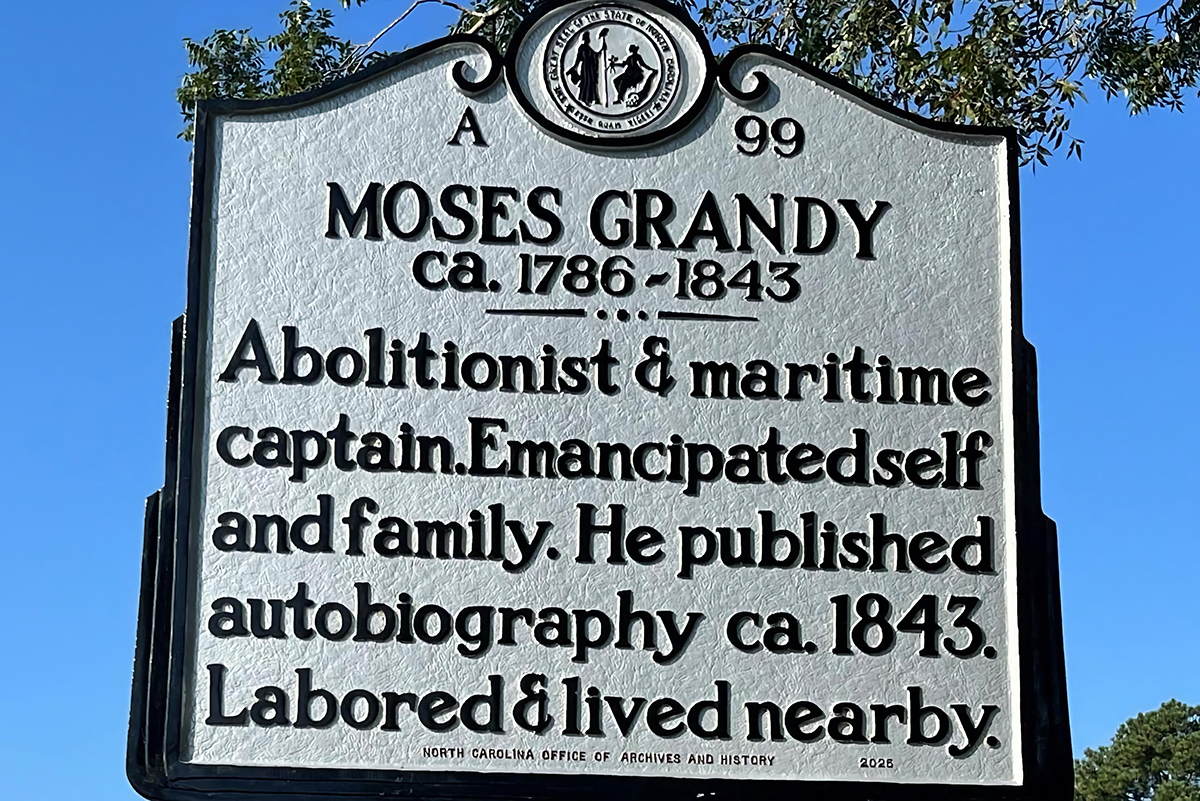
A highway sign installed last September in Camden County calls attention to Moses Grandy, born there an enslaved person, and the story of his life told in “Narrative of the Life of Moses Grandy; Late a Slave in the United States of America.”
Supporter Spotlight
The book was published in London, England, in 1843. When the book was printed, he was, Grandy guessed, 56 years old, although as he notes in his book, “Slaves seldom know exactly how old they are: neither they nor their masters set down the time of a birth; the slaves, because they are not allowed to write or read; and the masters, because they only care to know what slaves belong to them.”

The book was published the following year in the United States.
There are no kindly “Old Black Joes,” elderly enslaved people treasured for their wisdom by caring masters in Moses Grandy’s autobiography. Rather, early in the book, there is a description of his mother, “blind and very old … living in a little hut, in the woods, after the usual manner of old worn-out slaves.”
Grandy observed late in his narrative that, “As far as the owner is concerned, they live or die as it happens; it is just the same thing as turning out an old horse.”
The book is filled with Simon Legree-like characters, capricious in their cruelty, and chilling descriptions of the horrors of the American institution of slavery. Legree is a harsh slaveowner in Harriet Beacher Stowe’s fictional, antislavery novel, “Uncle Tom’s Cabin.”
Supporter Spotlight

Yet the book is more than that. Grandy’s eye for detail and his memory are remarkable. What emerges from the pages is an exceptional and complex description of the institution of slavery.
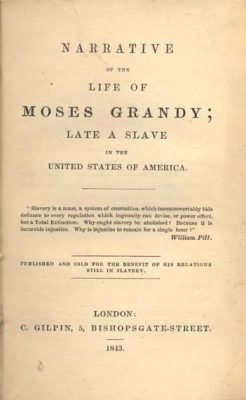
It is Grandy’s penchant for remembering names that may provide the most damning indictment of slavery.
The title page of the book carries the warning, “It is not improbable that some of the proper names in the following pages are incorrectly spelled. M. G., owing to the laws of the slave states, being perfectly illiterate, his pronunciation is the only guide.” Yet, if some names are muddled in pronunciation and untraceable, there is still plenty to go on.
He describes his first master, Billy Grandy, as “a hard-drinking man” who “sold away many slaves.”
The Camden County 1790 census lists 18 slaves in the William Grandy household, but its apparent there had been more.
“I remember four sisters and four brothers; my mother had more children, but they were dead or sold away before I can remember. I was the youngest,” Moses Grandy recalled.
His master died when he was probably 9 and the Grandy will bequeathed Moses to James Grandy, the son of William Grandy. James and Moses were the same age and there was a stipulation in the will that Moses would be hired out until “my master and myself were twenty-one years old.”
When he was old enough “to be taken away from my mother and put to field-work, I was hired out for the year, by auction, at the Court House, every January; this is the common practice with respect to slaves belonging to persons who are under age.”
The first person to buy his services, a Mr. Kemp, “used me pretty well; he gave me plenty to eat and sufficient clothing,” he then went to Jemmy Coates, “a severe man”
“Because I could not learn his way of hilling corn, he flogged me naked with a severe whip made of a very tough sapling…The point of it at last entered my belly and broke off; leaving an inch and a-half outside…On looking down I saw it sticking, out of my body: I pulled it out and the blood spouted after it. The wound festered, and discharged very much at the time, and hurt me for years after,” he said.
“I was next with Mr. Enoch Sawyer of Camden county,” Grandy recalled.
A prominent North Carolina politician immediately after the Revolution, Sawyer was deeply involved in developing the Great Dismal Swamp Canal. If the gravestone the Elizabeth City Economist found in November, 1897 is to be believed, Sawyer was a good man.
“Sacred to the memory of Enoch Sawyer, who was born on the 10th of March, 1758. and departed this life on the 16th of March, 1827, age 68 and six days. He was universally beloved and respected, and a faithful servant of the Lord Jesus. Precious in the sight of the Lord is the death of his Saints,” the Economist reported.
If Sawyer was a good man to his neighbors and peers, to Grandy, “It was cruel living.”
“We had not near enough of either victuals or clothes … I have often ground the husks of Indian corn over again in a hand-mill, for the chance of getting something to eat out of it,” Grandy reported. “In severe frosts, I was compelled to go into the fields and woods to work, with my naked feet cracked and bleeding from extreme cold.”
If the living was cruel in working for Sawyer, Grandy learned a skill that gave him a degree of freedom very few enslaved people enjoyed.
“The young Moses Grandy tended the ferry across the Narrows on the Pasquotank River,” historian David Cecelski wrote in his 1994 article “Moses Grandy: A Slave Waterman’s Life,” written for the Institute for Southern Studies.
The Black watermen were, Cecelski wrote, “an elite fraternity … both irreplaceable to the plantation economy, and subversive of the racial bondage that fueled it.”
That skill served Grandy well, raising his importance as a commodity, and the value that was placed on his skill as a waterman underscores how complex the institution of American slavery was.
After three years working for Sawyer his services were acquired by “Mr. George Furley (probably George Ferebee, early postmaster of South Mills) … he employed me as a car-boy in the Dismal swamp; I had to drive lumber, &. I had plenty to eat and plenty of clothes. I was so overjoyed… that I then thought I would not have left the place to go to heaven.”
Although no longer working under Sawyer, the “cruel living” touched him once again.
“I married a slave belonging to Mr. Enoch Sawyer,” he said. After eight months of marriage, he was returning home on a Friday, when he “heard a noise behind me, on the road which ran by the side of the canal … When they came up to me, one of them cried out, ‘Moses, my dear!’… It was my wife. She cried out to me, ‘I am gone.’
His wife had been sold.
He was able to walk with her for a short distance “and bid her farewell. I have never seen or heard of her from that day to this. I loved her as I loved my life.”
Next in the series: To purchase his freedom