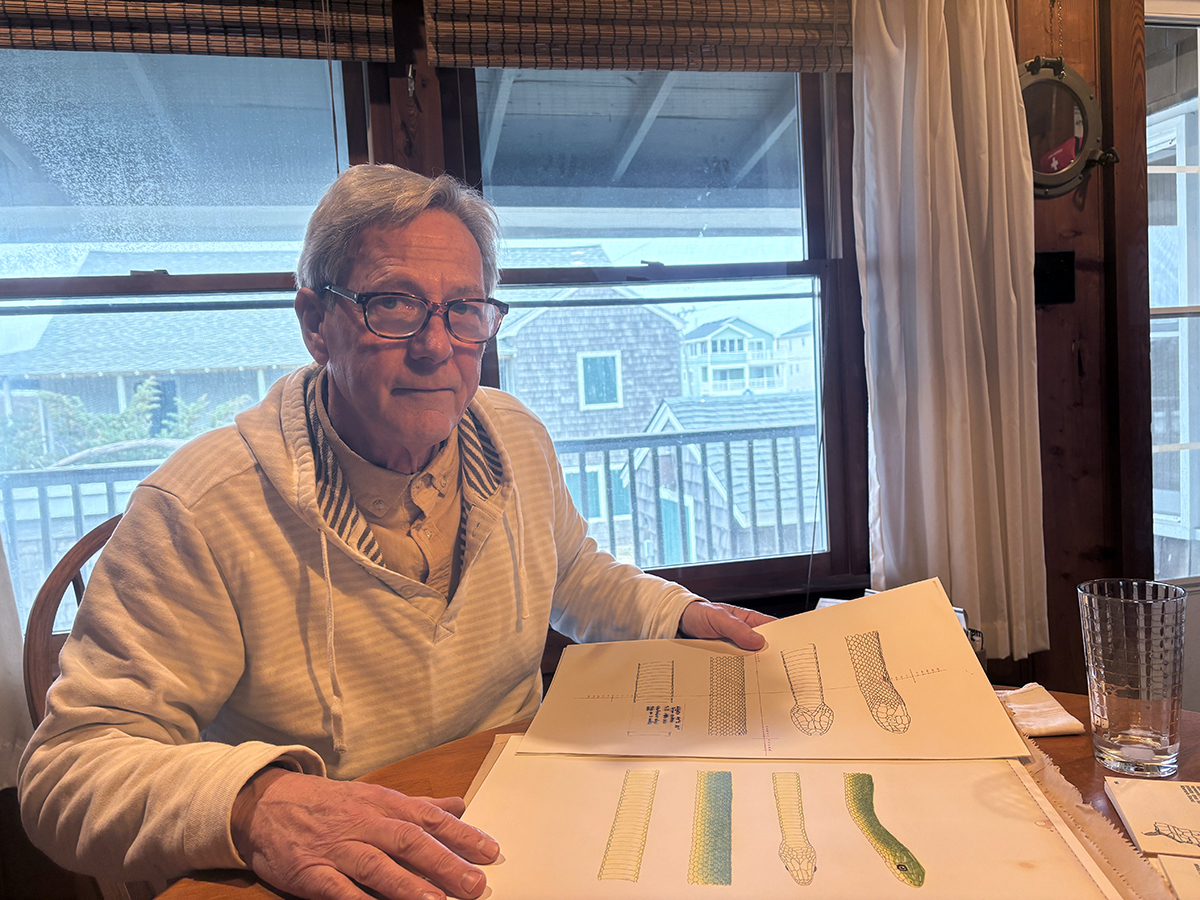
At first glance, the four, multi-colored snakes might be crawling across the cover of the long out-of-print paperback.
The chilling dead-eyes, the intricately patterned scales, the pointed heads and slender bodies are practically lifelike illustrations drawn by Donald R. Brothers, the same man who wrote “An Introduction to Snakes of the Dismal Swamp Region of North Carolina and Virginia” in 1992.
Supporter Spotlight

But what was then another modest nature guidebook, is now a remarkable collection of precise drawings created by a self-taught artist, a professional natural scientist and lifelong snake lover raised on the edge of the Dismal Swamp.
“Everyone that would see it would say, ‘Oh, man, this is so good to have,’” George Jackson, Brothers’ first cousin, said from his family’s cottage in Kill Devil Hills. As he showed off an old copy of the book, he added, “That’s what led to me pushing him to do it again.”
Jackson, 76, grew up with his older cousin in Elizabeth City, where Jackson still lives with his wife Blair. Brothers, 88, who is now retired and resides in Boise, Idaho, where he spent much of this career, was initially reluctant to do an update because of health issues.
“I said, I’ll do all the legwork. All you have to do is say yes, and I’ll make it happen,” Jackson recalled, adding he was relieved when his cousin agreed.
“I think one of the real jewels of this is that it’s written by a guy who was born here, lived here throughout his high school years, and this is when he developed this fascination with snakes.”
Supporter Spotlight

What’s also so impressive about his cousin, Jackson added, is that he had failed three years of school before he finally managed to graduate from high school, and it was only years later that he was diagnosed with dyslexia. Even more surprising to Jackson, he never saw his cousin draw, and had no idea he was such a talented artist. To him, the drawings provide the most unique value.
“If you’re trying to get straight on snakes, by looking at something — rather than it being a shot of a snake in the wild — it is from someone like Donald who just spent hours and hours and hours with a specimen, looking at it and drawing it,” Jackson said. “But there is an art form here that is important,” he added, not just for art’s sake, but as a depiction of nature as viewed by the artist.
When the Virginia state herpetologist J.D. Kleopfer, with the Virginia Division of Wildlife Resources, saw the drawings, he told him that he was amazed at Brothers’ accuracy in his illustrations. In fact, he said he had counted every scale on one of the snake drawings, and it was completely accurate.
In an interview, Kleopfer agrees that the book shines the most thanks to Brothers’ hand-drawn artwork.
“Biological illustrations are a kind of a thing of the past,” he said. “They’re a dying art form.” Elaborating on what he had conveyed to Jackson, Kleopfer was impressed at the beauty of the drawings.
“There’s such incredible detail with the scale count or the scale pattern on the head and on the belly and on the animal itself,” he said. “That’s really finite detail to have as a biological illustrator, and because photography, basically, you know, took over.”
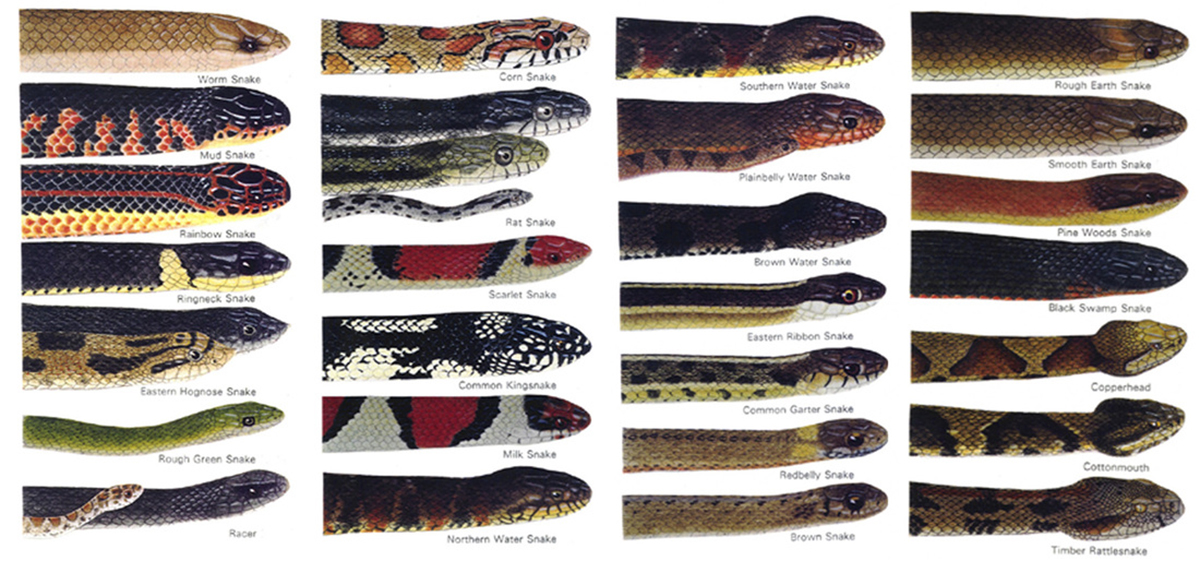
After consulting with Kleopfer and other herpetologists, Jackson made relatively minor updates on species and taxonomy.
Although the information is accurate, the book, then and now, is intended for nonprofessional readers, or as the revision says, “a cultural artifact that provides a snapshot” of the snakes in the region, and the author’s relationship to them. Two appendices are included with details on snake name changes and identifying shed snake skins.
The 2025 book was published in August, with a suggested retail cost of $24 from select outlets or tidaltalebooks@gmail.com.
But Jackson, who is a semi-retired lawyer, admits he doesn’t particularly like snakes, and still remembers his revulsion as a kid when Donald Ray, as he was known then — the oldest of his eight cousins — had asked him to carry a burlap sack filled with live water snakes. And then there was his bedroom, smelling of formaldehyde, lined with big, snake-filled jars.
“At that age, snakes are like monsters,” he said. “But I just remember my grandparents letting me go in there and you didn’t have to be told ‘Don’t touch anything.’ I didn’t.”
Still, Jackson said he appreciates the importance of snakes in the natural world, and the value of a guide book on snakes in the region to all the nonscientific folks who enjoy the outdoors, or are curious about the snakes in their yard.
The guide is as thorough as any nonscientist could want or need. There’s information about the appearance, habitat, diet, behavior and even reproduction of numerous regional snakes, from worm snakes to rattlesnakes, and whether they’re venomous and how to identify them.
Brothers, who has six children, 24 grandchildren, and eight great-grandchildren has been married to his wife Judy for close to 50 years. In addition to a full career in various natural sciences positions, the author, along with his wife, also managed to build a passive solar-powered home with a huge garden and numerous livestock they raised for food.
“We did the forming, framing, glazing, roofing, painting, plumbing, electrical, interior work and cabinets,” Brothers wrote on his website. “Only pouring the concrete, countertops and carpeting were done by others. Our home would be one of the first thermal envelope home build in Idaho.”
As he described his youth, Brothers said he grew up about a 10-minute bicycle ride from the southernmost edge of the swamp — “a fine place to study snakes.”
In an earlier memoir Brothers wrote, “Swamp Water in My Veins,” he told how he began collecting articles about snakes when he was young and writing things down. But he continued to struggle in school, with one teacher reporting that “Donald is interested in snakes and not much else.”
“Dispelling false popular beliefs about snakes was one of the primary objectives of the book,” Brothers wrote, explaining why he wrote the 1992 guide. “This was important because such beliefs contribute greatly to anxiety and fear.”
A partial list: snakes are slimy, they can jump, their tongues can sting, they can hypnotize their prey, they don’t die till sunset, the hiss of a snake is poisonous and some can crawl as fast as horse can run.
“More education is needed to dispel false popular beliefs and appreciate these interesting and important creatures of the animal kingdom,” he said.
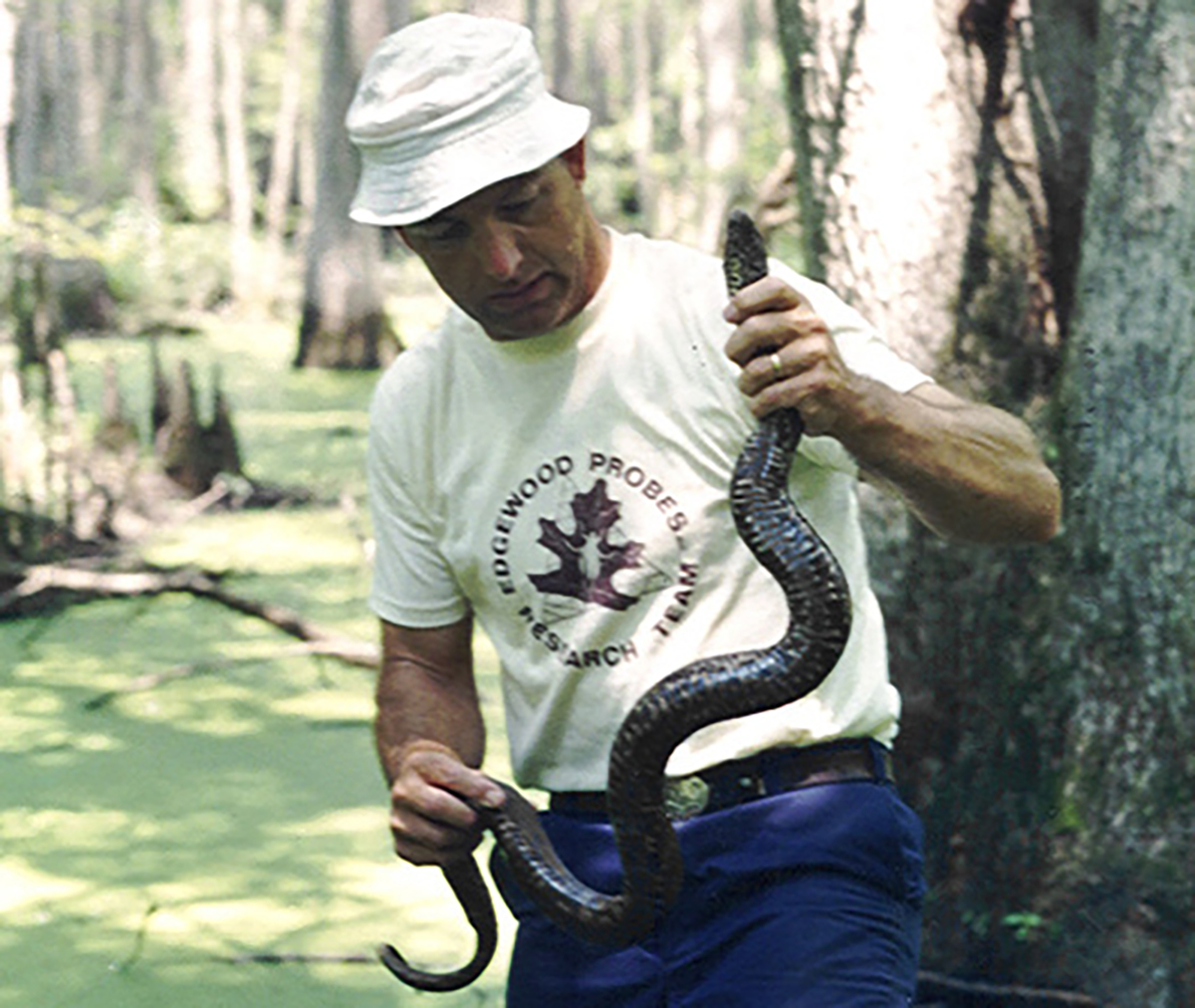
As someone who also loves snakes, Kleopfer, who has served as Virginia’s state herpetologist for 20 years, agrees that snakes are misunderstood.
“You know, snakes can be very polarizing,” he said. “Of course, you have the whole Garden of Eden story, which doesn’t help. There’s probably no other animal, group of animals that has more misinformation and folklore about it than snakes.”
But snakes eat lots of things we don’t want to deal with — such as carrion, he said.
“Snakes play an incredible role in the ecology of our ecosystems and controlling rodents and pests and stuff like that,” he said. “They’re also food for other animals as well.”
And snakes want nothing to do with people, so the best thing is to accept them and let them be.
“I always said that resolves 99% of all wildlife interactions, particularly with snakes,” Kleopfer said. “Just follow those four easy words: ‘Just leave it alone.’”
Even venomous snakes are not nearly as sinister as their reputations have them.
“Cottonmouths, or water moccasins, have a curiosity factor about them, but those things are big babies,” he said. “I mean, you really have to do something extraordinarily stupid to get bit by one. Yeah, they’re venomous, but they’re quite reluctant to strike.”
But all the better if Brothers’ well-illustrated book helps educate people about the value of snakes and basic science of herpetology.
It’s just a very cool historic document,” Kleopfer said. “It would be a nice addition to anybody’s literary collection if they’re into that kind of natural history or regional type of history.”
Though sleek and beautiful as they may be, he conceded, snakes fall short of the cute and winsome appeal of other animals that share their neighborhoods.
“They’re never going to be embraced like our furry and feathered friends are.”