From shortly after the Civil War until the mid-2000s, when the last menhaden plant was shuttered, the town of Beaufort would “smell of money.”
“The menhaden industry made Beaufort prosperous. Local menhaden companies once provided hundreds of jobs in the local community and surrounding areas with numerous factories and vessels working this lucrative fishery,” according to information from the North Carolina Maritime Museum, which has held several programs on the industry.
Supporter Spotlight
“The fishery itself, processing plants ashore, and support infrastructure provided steady employment opportunities, especially for African-Americans. While many visitors remember the smell of the fish, locals call it the ‘smell of money,’” It was their livelihood. Local merchants all benefited from the influx of people and money during menhaden’s fishing season. Menhaden fishing was recognized throughout Carteret County as an important part of this county’s commercial fishing industry.”
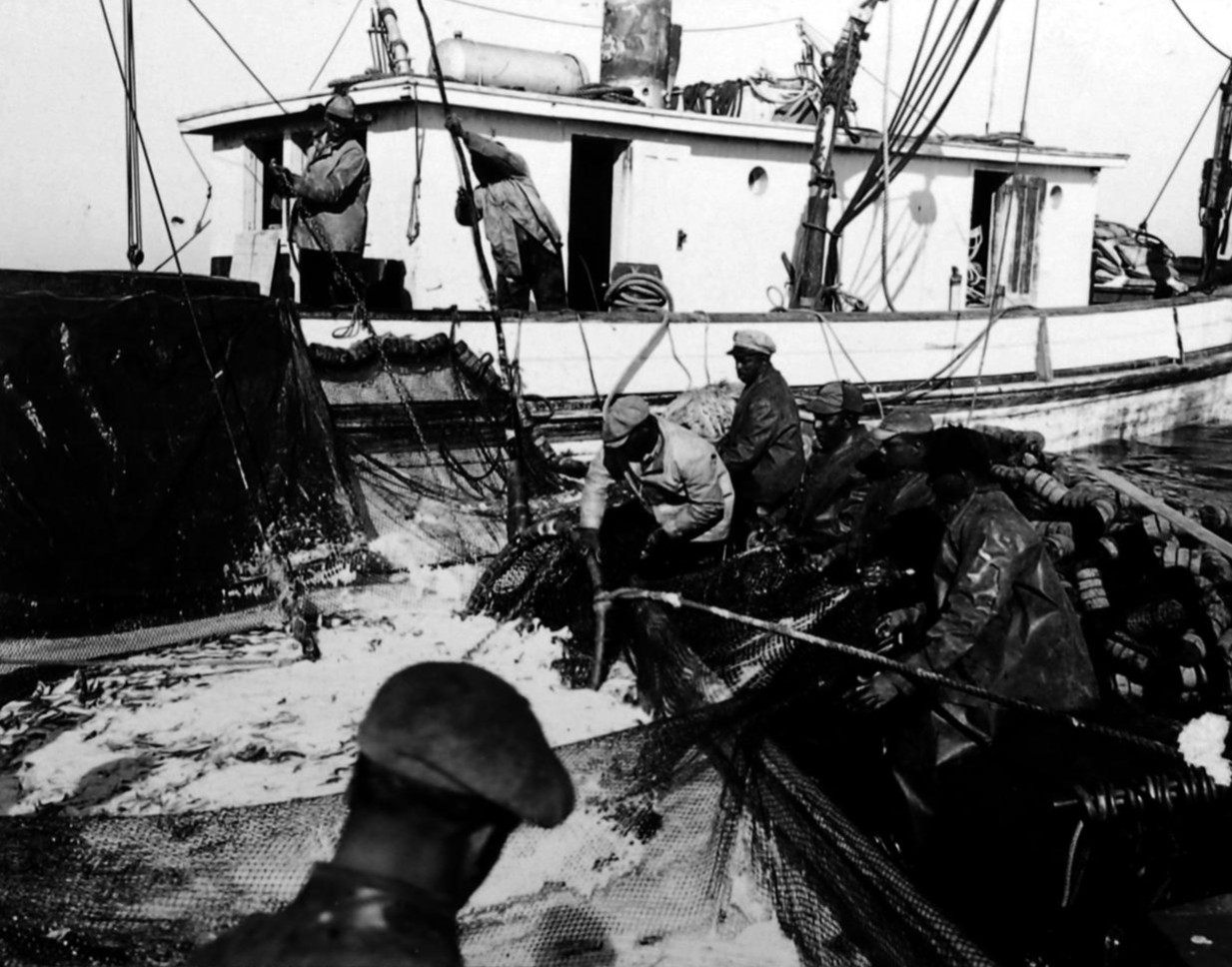
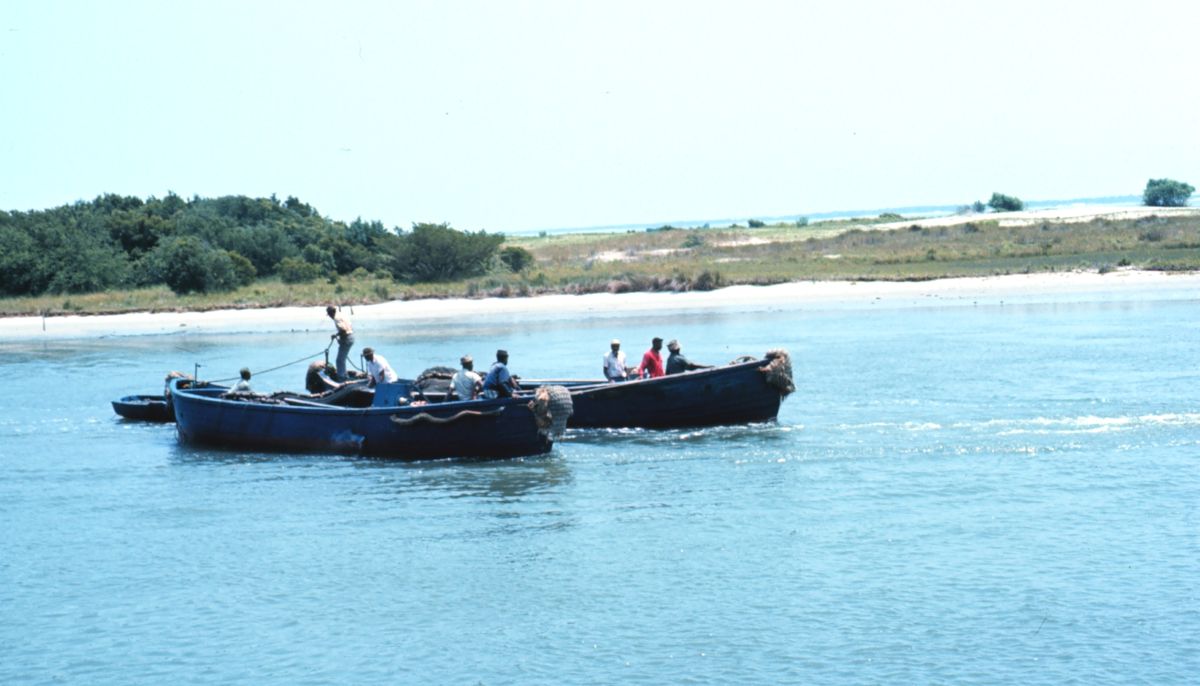
In the early days of catching menhaden, the mother boat would deploy smaller purse boats to maneuver a large net around a school of fish. Once the string draws the net shut around the hundreds of pounds of menhaden, the fishermen would haul the net by hand.
To perform this physically demanding, dangerous work, the fishermen would sing work songs, or chanteys, to help rhythmically synchronize their movements.
Barbara Garrity-Blake, fisheries social scientist and adjunct at Duke University Marine Lab in Beaufort, told Coastal Review that the menhaden fishermen used to sing these songs before hydraulic net-lifting technology was introduced in the early 1960s.
“Each vessel carried a crew of about two-dozen men, mostly African Americans, who worked shoulder to shoulder in purse boats to pull in a giant seine net heavy with menhaden — sometimes a 100,000 or more fish. The men would coordinate their pulling by singing in a call-and-response style where the leader would sing out a line and the crew would answer in harmony,” she continued.
Supporter Spotlight

Their songs were a seafaring tradition known as chanteys.
After the menhaden industry became mechanized in the 1960s and 1970s, and the songs were no longer sung, some of the former and retired fishermen began to perform these traditional work songs for audiences, eventually becoming formally known as the Menhaden Chanteymen in 1988.
After the group began performing publicly, they sang for the North Carolina General Assembly, National Council on the Arts, at New York City’s Carnegie Hall and on national television, including for a segment on “CBS Sunday Morning” with Charles Kuralt. The group recorded the album “Won’t You Help Me to Raise ‘Em: Authentic Net Hauling Songs from an African-American Fishery,” for Global Village Music in 1990.

The remaining members made special appearances at events throughout the county, including a handful at Core Sound Waterfowl Museum and Heritage Center on Harkers Island.
Beaufort Mayor Sharon Harker awarded in 2022 the two surviving Chanteymen, Ernest Davis and the Rev. Leroy Cox, the key to the city. Cox died in 2023, leaving Davis as the “last legacy-bearer of the Menhaden Chanteyman” until the final member, Davis, 86, died Jan. 3. His service and burial was Jan. 8 Mt. Tabor Missionary Baptist Church of North River. Noe Funeral Services of Beaufort handled the arrangements.
Garrity-Blake noted that Davis was the youngest of the Chanteymen and had “explained that singing generated a special power or strength, used for nets otherwise too heavy for human strength alone. So the chantey songs were used as a tool.”
In a recording, Davis explains that the fishermen would sing a chantey when they needed to raise up a net full of fish.
“If we couldn’t sing, we couldn’t get them raised up,” Davis said. The singing “would give you more spirit, and more power” and you could raise your fish better.
“At night you couldn’t sleep because you’d be hurting and cold so you just make up songs,” Davis said. And most of the captains would be singing right along with the crew. “Music could be heard all over the ocean … like music was on the water.”

Garrity-Blake said in an interview that she worked for many years with Davis and other menhaden workers on a project called “Raising the Story of Menhaden Fishing.”
The 2005 closure of Beaufort Fisheries, the last menhaden plant in the state, inspired North Carolina Humanities Council-funded project that Garrity-Blake helped launch in 2009 and 2010 with the Core Sound Waterfowl Museum and Heritage Center on Harkers Island.
Davis was among a group of menhaden workers, including captains, crewmen, cookhouse and factory workers, who met several times at the Beaufort train depot to plan the project, “which was hilarious because ‘planning’ took a backseat to telling tales,” Garrity-Blake said, adding that the meetings always turned into a big storytelling session and nobody wanted to leave when the meeting was over.
“I realized that the menhaden folks had a hunger for getting together to talk about fishing. They feared their experiences and the industry’s legacy as the economic backbone of Carteret County would be forgotten. So we decided to call it ‘Raising the Story’ — just as the men worked together to raise fish, we’d work together to raise the story of menhaden fishing,” Garrity-Blake continued.
Garrity-Blake conducted about a dozen oral history recordings of people representing different skills in the fishery, from ring-setter in the fishing process to factory owner, the late Jule Wheatly in December 2009. He died in October 2011.
Fine art photographer and Beaufort resident Scott Taylor took portraits of all the folks who were interviewed, and developed an exhibit for the waterfowl museum. The oral history interviews and photos are part of the Core Sound museum’s online collection, on a Facebook page also called “Raising the Story of Menhaden Fishing,” and on Carolina Coastal Voices YouTube channel.
As part of “Raising the Story,” the group wanted to involve young people who didn’t know anything about the industry, so they collaborated with Josie Boyette’s seventh grade class at Beaufort Middle School.
“Three of the men, including Ernest Davis, were invited into the classroom to share stories, and the kids asked questions and recorded them,” Garrity-Blake said. “Davis talked about his role as first mate, although he’d also served as fish boat captain on occasion. He was proud to have made a good living, putting his kids through college, menhaden fishing. He said, ‘A lot of people think fishing is a disgrace. But I made a good living. Didn’t look to get rich or nothing.’”
She added that Davis’ grandson Trevor was in the classroom. “It was wonderful to see the pride on that little boy’s face when his grandad shared a story about fending off a shark that had swum in the net.”
The project culminated in what Garrity-Blake called a “jam-packed event” at Core Sound, where the middle school students showcased their work, captains and crewmen told stories to the audience, and the Menhaden Chanteymen performed their songs.
“When they performed, it was powerful and otherworldly; everyone was mesmerized,” Garrity-Blake said.
Historian and author David Cecelski has written extensively about coastal North Carolina’s fisheries, including that of menhaden, many of which can be found on his personal website such as “Menhaden Fishing Days” and “It Was Like a Ballet’: Menhaden Fishermen at Work, 1947,” which he describes the process of hauling a net based on a photo from the North Carolina State Archives.
He was invited to speak at the “Raising the Story of Menhaden Fishing” event held in the fall of 2010. In 2017, Cecelski reflected on the “Raising the Story” project and shared his comments from that event in an essay he titled, “Music All Over the Ocean.”
In the essay, he calls the project a “commemoration of the central role that the menhaden industry played in Carteret County for generations.”
Cecelski, who grew up near Beaufort, writes that anybody listening to the oral histories Garrity-Blake recorded for the project would be impressed with what the menhaden fishery meant to Carteret County, particularly the stink that permeated the town when the fish were being processed.
“When the wind was right, the aroma of the fish covered those towns like a blanket. Coastal visitors sometimes complained, but my cousins in the industry used to call it ‘the smell of money,’” he wrote in 2021.
Cecelski explains in his 2017 piece that Davis’s story was typical of what the industry’s wages meant to local fishermen and fish factory workers.
Davis, who left school when he was 15 and went to work menhaden fishing at Beaufort Fisheries, said in his interview that it was hard work but it was what he had to do. He fished for 41 years and became one of the most respected first mates on the East Coast, sending all five of his own children to college and helping raise and educate nine younger brothers and sisters.
The oral histories also show how the men and women watched the menhaden industry change over their lifetimes, like motorizing the process to haul in the fish, business became more corporate, unions made headway and state and federal governments enacted environmental regulations, just to name a few.
“But through it all, I could hear two things in the men’s voices: a love for menhaden fishing — master net mender Lee Crumbacker said it well: ‘it grows on you like a barnacle on a pole’— and a fierce pride in their craftsmanship,” Cecelski writes.
Cecelski writes that as a child, the first thing he ever heard about the menhaden industry was his mother’s stories about those chanteys. His mother grew up in Harlowe in the 1920s and 1930s, when Highway 101 was still a dirt road.
“Many of Beaufort’s African American fishermen lived in Harlowe, particularly in a reclusive community just across the county line called Craven Corner. As they drove oxen and carts down the road on their way to Beaufort, the menhaden fishermen sang the same songs that they sung as they hoisted the nets onto their boats,” he writes.
“Early Monday mornings, long before first light, my mother would wake up in her bed at the sound of those beautiful, haunting songs and listen to them as the fishermen moved through the darkness and toward the sea.”
Cecelski observes that the fishermen in the interviews talk about the chanteys the same way his mother did.
Davis said in his “Rising the Story” interview they “would sing all night long just to keep their minds off the cold and hurt. It ‘just seemed like music was all over the ocean’,” Cecelski writes.
“The fishermen mostly stopped singing their legendary chanteys with the introduction of power blocks and hardening rigs in the late 1950s and early 1960s, but those songs have remained a powerful memory for all who ever heard them.”
And while the chanteys have not been heard on a menhaden boat in a long time, but older people from around Carteret County still remember them, and tell Cecelski “how, on cool autumn days, you could sometimes stand on shore and hear the songs coming across the water. They filled the air and stirred the heart and got deep inside your bones,” Cecelski describes.
“And if you heard those songs, like my mother did when she was a little girl, you never forgot them or the way that they made you feel. It is hard to put into words, but it was not just the beauty of the melodies or the men’s fine voices, but the appearance that the music was rising right out of the sea.”