A group of North Carolina State University researchers has created a model that simulates wind, waves, tides and currents to help pinpoint areas that are likely best to install offshore energy facilities.
The model, called a portfolio optimization framework, also identifies what combination of wind and marine hydrokinetic technologies, which capture energy through water flow, may work together in an area to produce the greatest amount of power.
Supporter Spotlight

“It’s not about only one type, but multiple sources of generation that can somehow work together to generate a more stable output of your portfolio,” explained Dr. Anderson de Queiroz, co-author of the study and associate professor of civil, construction and environmental engineering. “For example, if you think about the single source, let’s say offshore wind or wave energy, they have lots of variability with respect to their supply because it depends on natural conditions. It depends on wind speed or the ocean heights and in periods, so it’s variable.”
By locating areas where different offshore energy technologies can work together, a phenomenon researchers refer to as “complementary behavior,” power companies can get the most bang for their buck.
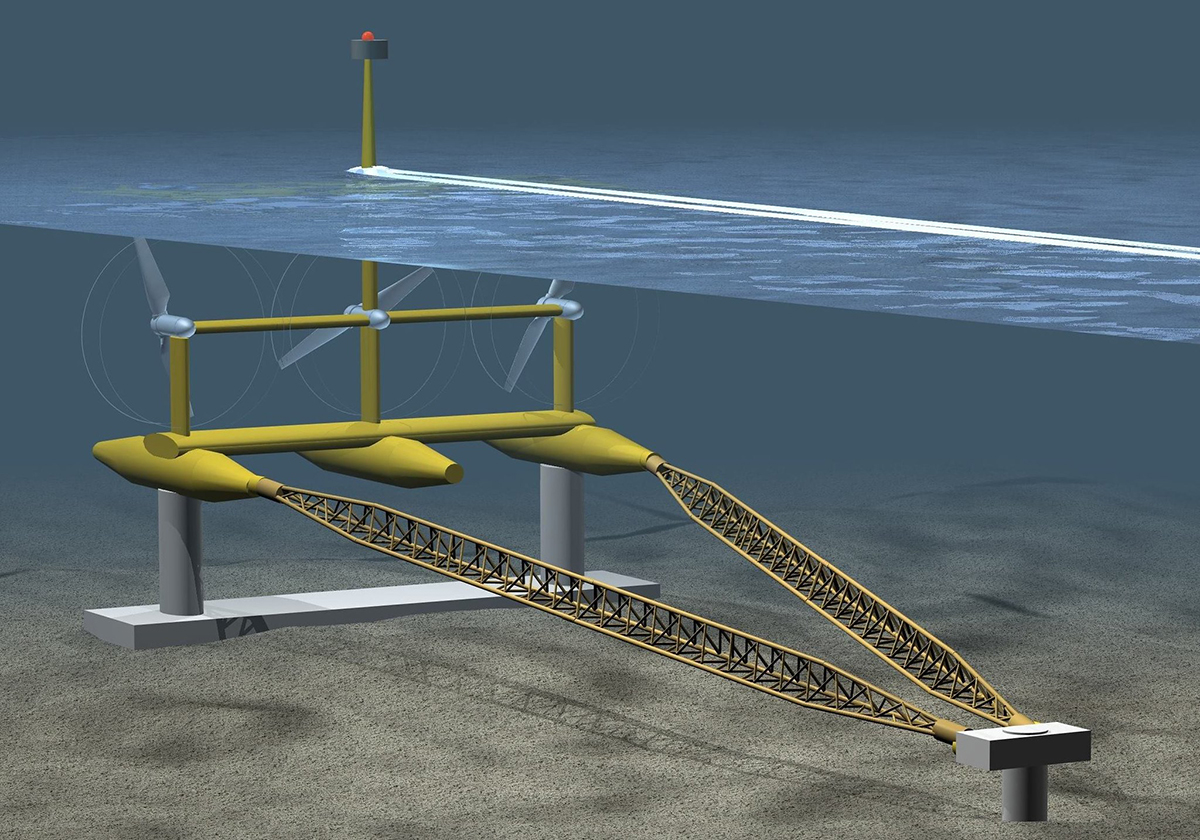
For context, picture an offshore field of 50 wind turbines. Within that field are marine hydrokinetic devices such as wave energy converters or underwater kite turbines that generate electricity from ocean currents and tidal streams.
“When you’re collecting the electricity, instead of collecting only from wind with transmission lines, you can also collect electricity from this other source. So, the electricity that you’re bringing to shore in that situation will be more stable because of the complementary behavior between the sources,” de Querioz said.
For the developer trying to explore and analyze where they can get the most power output possible, this model could help reduce their financial risk.
Supporter Spotlight

“For government analysts and planners, they can also see strategically where there are regions that would be beneficial in terms of most electricity that they are able to get to at a reasonable cost and that’s away from, for example, protected habitat areas or away from strategic areas” used by military forces, de Querioz said.
The team of researchers, with support from the North Carolina Renewable Ocean Energy Program, conducted an analysis for the North Carolina coast, focused on wind turbines and marine hydrokinetic kites.
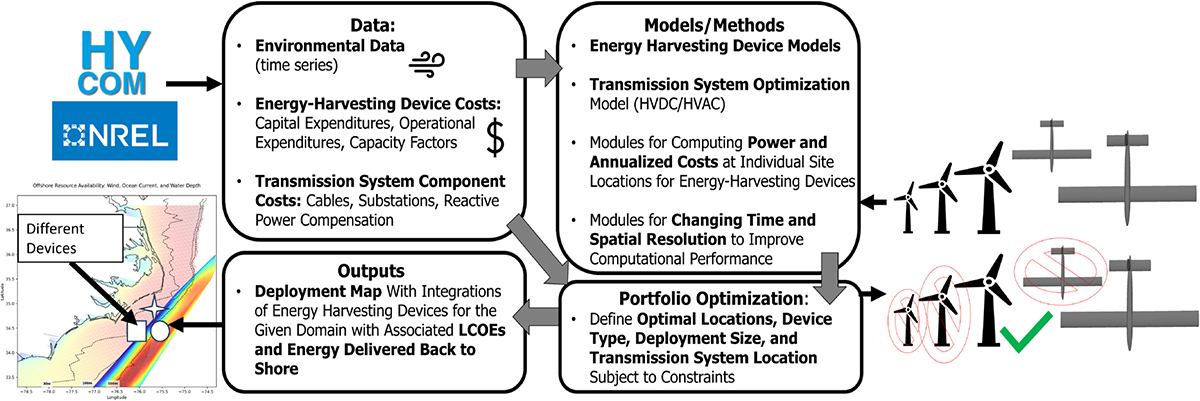
But de Querioz points out that the model they have developed can be used globally and with any combination of technologies. And, he said, it may be applied onshore.
The research team is in the process of expanding its analysis to other regions, including the coasts of New Jersey and Virginia.
The project, which is through the Atlantic Marine Energy Center and funded by the U.S. Department of Energy, will use the portfolio optimization model to support bringing electricity to the East Coast through the Eastern Interconnection.
The Eastern Interconnection spans from central Canada east to the Atlantic Coast, south to Florida and west to the foot of the Rockies. It is one of two major power grids.
Researchers will pair the portfolio optimization framework with another model known as Tools for Energy Model Optimization and Analysis, commonly referred to as Temoa, which produces long-term analyses of energy systems.
“We are going to combine analysis from this offshore portfolio with the long-term energy planning for the Eastern Interconnection,” de Querioz said. “Basically, we’re looking at the entirety of the Eastern Interconnection, and then deploying not only offshore energy, but also looking at natural gas potential, new nuclear or the potential to have energy storage, onshore solar, and things like that.”
The team is also working with the North Carolina Renewable Energy Program this year to develop an adapted design for a wave power buoy called Reference Model 3, or RM3, that converts wave energy into electrical power.
“On these, we’re going to do more specific and detailed analysis for the North Carolina coast with this new design of wave energy converters,” de Queiroz said.
He is extending an invitation to collaborate with industry, government and other scientists with an interest in the model. The model is expected to be released sometime this year. Anyone interested may contact de Queiroz by email at ardequei@ncsu.edu.
“Fused Portfolio Optimization for Harnessing Marine Renewable Energy Resources” was published in the journal Energy earlier this month.
N.C. State doctoral student Mary Maceda is a corresponding author of the study. Co-authors of the paper include Rob Miller, a doctoral student, Victor de Faria, a recent doctoral graduate, Dr. Matthew Bryant, professor of mechanical and aerospace engineering at the university, and Dr. Chris Vermillion with the University of Michigan.